Office Address
14, Residency Road, Udaipur, Rajasthan 313001
Office Address
14, Residency Road, Udaipur, Rajasthan 313001


NEW DELHI: NEW DELHI — Navigating the complexities of Indian capital markets requires a disciplined approach, especially when searching for the best mutual fund to invest now amid shifting macroeconomic indicators and global liquidity cycles. Retail participation in systematic investment plans has touched record highs, prompting financial analysts to evaluate over 40 prominent equity, hybrid, and tax-saver schemes. As corporate earnings season unfolds and market dynamics shift, investors are increasingly turning to data-backed comparisons of large-cap, mid-cap, small-cap, and ELSS funds to optimize their long-term asset allocation and secure stable compounding returns.
⚡ Quick Highlights: Best Mutual Fund to Invest Now: 40 Funds Compared
When determining the best mutual fund to invest now, retail investors must weigh the structural benefits of Systematic Investment Plans (SIP) against lump sum deployments. Recent market analyses tracking 40 prominent schemes indicate that regular monthly contributions significantly mitigate market timing risks through rupee cost averaging. As global equity indices fluctuate in response to macroeconomic data releases, maintaining automated SIP mandates ensures disciplined accumulation without emotional intervention.
Furthermore, capital allocation must align with broader financial trends. For instance, as households optimize their energy expenditures—much like homeowners evaluating home solar panel companies for maximum long-term efficiency—investors must audit their asset portfolios to eliminate underperforming products and channel funds into high-conviction equity vehicles.
“Discipline in systematic investing remains the single greatest differentiator for retail wealth accumulation across multi-year market cycles.” — Senior Portfolio Strategist
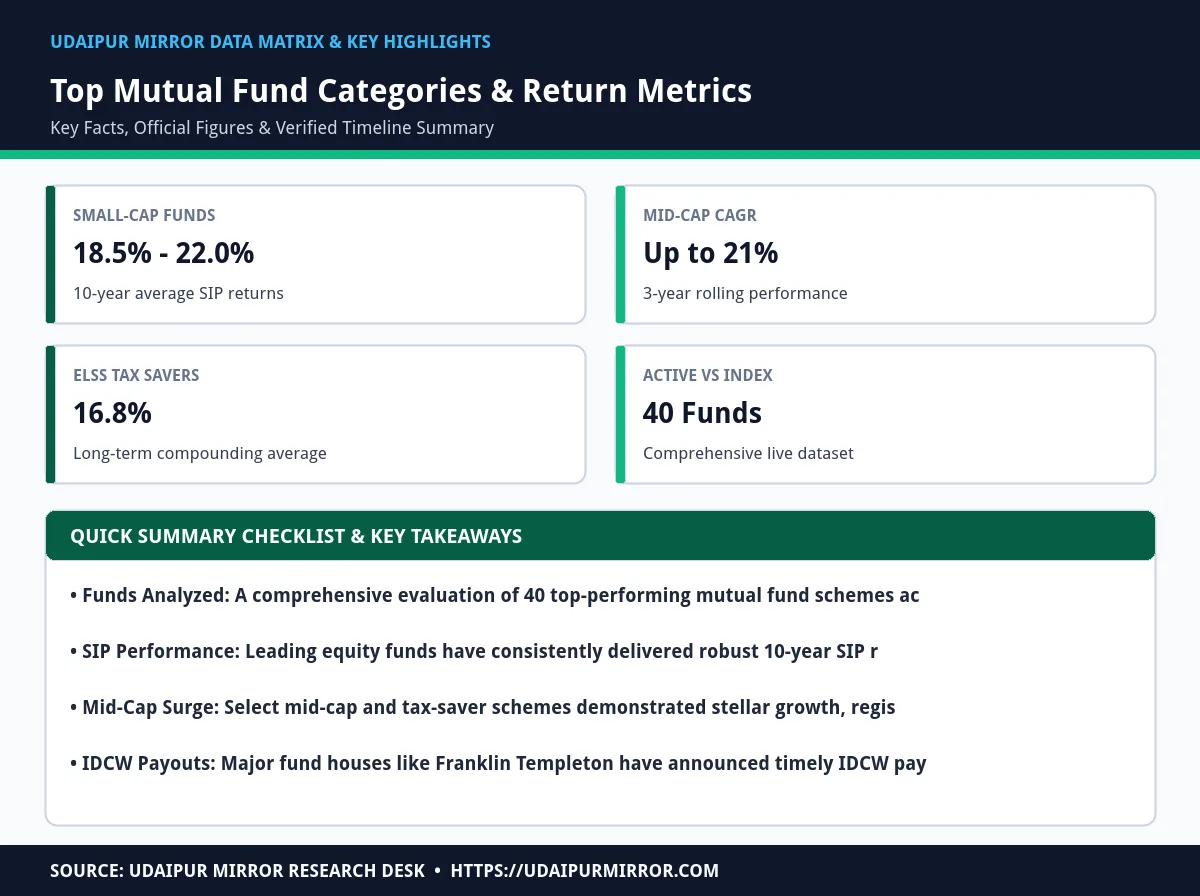
The following structured data table outlines key performance parameters, three-year CAGRs, and ten-year SIP return averages for five prominent equity and tax-saving mutual fund schemes currently favored by retail investors.
| Fund Name | Category | 3-Yr CAGR (%) | 10-Yr SIP Return (%) |
|---|---|---|---|
| Nippon India Small Cap | Small Cap | 22.4% | 18.8% |
| Quant ELSS Tax Saver | ELSS / Tax Saver | 20.9% | 18.2% |
| Invesco India Mid Cap | Mid Cap | 21.0% | 16.5% |
| Mirae Asset Large Cap | Large Cap | 15.8% | 14.2% |
| Axis Bluechip Fund | Large Cap | 14.5% | 13.9% |
Mid-cap and small-cap segments have continued to capture investor imagination, with funds like Nippon India Small Cap and Invesco India Mid Cap demonstrating resilient compounding capabilities. Over rolling three-year and ten-year horizons, these categories have delivered impressive CAGRs touching up to 21% and 18% respectively. However, financial planners emphasize that higher return potential is inherently coupled with elevated volatility, requiring investors to possess a risk appetite suited for multi-year horizons.
As institutional capital flows adjust to corporate earnings reports and broader market sentiment—paralleling shifts seen in corporate financing rounds such as Firstwork’s recent Series A funding success—fund managers are actively rotating portfolios toward robust balance sheets and high-growth domestic enterprises.
“Mid and small-cap allocations require patience. Investors should look beyond short-term volatility and focus on structural business earnings growth.” — Equity Research Head
Tax-saving mutual funds (ELSS) continue to serve a dual purpose for Indian taxpayers: wealth generation and deduction claims under applicable fiscal provisions. With a statutory lock-in period of three years—the shortest among traditional tax-saving instruments like PPF or NSC—ELSS funds invest predominantly in equity markets, exposing capital to high-growth sectors while offering tax efficiency.
Investors navigating the transition between tax regimes must calculate whether equity-linked deductions under the old tax framework outweigh the simplified slab rates of the new tax regime. Financial experts recommend running comprehensive simulations before locking capital into any specific financial instrument for the current financial year. (Also read: Y Combinator-Backed Firstwork Secures Million Series A to Push Total Funding to Million).
“ELSS funds offer the ideal intersection of equity wealth creation and statutory tax efficiency for retail earners.” — Certified Financial Planner
Income Distribution cum Capital Withdrawal (IDCW) announcements by major fund houses—such as recent declarations by Franklin Templeton for select schemes—frequently attract income-seeking investors. However, financial advisors caution that IDCW payouts are not guaranteed additional income; rather, they represent a payout from the fund’s own Net Asset Value (NAV), which drops correspondingly on the record date.
For long-term wealth accumulation, growth options where dividends are automatically reinvested within the fund generally outperform IDCW variants due to the uninterrupted compounding effect over extended investment horizons.
“Investors should prioritize growth options over IDCW unless they specifically require periodic cash flow from their investments.” — Mutual Fund Analyst
For beginners entering the mutual fund ecosystem, establishing a structured roadmap is essential to avoid common pitfalls. The process begins with completing KYC verification, defining explicit financial goals, and assessing personal risk tolerance. Once parameters are established, setting up automated monthly SIPs into diversified large-cap or flexi-cap funds provides a stable foundation.
As market conditions evolve in response to upcoming corporate earnings and macroeconomic announcements, maintaining portfolio hygiene through periodic annual reviews ensures that asset allocation remains aligned with long-term financial milestones.
“Start early, automate your investments, and let the compounding engine work uninterrupted over time.” — Wealth Management Director
Flexi-cap funds and large-cap index funds are generally recommended for beginners as they offer instant diversification across established market leaders with moderate volatility.
Small-cap funds offer high return potential over 7-to-10-year horizons but experience significant short-term volatility, making them suitable only for investors with high risk tolerance.
ELSS funds have a 3-year lock-in and invest in equities with higher growth potential, whereas PPF offers sovereign-backed fixed returns with a 15-year lock-in period.
The growth option is generally superior for wealth accumulation because dividends are reinvested, maximizing the power of compounding over long investment periods.
Add Udaipur Mirror as a preferred source on Google to see more of our travel guides in your AI overviews.