Office Address
14, Residency Road, Udaipur, Rajasthan 313001
Office Address
14, Residency Road, Udaipur, Rajasthan 313001


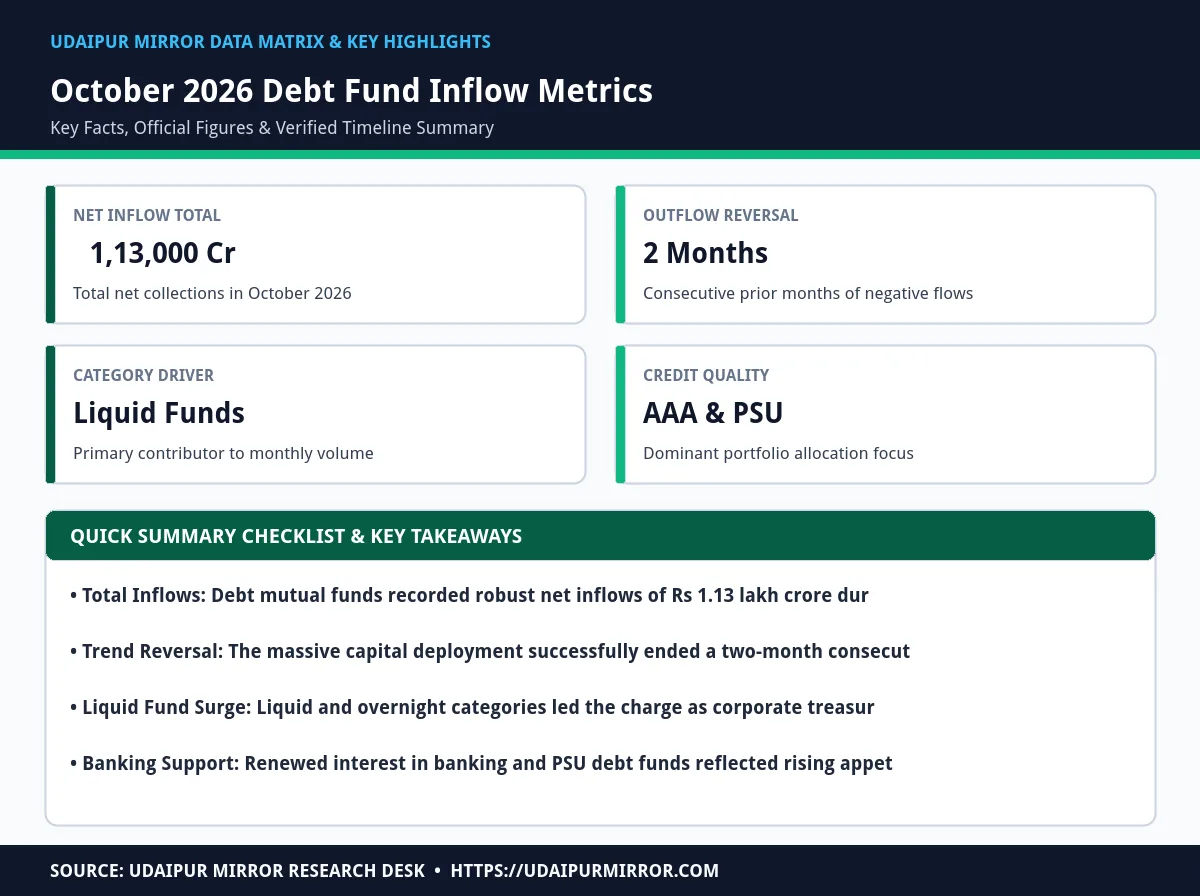
MUMBAI: MUMBAI — Marking a sharp structural reversal from the liquidity-constrained pressures of the previous two quarters, the Indian fixed-income ecosystem experienced a massive revival as debt mutual funds inflows October crossed the Rs 1.13 lakh crore threshold, according to the latest data released by the Association of Mutual Funds in India (AMFI). Institutional rebalancing, corporate treasury allocations, and shifting macroeconomic expectations acted as primary catalysts for this dramatic turnaround, restoring confidence among retail and institutional participants navigating the current interest rate cycle of FY 2026-27.
⚡ Quick Highlights: Debt Mutual Funds See Rs 1.13 Lakh Crore Inflows in October
The turnaround seen in fixed-income asset classes comes on the heels of consecutive months of net redemptions driven primarily by advance tax payment outflows and quarterly advance corporate commitments. As those liquidity pressures eased in October, corporate treasuries quickly redirected surplus capital back into short-term instruments to optimize idle cash yields.
Furthermore, fund managers noted that shifting macroeconomic signals regarding domestic inflation and global monetary policy created a favorable window for fixed-income deployment. Investors looking to secure favorable yields before any potential interest rate pivot actively locked into medium-to-long duration papers, boosting overall category assets under management (AUM).
As part of wider infrastructural developments across the nation, state-level initiatives such as the renewable energy PMU rollout continue to stimulate institutional interest in specialized corporate debt and green infrastructure bonds.
“The Rs 1.13 lakh crore inflow in October highlights the cyclical nature of corporate liquidity. Once advance tax liabilities cleared, treasury managers decisively moved back into high-grade debt instruments.” — Senior Fixed Income Strategist
The sudden surge in fixed-income allocations was not uniform across all categories. While short-end funds captured bulk corporate cash, medium-to-long duration categories also witnessed steady accumulation as investors positioned themselves for potential rate adjustments. For broader context on how capital allocations shift across asset classes, market observers also track alternative avenues such as gold price trends and green energy financing frameworks.
| Mutual Fund Category | October 2026 Inflows (₹ Cr) | September Status | Primary Investor Segment |
|---|---|---|---|
| Liquid Funds | +54,200 | Outflows | Corporate Treasuries |
| Overnight Funds | +28,150 | Inflows | Institutional Cash |
| Money Market Funds | +15,400 | Outflows | Banks & Corporates |
| Banking and PSU Debt | +8,950 | Inflows | Retail & HNI Investors |
| Dynamic Bond Funds | +6,300 | Neutral | Active Portfolio Managers |
Categorically, liquid funds and overnight funds accounted for the lion’s share of the Rs 1.13 lakh crore tally. These categories provide unmatched safety and instant liquidity, making them the preferred parking ground for corporate surplus funds awaiting deployment in business expansion or operational expenses.
Banking and PSU debt funds also registered healthy inflows, supported by investors seeking better risk-adjusted returns compared to traditional bank fixed deposits without taking on unwarranted credit risk. This trend underlines the maturing mindset of Indian retail and institutional fixed-income participants.
“Liquid funds act as the financial shock absorbers of corporate India. Their dramatic rebound in October is a textbook reflection of normal post-quarterly-advance-tax liquidity normalization.” — AMFI Market Analyst
While institutional capital dominated the October headline figures, individual retail investors are increasingly utilizing target maturity funds and dynamic bond funds for long-term goal planning. Unlike traditional fixed deposits, debt mutual funds offer indexation benefits and tax-efficient structures for investors in higher tax brackets, subject to prevailing tax laws.
Financial advisors recommend maintaining a balanced asset allocation strategy, combining the stability of debt funds with the growth potential of equity portfolios. Understanding interest rate sensitivities and expense ratios remains vital for maximizing net returns in the fixed-income segment. (Also read: Gold Price Rise Today November 14 2026: 22K and 24K Rates in Major Cities).
“Retail investors should view debt funds not merely as post-retirement parking tools, but as strategic building blocks for capital preservation and tactical asset allocation.” — Certified Financial Planner
The turnaround was primarily driven by the normalization of corporate liquidity after advance tax outflows in August and September, leading treasuries to redeploy surplus cash into liquid and overnight funds.
Liquid funds and overnight funds captured the largest share of inflows as institutional investors and corporate treasuries sought safe, short-term parking instruments with high liquidity.
Debt mutual funds offer professional management, flexible withdrawal options, and potential tax efficiency advantages through capital gains taxation, whereas traditional fixed deposits offer guaranteed fixed interest rates.
Debt funds investing in AAA-rated corporate bonds, government securities, and Treasury bills carry very low credit risk, though they remain subject to market-related interest rate fluctuations.
Add Udaipur Mirror as a preferred source on Google to see more of our travel guides in your AI overviews.