Office Address
14, Residency Road, Udaipur, Rajasthan 313001
Office Address
14, Residency Road, Udaipur, Rajasthan 313001

NEW DELHI: NEW DELHI — Marking a pivotal turning point for the nation’s technology landscape, a comprehensive new study released by telecommunications giant Ericsson projects that India’s daily multimodal ai use to double by the end of the decade. The findings underscore an unprecedented acceleration in how Indian consumers and enterprises integrate text, voice, vision, and contextual data processing into their everyday routines. As major IT capitals and innovation hubs adapt to this computational surge, the broader ecosystem faces critical decisions regarding cloud infrastructure, data localization, and energy efficiency. Amid ongoing shifts in market capitalizations—comparable to recent conversations around capital markets such as the financial momentum surrounding events like the Jio Platforms IPO—tech leaders are aggressively re-allocating capital toward generative AI architectures.
⚡ Quick Highlights: India Multimodal AI Use to Double by 2030: Ericsson Report
The latest findings published by Ericsson highlight a fundamental shift in how digital services are consumed across the Indian subcontinent. While early waves of artificial intelligence relied heavily on text prompts and rigid query formats, modern multimodal frameworks allow seamless interaction using voice, images, gestures, and live video feeds. This capability is unlocking unprecedented use cases across financial services, education, healthcare, and retail.
Market analysts attribute this accelerated trajectory to India’s unique demographic dividend paired with some of the world’s most affordable data tariffs. As consumers increasingly interact with apps in regional Indian languages through voice and visual interfaces, platforms are forced to scale their backend infrastructure. Furthermore, retail investors and market observers monitoring portfolio adjustments—such as shifts observed alongside announcements like the India smartphone brand timeline—recognize that software and hardware integration will dictate the next decade of corporate leadership.
“India is transitioning from a consumption-led digital economy to an intelligence-first ecosystem where multimodal AI will power every daily interaction.” — Senior Technology Analyst, Ericsson Research India
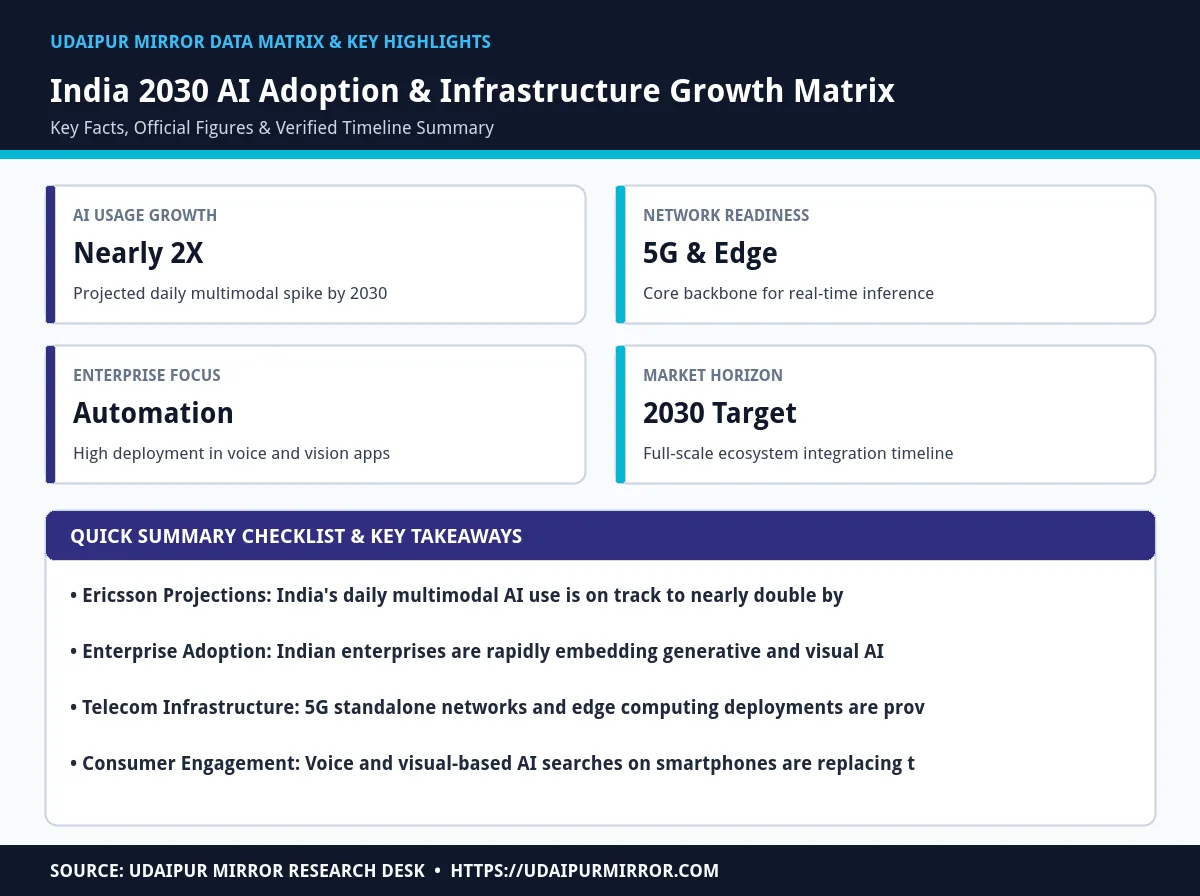
The transition toward ubiquitous artificial intelligence involves multiple layers of the technology stack. The following table contrasts current deployment metrics with projected milestones for the Indian market through 2030.
| Technology Vector | 2026 Baseline Status | 2030 Projected Milestone | Primary Growth Driver |
|---|---|---|---|
| Multimodal Interactions | Moderate text & basic voice use | Universal integration of vision, audio, text | Advanced smartphone chipsets |
| Enterprise Cloud Workloads | Hybrid pilots & experimental rollouts | Mission-critical autonomous operations | Scalable sovereign infrastructure |
| Telecom Network Latency | Early 5G Standalone coverage | Ultra-low latency edge computing nationwide | 5G-Advanced and early 6G trials |
| Consumer AI Penetration | Urban-centric early adopters | Deep rural & multilingual mass adoption | Affordable localized hardware |
| Semiconductor Supply | Heavy reliance on imported chips | Emerging domestic assembly & fabrication | Government PLI and fab incentives |
To support the projected doubling of daily multimodal interactions by 2030, Indian enterprises and cloud providers are undertaking massive capital expenditure cycles. Traditional data centers are being retrofitted with specialized graphics processing units (GPUs) and high-performance tensor cores capable of handling complex neural network training and real-time inference.
At the same time, Indian IT services giants are re-architecting their service delivery models. Rather than relying solely on traditional software outsourcing, firms are embedding proprietary AI copilots and automated agents into client operations. This structural transformation requires robust cybersecurity protocols and stringent adherence to emerging data protection regulations.
“Infrastructure is the new battleground. Companies that fail to modernize their cloud and edge architectures today will struggle to process tomorrow's multimodal volumes.” — Enterprise Cloud Architect
The smartphone remains the primary gateway for artificial intelligence in India. Device manufacturers are racing to pack Neural Processing Units (NPUs) into mid-range and budget devices, ensuring that advanced multimodal features are not restricted to premium flagships. This hardware democratization is a crucial factor in Ericsson’s long-term forecast.
As on-device AI capabilities improve, consumers can execute complex tasks—such as real-time multilingual translation, visual object recognition, and automated creative editing—without experiencing severe battery drain or relying entirely on cloud connectivity. This symbiotic relationship between hardware advancements and software intelligence is reshaping consumer expectations across the board. (Also read: Edelweiss Mutual Fund Reopens Overseas Scheme While Permanently Closing SIPs and STPs in Six Others).
“The next billion smartphone users in India will experience the internet primarily through voice and camera-driven AI interfaces rather than keyboards.” — Consumer Electronics Strategist
Despite the optimistic projections, the road to 2030 is not without obstacles. Recent quarterly earnings reports from major Indian IT firms reveal that fierce competition and AI pricing pressures are squeezing operating margins. Enterprises are demanding higher efficiencies and demonstrable return on investment from their technology partners, leading to compressed project timelines and pricing renegotiations.
Additionally, cultivating specialized talent capable of building, fine-tuning, and maintaining complex multimodal models remains a critical bottleneck. Educational institutions and corporate upskilling programs are scrambling to bridge the skills gap, fostering closer collaboration between academia and industry leaders.
“While demand for AI is soaring, margin pressures mean tech firms must innovate efficiently to maintain sustainable growth.” — IT Sector Financial Analyst
The Ericsson report projects that India’s daily multimodal AI use will nearly double by 2030, driven by explosive growth in mobile broadband, 5G networks, and consumer adoption of voice and visual AI apps.
Multimodal AI refers to artificial intelligence systems that can simultaneously process and understand multiple types of data inputs, including text, speech, images, and live video streams.
Indian enterprises are heavily investing in cloud infrastructure, high-performance GPUs, edge computing, and automated software agents to integrate AI into their daily workflows and customer service operations.
Key challenges include intense AI pricing pressure from clients, margin compression for IT giants, the need for sovereign cloud infrastructure, and a shortage of specialized machine learning talent.
Add Udaipur Mirror as a preferred source on Google to see more of our travel guides in your AI overviews.