Office Address
14, Residency Road, Udaipur, Rajasthan 313001
Office Address
14, Residency Road, Udaipur, Rajasthan 313001

NEW DELHI: NEW DELHI — In a landmark policy announcement shaking up the global consumer electronics market, Union Minister for Railways, Information & Broadcasting, and Electronics & Information Technology Ashwini Vaishnaw has declared that india own smartphone brand 2028 will officially materialize. Speaking at a high-profile technology summit, the minister urged industry stakeholders to note the timeline as India transitions from a massive assembly hub to a true intellectual property creator in mobile telecommunications, matching parallel advancements where Artificial Intelligence’s Next Big Bottleneck in India is a Very Small Chip highlights the urgency of deeper semiconductor integration.
⚡ Quick Highlights: India Own Smartphone Brand by 2028 Announced by Vaishnaw
Union Minister Ashwini Vaishnaw’s declaration that India will field its very own domestic smartphone brand by 2028 has instantly galvanized the country’s technology and manufacturing sectors. Speaking with absolute confidence, the minister emphasized that India has moved past the era of being a mere consumer market or a basic assembly outpost for foreign conglomerates. Instead, the country is systematically building the foundational pillars required to design, manufacture, and market an entirely indigenous mobile device from scratch.
This announcement is not merely a rhetorical aspiration; it is backed by concrete policy measures, massive financial allocations under successive Production-Linked Incentive (PLI) schemes, and burgeoning domestic semiconductor fabrication facilities. As global supply chains diversify, establishing a home-grown flagship brand ensures that national data security, hardware integrity, and technological sovereignty remain uncompromised. (Also read: Artificial Intelligence's Next Big Bottleneck in India is a Very Small Chip).
“Note the date: by 2028, India will have its own fully indigenous smartphone brand operating at global scale, cementing our status as a true technology creator.” — Ashwini Vaishnaw, Union Minister for Electronics & IT
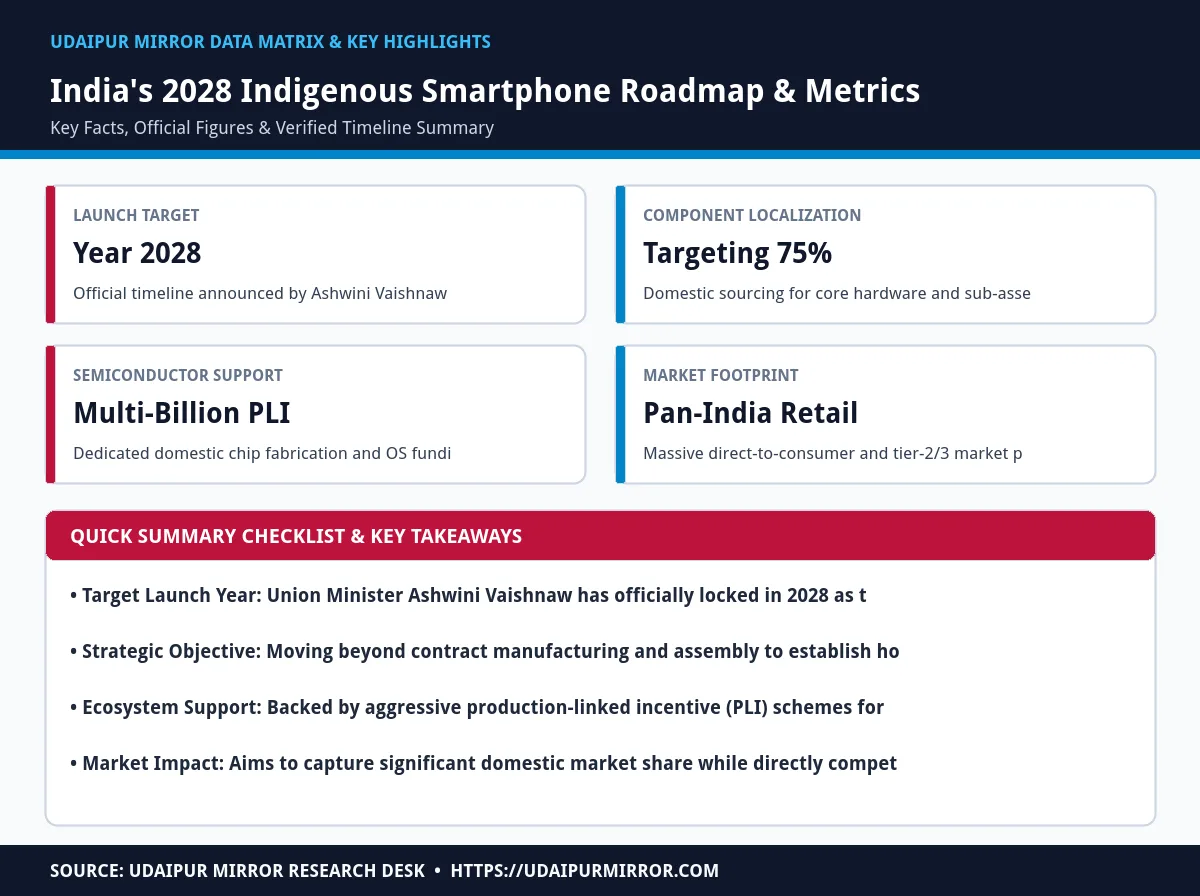
The trajectory of India’s electronics sector has accelerated rapidly from simple import-dependent retailing to sophisticated component fabrication. The table below outlines the strategic phases leading up to the 2028 indigenous smartphone debut.
| Phase / Year | Core Focus Area | Government Policy Support | Expected Outcome |
|---|---|---|---|
| Phase 1 (2020-2023) | Basic Mobile Assembly & Import Substitution | PLI Scheme 1.0 for Large Scale Electronics | Surge in local manufacturing numbers and export readiness |
| Phase 2 (2024-2026) | Component Deepening & SMT Line Expansion | PLI for IT Hardware & Display Ecosystem | Local production of chargers, batteries, and mechanicals |
| Phase 3 (2027-2028) | Indigenous Brand Launch & IP Creation | Specialized Semiconductor Design & Fab Incentives | Commercial rollout of India’s own national smartphone brand |
For years, Indian consumers have enjoyed smartphones assembled within the country using imported silicon, camera sensors, and display panels. While this generated millions of jobs and boosted exports, the ultimate intellectual property profits and core design rights remained overseas. The 2028 initiative targets this exact structural gap. By fostering indigenous chipset design, custom operating system optimizations, and local R&D centers, the upcoming brand aims to compete directly with established global titans.
Industry analysts point out that this hardware push mirrors parallel developments in performance tech, much like how upcoming specialty devices and alternative releases are monitored closely by consumers looking for cutting-edge specs. Building a national brand requires simultaneous advancements in battery technology, thermal management, and cellular reception standards.
No modern smartphone brand can thrive without a reliable, localized supply of advanced silicon. Fortunately, India’s multi-billion-dollar semiconductor mission is maturing precisely on schedule to support the 2028 smartphone rollout. With multiple fabrication plants (fabs) and outsourced semiconductor assembly and test (OSAT) facilities breaking ground across Gujarat and other states, domestic processors and power management integrated circuits (PMICs) will be ready to power home-grown handsets.
Furthermore, local accessory and subsystem ecosystems—spanning battery cells, printed circuit board assemblies (PCBAs), and acoustic components—are scaling up rapidly to meet stringent international quality benchmarks ahead of the commercial debut. (Also read: IT Sector Q2 Results Preview: TCS, HCL, Infosys, Wipro To See Muted Quarter).
When the indigenous brand arrives in 2028, it will enter a fiercely competitive market currently dominated by established brands from South Korea, China, and the United States. To succeed, the new brand will likely leverage aggressive pricing, deep integration with government digital public infrastructure (such as Aadhaar, UPI, and DigiLocker), and tailored software features catering specifically to regional Indian languages and consumer preferences.
Consumer reception is expected to be overwhelmingly favorable, driven by rising national pride in ‘Make in India’ initiatives and a growing demographic of tech-savvy buyers seeking high-value alternatives without compromising on premium hardware specifications.
Union Minister Ashwini Vaishnaw has announced that India’s own indigenous smartphone brand will officially launch by 2028.
The primary objective is to transition India from a contract manufacturing and assembly hub to a creator of home-grown intellectual property, domestic chip design, and advanced mobile hardware.
India’s upcoming semiconductor fabrication plants and OSAT facilities will supply homegrown silicon processors and power management chips directly to the domestic brand.
Yes, the brand is being engineered to incorporate cutting-edge 5G connectivity standards and deep optimization for India’s telecom networks.
Add Udaipur Mirror as a preferred source on Google to see more of our travel guides in your AI overviews.