Office Address
14, Residency Road, Udaipur, Rajasthan 313001
Office Address
14, Residency Road, Udaipur, Rajasthan 313001

NEW DELHI: NEW DELHI — The rapid acceleration of generative machine learning models across the subcontinent has brought to light a critical physical constraint. While venture capitalists continue to pour massive capital into localized language tools and automated coding assistants, industry analysts warn that the true ai hardware bottleneck in india is an acute scarcity of specialized silicon microprocessors essential for training advanced deep neural networks.
⚡ Quick Highlights: AI Hardware Bottleneck in India: The Semiconductor Crisis
The modern artificial intelligence narrative is frequently dominated by sprawling software models, billions of parameters, and instantaneous text generation. However, beneath the digital surface lies a stark physical reality: advanced machine learning requires specialized silicon. These minuscule semiconductor wafers serve as the absolute engine room for algorithmic training. As domestic enterprises rapidly adopt automation, the shortage of these components threatens to derail ambitious corporate roadmaps.
Industry observers note that while capital allocation toward digital transformation remains robust—drawing parallels to historical trends observed when economic ties between nations deepen—the physical logistics of chip supply chains cannot be easily bypassed with software optimization alone. Startups are increasingly forced to reallocate significant portions of their venture capital funding just to secure cloud-based processing power.
“You can write the most efficient neural network algorithm in the world, but without the physical silicon to execute it at scale, your innovation remains trapped on a whiteboard.” — Dr. Ramesh Swaminathan, Senior Semiconductor Research Fellow
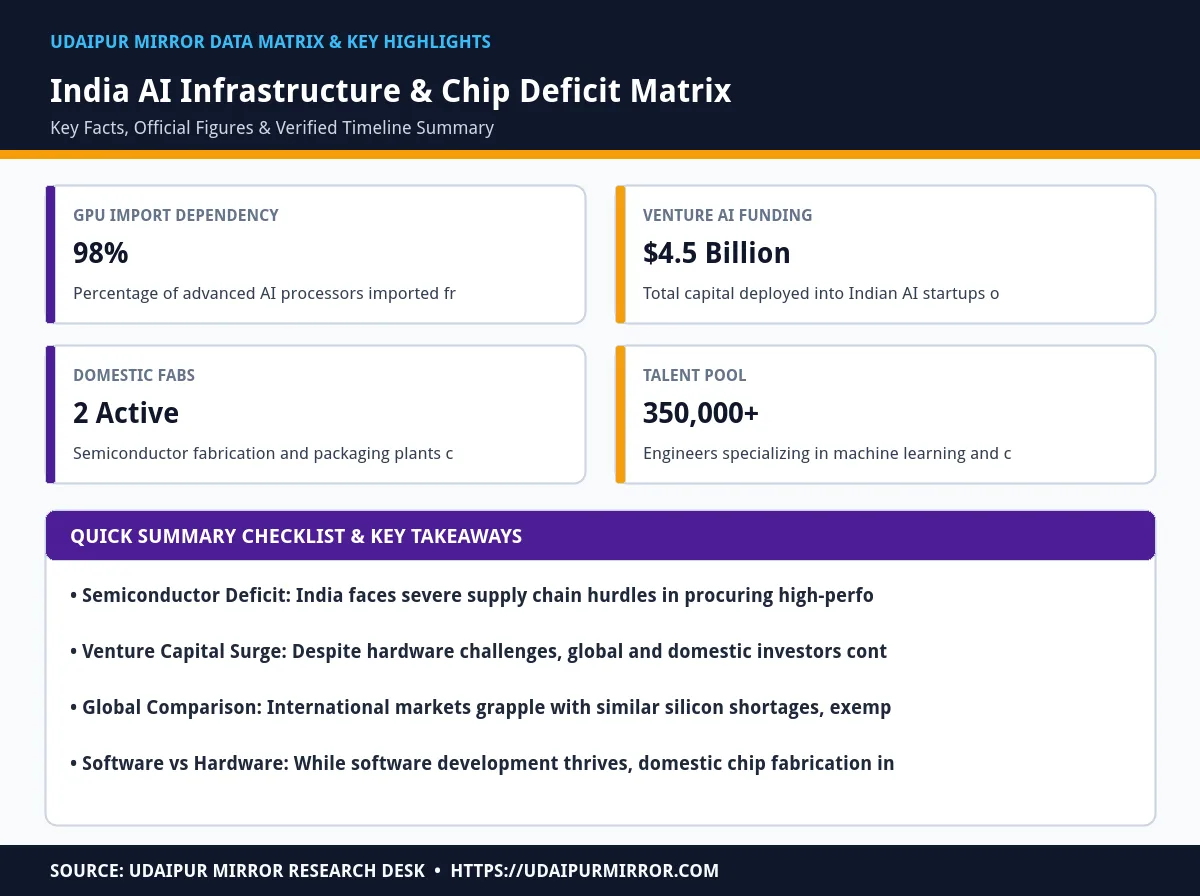
The following table outlines key parameters governing the current artificial intelligence boom, contrasting software-heavy funding rounds with physical hardware constraints across major emerging tech hubs.
| Ecosystem Segment | Capital Inflow (USD) | Primary Constraint | Key Market Player | Risk Level |
|---|---|---|---|---|
| AI Code Testing | $66 Million | Compute Scaling | Blacksmith ($1B Val.) | Moderate |
| Enterprise Automation | $1.0 Billion | Infrastructure Cost | Flapping Airplanes | High |
| Silicon & Hardware | $1.5 Billion | Wafer Fabrication | Tenstorrent | Critical |
| Enterprise Software | Conservative | Capex Restraint | Zoho Corporation | Low |
| Domestic IT Services | Market Fluctuations | Global Demand | TCS, Infosys, Wipro | Moderate |
Venture capital deployment into Indian technology sectors continues at a brisk pace, with early-stage and growth-stage funds aggressively backing generative intelligence platforms. Recent global announcements, such as AI startup Flapping Airplanes securing a staggering $1 billion Series A and code-testing platform Blacksmith raising $66 million at a unicorn valuation, highlight the boundless optimism of equity investors. Yet, this capital influx creates an immediate paradox.
When tech enterprises receive massive cash injections, their first operational hurdle is procuring the compute infrastructure necessary to fulfill investor growth expectations. When hardware scarcity inflates server costs, burn rates accelerate dangerously. This dynamic parallels broader market jitters, such as when IT sector Q2 results preview models anticipate margin compressions across legacy technology giants due to escalating operational overheads.
“We are witnessing a fascinating mismatch where software capital is abundant, but the physical building blocks of that software are rationed like precious metals.” — Ananya Roy, Venture Partner at Mumbai Tech Ventures
Not all industry leaders are rushing headlong into capital-intensive infrastructure plays. Prominent figures like Zoho founder Sridhar Vembu have publicly cautioned that the current artificial intelligence frenzy bears the hallmarks of a market bubble, declaring that his firm will intentionally avoid massive infrastructure investments for the time being. This conservative stance underscores a growing divergence in the Indian tech landscape.
While venture-backed upstarts burn through capital to acquire scarce computing power, bootstrapped giants prefer financial prudence. This strategic divide raises critical questions about long-term sustainability. If the chip bottleneck persists, capital-efficient businesses may weather potential market corrections far better than heavily leveraged competitors who overpaid for restricted hardware. (Also read: IT Sector Q2 Results Preview: TCS, HCL, Infosys, Wipro To See Muted Quarter).
“Building sustainable enterprise software does not require us to mortgage our future on overpriced, scarce hardware infrastructure that may soon face severe overcapacity corrections.” — Sridhar Vembu, CEO and Founder of Zoho
The hardware crunch is by no means isolated to the subcontinent. International funding rounds—such as Tenstorrent securing $1.5 billion in recent financing—demonstrate that global venture capital is actively hunting for alternative processor architectures to break current semiconductor monopolies. For India, overcoming the chip bottleneck requires a two-pronged strategy: aggressive global procurement partnerships and long-term domestic semiconductor fabrication investments.
Government-backed initiatives under the India Semiconductor Mission are gradually laying the groundwork for indigenous manufacturing, but fab plants require years of meticulous engineering and billions in capital before commercial production begins. In the interim, Indian AI startups must navigate complex supply chains, optimize lightweight models that demand fewer computational resources, and foster strategic alliances with international chip designers.
“India's emergence as an artificial intelligence superpower will not be determined solely by our software engineering prowess, but by how quickly we master the physics of hardware manufacturing.” — Vikramaditya Rao, Director of Deeptech Policy Initiatives
The primary bottleneck is the acute scarcity and high cost of specialized semiconductor chips, particularly advanced GPUs and custom accelerators required to train large-scale artificial intelligence models.
Startups are allocating large portions of their venture capital funding toward cloud compute leasing, optimizing smaller and more efficient open-source models, and seeking out alternative processor architectures.
Venture capital provides the necessary financial fuel for R&D and scaling, but it also creates intense pressure on startups to secure scarce computing infrastructure rapidly, driving up burn rates.
No. While venture-backed startups are aggressively building out compute capabilities, established bootstrapped giants like Zoho have adopted a cautious approach, avoiding massive capital expenditures on AI infrastructure.
Add Udaipur Mirror as a preferred source on Google to see more of our travel guides in your AI overviews.





[…] to Get Its Own Smartphone Brand by 2028: Ashwini Vaishnaw Says Note the Date 2 seconds ago ⚡ Business Artificial Intelligence's Next Big Bottleneck in India is a Very Small Chip 16 minute… Business Old values, new avenues: Deepening strategic and economic ties between India and Poland […]