Office Address
14, Residency Road, Udaipur, Rajasthan 313001
Office Address
14, Residency Road, Udaipur, Rajasthan 313001

MUMBAI / UDAIPUR: As the corporate earnings calendar unfolds for the second quarter of fiscal 2026, market participants are keeping a close watch on the it sector q2 results preview. India’s top-tier information technology powerhouses—Tata Consultancy Services (TCS), Infosys, HCLTech, and Wipro—are projected to deliver relatively muted revenue growth numbers. While artificial intelligence and cloud modernization pipelines continue to expand across enterprise portfolios, legacy discretionary spending constraints and cautious macroeconomic indicators in key Western markets are keeping overall top-line expansions in check.
⚡ Quick Highlights: IT Sector Q2 Results Preview: TCS, Infosys, Wipro Muted Quarter
The dichotomy defining India’s technology sector in late 2026 is stark: enterprise adoption of artificial intelligence is surging at an unprecedented pace, yet overall top-line growth for major IT service providers remains subdued. Corporations worldwide are aggressively allocating budgets toward generative AI pilots, machine learning models, and automated enterprise workflows. However, these deployments often cannibalize traditional legacy maintenance contracts, leading to flat or muted revenue expansion.
Market analysts note that while deal total contract values (TCVs) remain healthy, conversions into realized revenue are taking longer. This trend echoes broader financial market jitters where indices experience intermittent corrections, mirroring periods when top 10 firms lose Rs 1.56 trillion in market value due to sectoral shifts and foreign portfolio outflows. For retail and institutional investors tracking these developments, examining broader asset allocations through instruments like the best mutual fund to invest now remains a prudent strategy to balance portfolio volatility. (Also read: Top 10 Firms Lose Rs 1.56 Trillion In Market Value; HDFC Bank, Bajaj Finance Lead Decline).
“Enterprise clients are demanding immediate return on investment from AI deployments, shifting budgets away from legacy IT infrastructure into specialized cognitive solutions.” — Principal Technology Analyst, Mumbai Financial Desk
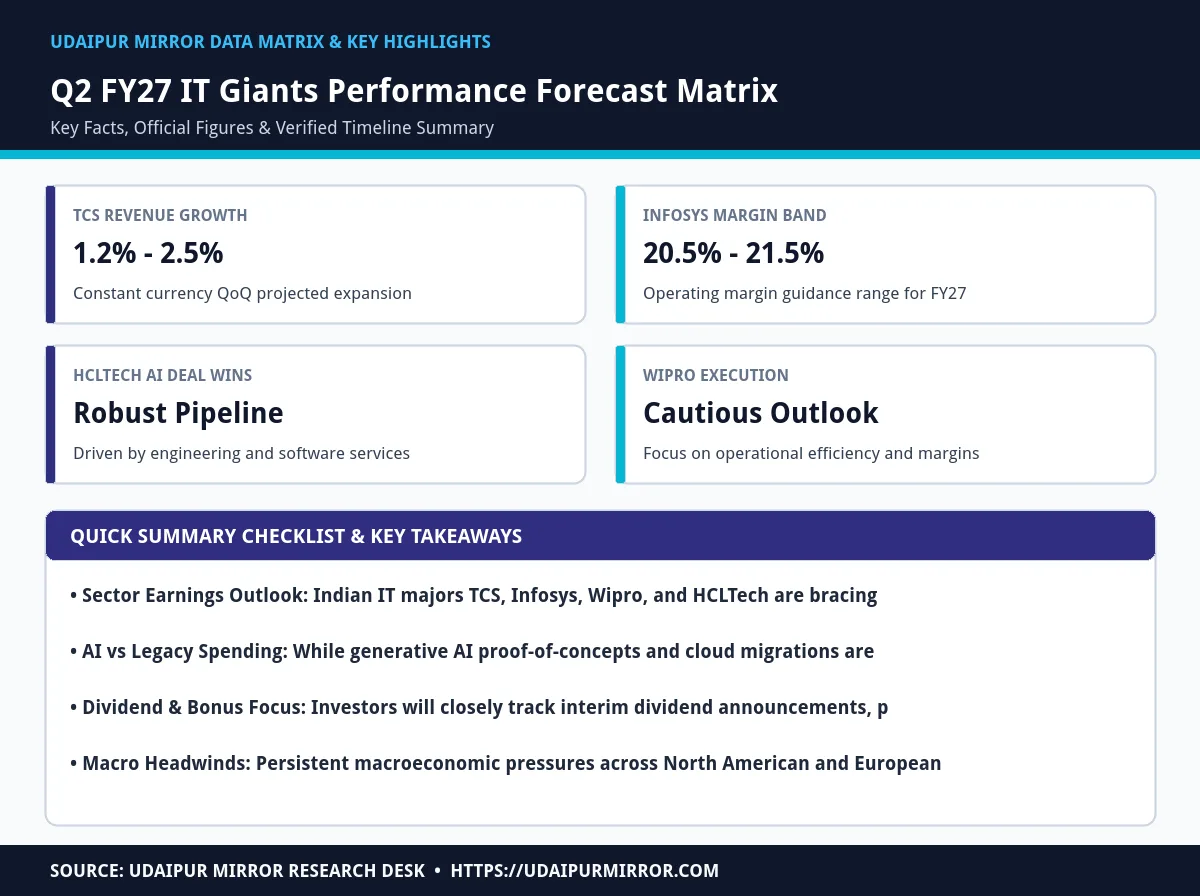
The table below outlines the anticipated performance metrics, reporting dates, and historical dividend tendencies for major Indian IT sector flagbearers during the ongoing Q2 reporting cycle.
| Company Name | Expected Revenue Growth (QoQ) | Operating Margin Outlook | Anticipated Dividend / Action | Key Growth Driver |
|---|---|---|---|---|
| Tata Consultancy Services (TCS) | 1.5% to 2.2% | 24.0% – 24.5% | Interim Dividend Expected | Cloud Migration & BFSI Deals |
| Infosys | 1.8% to 2.6% | 20.5% – 21.5% | Interim Dividend Likely | Large Enterprise GenAI Programs |
| HCLTech | 2.0% to 3.0% | 18.0% – 18.5% | Regular Dividend Payout | Engineering & R&D Services |
| Wipro | 0.5% to 1.5% | 16.5% – 17.2% | Dividend Consideration | Consulting & Transformation Deals |
| Tech Mahindra | 1.0% to 2.0% | 12.5% – 13.5% | Standard Distribution | Telecom Infrastructure & 5G Rollouts |
As India’s IT bellwethers begin releasing their quarterly scorecards, attention will focus heavily on operational margin resilience. Wage hikes, sub-contractor expenses, and talent localization costs in North America have put pressure on operating margins throughout the fiscal year. Companies have countered these pressures through aggressive automation, higher offshore delivery ratios, and optimized pyramid structures.
Investors evaluating the upcoming results should also monitor commentary on the upcoming primary market issuances and digital infrastructure investments, comparing tech sector dynamics with concurrent market milestones such as tracking the Jio IPO live tracker for subscription updates. Management guidance regarding discretionary spending recovery in the second half of FY27 will serve as the primary catalyst for stock rerating.
“Margin protection will be the standout highlight of this quarter as companies successfully leverage internal automation to offset wage headwinds.” — Senior Equity Research Lead
Beyond top-line metrics, Indian IT companies have historically maintained robust shareholder-friendly capital allocation policies. Even during muted revenue quarters, firms like TCS and Infosys are widely expected to announce attractive interim dividends. These periodic payouts act as a strong valuation cushion for long-term investors weathering short-term cyclical downturns in stock prices.
Furthermore, corporate boards are evaluating share buyback programs and optimized free cash flow utilization to boost return on equity (ROE). As macroeconomic visibility clears toward the latter half of 2026, market strategists anticipate gradual multiple expansions for IT stocks that demonstrate successful pivots toward high-margin software engineering and proprietary AI platforms. (Also read: Jio IPO Live Tracker: Subscription Status, GMP & KFin Tech Allotment Guide).
“Consistent dividend payouts remain the bedrock of investor confidence in the Indian IT sector during transitional growth cycles.” — Portfolio Manager, Institutional Equities
The muted Q2 outlook is primarily driven by cautious discretionary technology spending by enterprise clients in North America and Europe, alongside a transitional shift where spending is redirected toward generative AI pilots rather than legacy maintenance.
Major Indian IT flagbearers including Tata Consultancy Services (TCS), Infosys, HCLTech, and Wipro are releasing their Q2 financial scorecards during this reporting window.
Yes, top-tier IT firms like TCS and Infosys traditionally declare interim dividends alongside their Q2 earnings announcements to reward shareholders and maintain robust capital return yields.
While AI revenue is surging and forming a growing share of total contract values, it often displaces traditional legacy outsourcing contracts, resulting in a temporary stabilization or muted overall revenue growth rate.
Add Udaipur Mirror as a preferred source on Google to see more of our travel guides in your AI overviews.