Office Address
14, Residency Road, Udaipur, Rajasthan 313001
Office Address
14, Residency Road, Udaipur, Rajasthan 313001


NEW DELHI / FRANKFURT: Global macroeconomic markets experienced a unique divergence on Friday as european automakers earnings boost figures surprised Wall Street and European bourses, even though mounting competitive pressures from lower-cost Chinese manufacturers continued to cloud the sector’s broader recovery path. As international equity desks process these corporate scorecards alongside shifting central bank policy trajectories, investors are closely evaluating how supply chain realignments, fluctuating crude oil benchmarks, and broader trade dynamics intersect with domestic portfolios. As noted in recent domestic market updates such as the Sensex Surges 905 Points analysis, international equity sentiment frequently spills over into emerging markets, affecting heavyweight equities and sector-specific rotations.
⚡ Quick Highlights: European Automakers Earnings Boost Amid Chinese Competition
Major European automotive manufacturers released their quarterly financial results, revealing a surprisingly robust earnings boost that temporarily defied prevailing bearish sentiment. Industry analysts point out that strict cost optimization, disciplined vehicle pricing strategies, and resilient demand for high-margin luxury and internal combustion engine models helped cushion legacy carmakers against margin erosion.
However, executives during earnings calls emphasized that this short-term profitability should not be mistaken for a full structural recovery. The intense pace of market penetration by Chinese electric vehicle manufacturers continues to pressure traditional European marques, forcing them to accelerate their own EV development timelines while defending their domestic market shares. These dynamic shifts in international commerce often mirror trends seen in digital transformation cycles, much like how Tata Consultancy Services Stock Price updates reflect rapid technological adaptation across global IT sectors.
“Our latest earnings demonstrate operational resilience, but the competitive heat from low-cost Asian electric vehicle imports requires structural transformation across our entire manufacturing ecosystem.” — European Automotive Industry Analyst
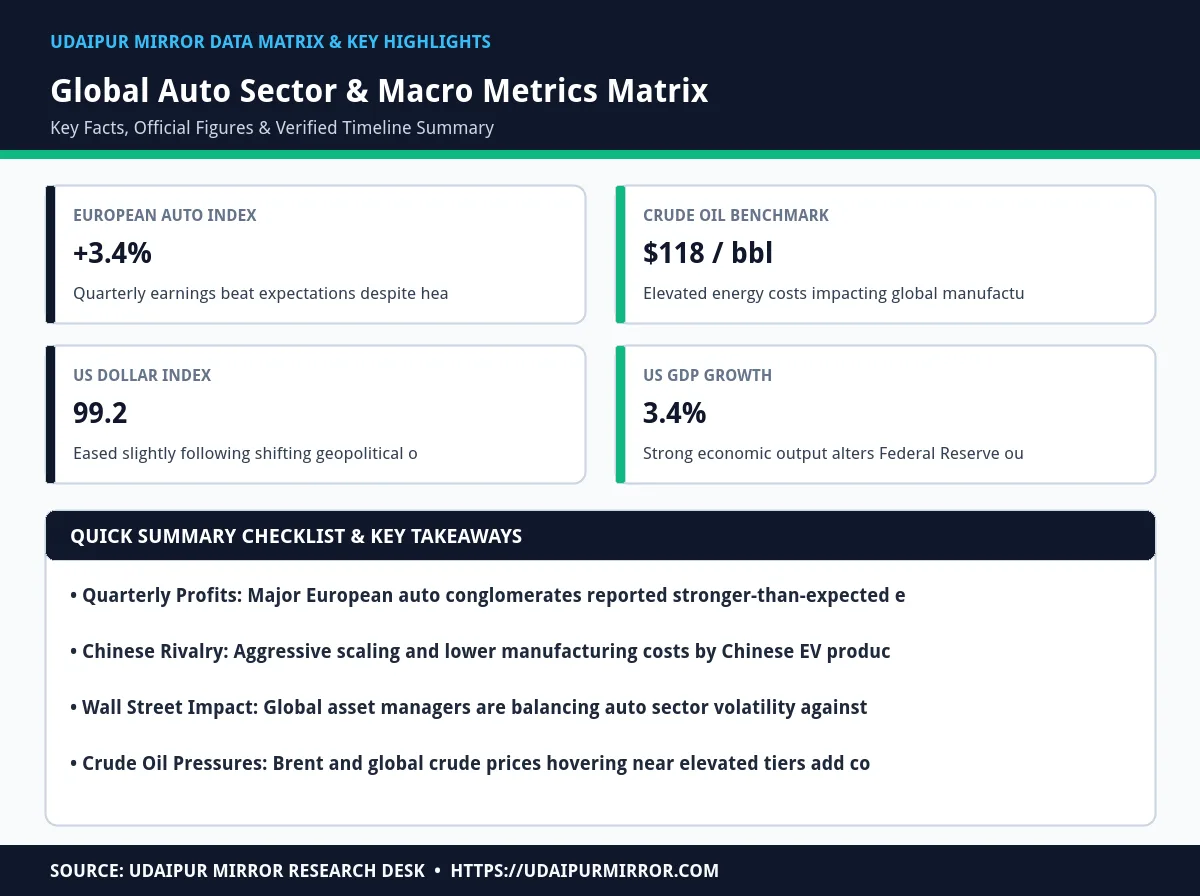
The following data matrix outlines key global financial markers, commodity rates, and regional market adjustments recorded at the end of October 2026, offering crucial context for institutional and retail investors navigating cross-border exposures.
| Market Indicator / Asset | Current Level / Rate | Weekly Trend | Primary Economic Driver |
|---|---|---|---|
| European Auto Earnings Index | Up 3.4% QoQ | Positive | Cost-cutting measures & premium mix |
| Brent Crude Oil Price | $118.50 per barrel | Bullish | Geopolitical tensions & supply tightness |
| US Dollar Index (DXY) | 99.20 | Bearish | Reduced safe-haven demand & US-Iran optimism |
| US 10-Year Treasury Yield | 4.24% | Stable | Robust US GDP growth figures at 3.4% |
| Gold Spot Price | $2,760 / oz | Consolidating | Profit-booking after recent record highs |
The primary shadow over Europe’s automotive sector remains the rapid, cost-effective surge of Chinese competitors. Backed by extensive supply chain integration and advanced battery manufacturing ecosystems, Chinese brands have steadily chipped away at the mid-market segment in Europe. This competitive pressure has triggered intense regulatory debates in Brussels regarding tariffs and trade barriers, even as individual automakers strive to restructure their operations for enhanced competitiveness.
For global investors, this ongoing rivalry dictates capital allocation decisions. Asset managers are increasingly favoring firms with robust balance sheets and agile supply chains capable of withstanding margin compression. Market participants tracking these developments also keep a close eye on domestic indices, where earnings-driven momentum plays a vital role, similar to the trends observed during recent market rallies driven by IT and retail earnings.
“The race for EV dominance is no longer just about technology; it is a brutal test of supply chain efficiency and cost discipline against formidable Asian competitors.” — Global Macro Strategist, Frankfurt
Beyond the automotive sector, global financial markets are navigating a complex matrix of macroeconomic indicators. Crude oil prices have climbed sharply toward $118 per barrel amid heightened geopolitical risks and potential supply concerns following Middle Eastern developments. This surge in energy costs threatens to reintroduce inflationary pressures, complicating monetary policy calculations for major central banks including the US Federal Reserve and the European Central Bank.
Concurrently, recent data showing US GDP expanding at an annualized rate of 3.4% has reinforced economic resilience, even as the tech-heavy Nasdaq experiences intermittent pullbacks. The easing of the US Dollar Index, driven partly by shifting geopolitical optimism regarding US-Iran discussions, has temporarily reduced safe-haven demand, allowing commodities and select international equities to find temporary relief. (Also read: Markets Rally for 2nd Day Amid Buying in IT Firms and Earnings-Driven Demand in Trent).
“Crude oil hovering near $118 creates a delicate balancing act for central bankers trying to anchor inflation without stalling post-midterm economic momentum.” — Chief Economist, London Brokerage
For investors in India, international macroeconomic shifts and European corporate earnings hold significant signaling value. Foreign institutional investor (FII) flows into Indian equities are frequently dictated by global risk appetite, currency valuations, and commodity price trends. When European and US markets face sector-specific disruptions or energy shocks, capital reallocations often ripple through emerging market indices.
As domestic markets respond to local corporate scorecards and robust domestic participation, keeping a watchful eye on international automotive health, crude oil trajectories, and central bank liquidity measures ensures a well-rounded risk management strategy for portfolios exposed to global trade.
“Indian market resilience is increasingly tested by global macroeconomic headwinds, making cross-border awareness essential for modern investors.” — Senior Portfolio Manager, Mumbai
European automakers recorded stronger quarterly earnings due to strict cost optimization, disciplined pricing strategies, and resilient demand for high-margin luxury and internal combustion models.
Aggressive scaling, lower manufacturing costs, and rapid EV expansion by Chinese competitors are pressing legacy profit margins and pressuring European carmakers to accelerate their own electric vehicle timelines.
Crude oil prices have risen to approximately $118 per barrel amid geopolitical tensions and supply considerations, introducing potential inflationary pressures for global manufacturing.
International macroeconomic trends, energy price spikes, and shifts in foreign institutional investor risk appetite directly influence capital flows, currency valuations, and sectoral performance in Indian markets.
Add Udaipur Mirror as a preferred source on Google to see more of our travel guides in your AI overviews.






[…] Fashion Accessories Startup Qiroko Secures Rs 1.5 Cr Funding From ISV Capital 2 seconds ago ⚡ Business Global Market: European Automakers Secure Earnings Boost as Chinese Competition Weighs on … Apps Tata Consultancy Services Stock Price and Market Intelligence Update 1 minute ago ⚡ […]