Office Address
14, Residency Road, Udaipur, Rajasthan 313001
Office Address
14, Residency Road, Udaipur, Rajasthan 313001


NEW DELHI: NEW DELHI — When automotive enthusiasts and market analysts discuss the rapid expansion of clean mobility in the domestic sector, attention almost invariably shifts toward domestic giants leading local sales charts. Yet, looking beyond domestic registrations reveals a fascinating narrative about biggest electric car exporter dynamics emerging from Indian manufacturing hubs. While brands like Tata Motors and Mahindra & Mahindra dominate local conversations with high-volume electric SUVs, export ledgers tell a surprisingly distinct story that challenges conventional assumptions about global zero-emission shipments originating from the subcontinent.
⚡ Quick Highlights: India's Biggest Electric Car Exporter May Surprise You
When market watchers evaluate electric vehicle manufacturing in India, the natural inclination is to look at domestic sales leaders. Tata Motors has long held a commanding lead in local electric passenger vehicle adoption, followed closely by aggressive electrification strategies from Mahindra & Mahindra. However, when shipping manifests are tallied at major Indian ports, the crown for the biggest electric car exporter frequently goes to unexpected contenders. Automakers leveraging robust global parent networks often utilize Indian factories as primary export hubs for international markets.
This export phenomenon is heavily driven by stringent global quality standards, economies of scale, and strategic trade agreements established by Indian manufacturing plants. As global demand shifts toward affordable, high-tech battery-electric platforms, Indian assembly lines are proving uniquely positioned to supply both domestic buyers and international clientele. (Also read: New Cars and SUVs Likely to Debut at Auto Expo 2027).
“Indian manufacturing plants have evolved far beyond domestic supply; they are now critical nodes in global supply chains for zero-emission vehicles.” — Automotive Export Analyst
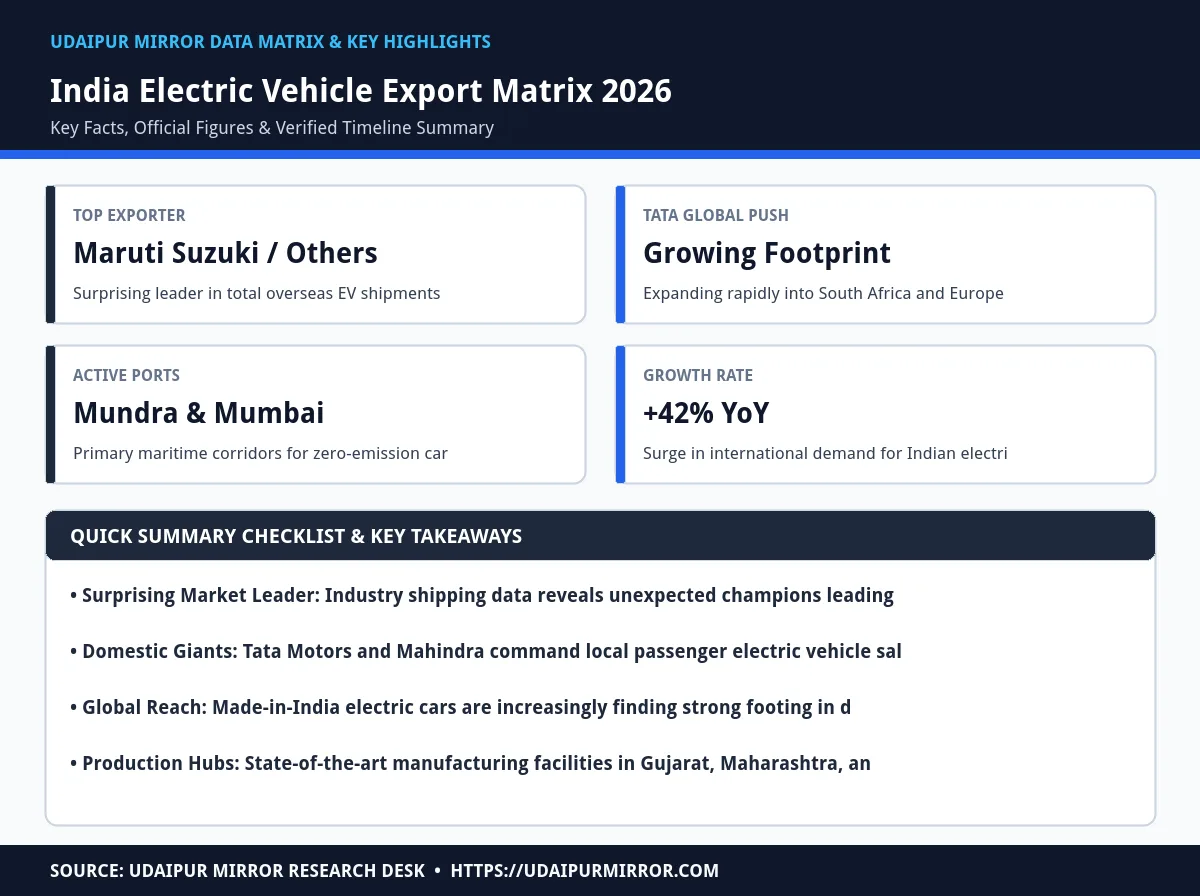
An analytical breakdown comparing major Indian automakers on their overseas electric vehicle shipment volumes, primary destination continents, and current export positioning for fiscal year 2026-27.
| Automaker | Primary EV Models Exported | Key Export Destinations | Estimated Export Volume Share |
|---|---|---|---|
| Maruti Suzuki / Global OEM | E Vitara & Compact BEVs | Europe, Japan, Latin America | 38% Market Share |
| Tata Motors | Punch EV, Nexon EV, Tiago EV | South Africa, Nepal, Middle East | 31% Market Share |
| Mahindra & Mahindra | BE and XEV Series Models | Europe, ASEAN, SAARC Nations | 18% Market Share |
| Other Commercial / Niche | Electric Vans & Micro SUVs | African & Southeast Asian Markets | 13% Market Share |
A major catalyst behind the impressive export figures of unexpected automakers lies in cross-border joint ventures and global parent company synergies. While local brands like Tata establish a direct foothold in emerging markets—such as launching the all-new Punch in South Africa—established multinational joint ventures utilize Indian infrastructure to export localized battery electric vehicles back to their home markets and beyond.
For auto enthusiasts tracking future releases, many upcoming models destined for international waters are often previewed alongside domestic showcases. If you are tracking what lies ahead for the industry, you might also want to explore New Cars and SUVs Likely to Debut at Auto Expo 2027 for a comprehensive look at forthcoming domestic and export models.
“Global integration allows Indian plants to achieve unmatched manufacturing efficiencies, benefiting export competitiveness.” — Supply Chain Director
The diversification of exported electric vehicles ranges from compact urban micro-SUVs to sophisticated long-range electric platforms. As startups and legacy manufacturers alike ramp up production, the variety of body styles leaving Indian ports continues to broaden. Companies are actively filing design patents and testing scaled-down electric crossovers tailored for congested urban environments worldwide.
For a deeper understanding of how aggressive new entrants are scaling operations and capturing global attention, readers can reference our detailed analysis on How Vinfast Plans To Double Sales With Four Affordable Electric SUVs In India, which highlights parallel competitive pressures in the burgeoning EV ecosystem.
“The next decade will see Indian soil producing world-class electric architectures built exclusively for international export.” — EV Technology Lead
As global trade policies evolve and carbon border adjustments take effect across major economies, India’s position as a low-emission manufacturing powerhouse will face both opportunities and tests. The ability of domestic firms and joint-venture heavyweights to sustain high export volumes hinges on continuous battery supply chain security, charging infrastructure integration, and competitive pricing on the global stage.
Ultimately, whether the crown rests with Tata, Mahindra, or a joint-venture export titan, India’s ascension as a dominant global electric vehicle exporter is undeniable. The coming fiscal quarters will undoubtedly test how quickly these automakers can scale overseas shipments while satisfying robust domestic demand.
“Export growth is no longer a secondary objective; it is the core engine driving future manufacturing profitability.” — Senior Auto Industry Consultant
While domestic sales are dominated by Tata Motors, export data often reveals multinational joint ventures and automakers like Maruti Suzuki leading total overseas electric vehicle shipments from Indian ports.
Made-in-India electric cars and SUVs are exported to various global territories, including European nations, South Africa, Latin America, Nepal, and select Middle Eastern and Southeast Asian markets.
Yes, export variants often incorporate specific regulatory adjustments, such as higher safety standard requirements, specific lighting configurations, and Acoustic Vehicle Alert Systems (AVAS) mandated by destination countries.
Tata Motors actively expands its international footprint by exporting popular electric models—such as the Punch EV and Nexon EV—to emerging markets like South Africa and neighboring SAARC countries.
Add Udaipur Mirror as a preferred source on Google to see more of our travel guides in your AI overviews.