Office Address
14, Residency Road, Udaipur, Rajasthan 313001
Office Address
14, Residency Road, Udaipur, Rajasthan 313001


MUMBAI: MUMBAI — In a significant development for retail equity investors seeking regular cash flows, ICICI Prudential Mutual Fund has announced Income Distribution cum Capital Withdrawal (IDCW) payouts across a wide range of its flagship equity portfolios. Investors tracking icici pru mf idcw payouts will find that the fund house has set specific record dates for unitholders registered under the eligible dividend options of these designated schemes. This announcement comes at a time when market participants are carefully evaluating asset allocation strategies, balancing long-term capital appreciation with periodic liquidity requirements amidst evolving macroeconomic indicators and changing tax norms surrounding capital gains.
⚡ Quick Highlights: ICICI Pru MF Announces IDCW Payouts Across Equity Schemes
ICICI Prudential Mutual Fund’s decision to announce Income Distribution cum Capital Withdrawal (IDCW) payouts across its large & mid cap, mid cap, and small cap schemes provides a structured liquidity option for unitholders who prefer periodic cash flows over pure capital compounding. Under mutual fund regulations, IDCW distributions are sourced from the distributable surplus of the respective schemes. While these payouts offer tangible returns to investors, financial advisors continuously remind retail participants that IDCW is not an assured or guaranteed yield, as it fluctuates directly with realized market gains and portfolio performance.
As Indian capital markets navigate through dynamic shifts—including recent industry discussions regarding long-term capital gains (LTCG) rationalization and potential tax-free mutual fund switching proposals put forth by regulatory bodies—unitholders must carefully evaluate whether opting for IDCW or staying invested in growth options aligns best with their overarching financial goals. For sustainable wealth creation, balancing equity exposure with green investments such as Gujarat Achieves 90% of PM Surya Ghar Target With 9.08 Lakh Rooftop Solar Installations can provide an effective hedge against market volatility.
“IDCW payouts provide regular cash flow options for investors, but unitholders must factor in that such distributions reduce the net asset value of their mutual fund schemes accordingly.” — Senior Financial Analyst, Mumbai
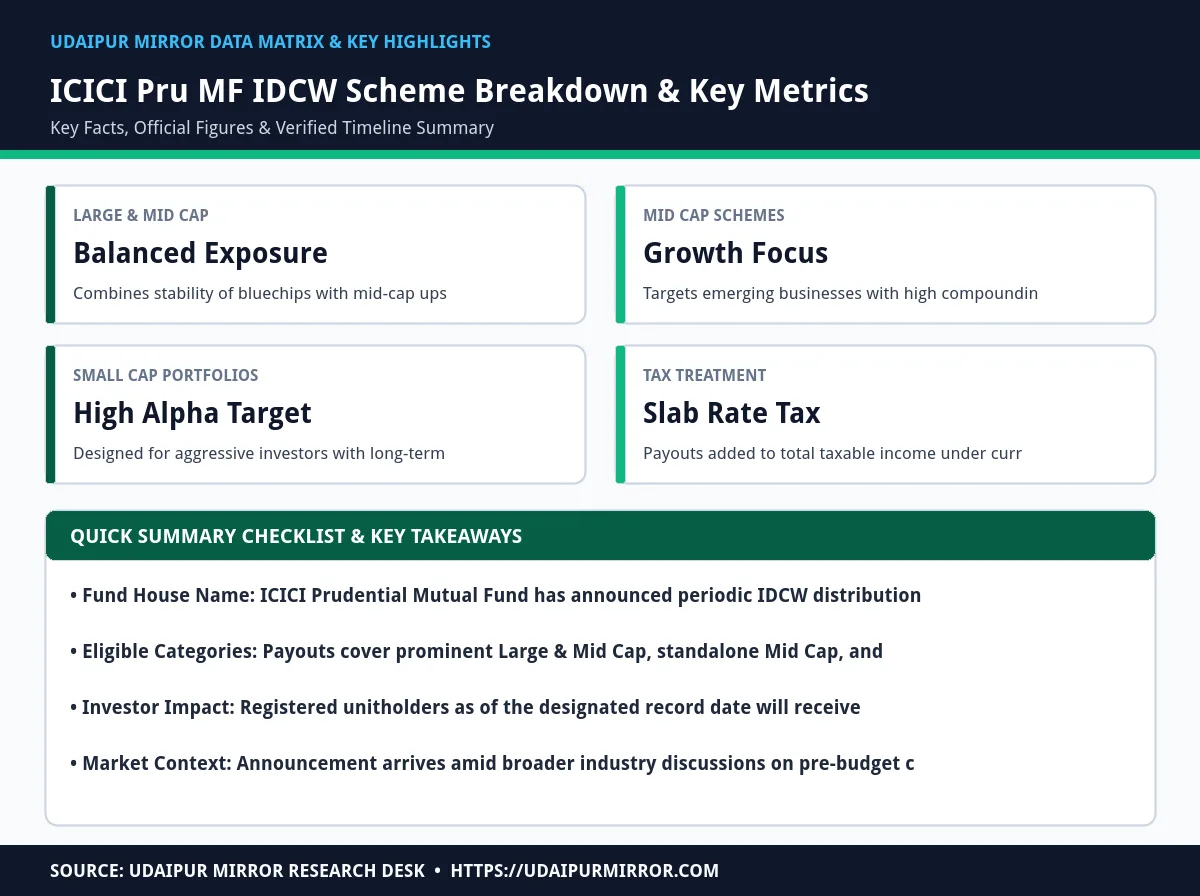
The following structured data table outlines the key parameters, asset categories, and distribution frameworks associated with the latest ICICI Prudential Mutual Fund IDCW payout announcements for retail and institutional unitholders.
| Scheme Category | Investment Focus | Risk Profile | Distribution Type | Taxation Rule |
|---|---|---|---|---|
| Large & Mid Cap | Top 250 Indian equities | Moderately High | IDCW Payout / Reinvestment | Added to Investor Slab |
| Mid Cap Schemes | Rank 101-250 companies | High | IDCW Payout / Reinvestment | Added to Investor Slab |
| Small Cap Schemes | Rank 251 and beyond | Very High | IDCW Payout / Reinvestment | Added to Investor Slab |
| Tax Planning ELSS | Statutory 3-year lock-in | High | Section 80C Compliant | Subject to LTCG norms |
| Index Funds | Nifty / Sensex replication | Market Risk | Growth / IDCW Options | Standard Capital Gains |
One of the most critical aspects for investors receiving IDCW payouts is understanding the associated tax liabilities. Unlike capital gains tax which applies upon redemption, IDCW income is treated as ‘income from other sources’ and is added directly to the investor’s total taxable income. It is subsequently taxed according to the individual’s applicable income tax slab rates. Furthermore, mutual fund houses deduct Tax Deducted at Source (TDS) on IDCW payments if the aggregate distribution amount crosses statutory threshold limits within a financial year.
Investors planning their overall financial portfolio should also take note of evolving tax structures and compliance standards. While managing investments, maintaining comprehensive records of all financial transactions safeguards against unexpected tax demands—a scenario recently highlighted by legal precedents such as ITAT rulings on bank cash deposits. For those looking to diversify their lifestyle assets or celebrate milestone financial achievements, exploring high-end lifestyle investments like GIVA Secures $100M in Multiples-Led Funding Round as India Startup Ecosystem Accelerates illustrates the robustness of the broader Indian economic landscape.
“Investors in higher tax brackets should carefully analyze whether IDCW options suit their post-tax return expectations compared to growth-oriented mutual fund plans.” — Taxation Expert & Chartered Accountant
IDCW stands for Income Distribution cum Capital Withdrawal. It is the nomenclature mandated by SEBI for what was previously known as dividend option in mutual fund schemes.
All unitholders who hold units in the eligible ICICI Prudential schemes under the IDCW option as of the officially announced record date are eligible for the payout.
No, IDCW payouts are not tax-free. They are added to the investor’s total taxable income and taxed according to their applicable individual income tax slab rates.
Yes. When an IDCW payout is made, the NAV of the mutual fund scheme falls by an amount equivalent to the payout per unit, along with any applicable statutory taxes or levies.
Add Udaipur Mirror as a preferred source on Google to see more of our travel guides in your AI overviews.






[…] Guide 2026: Shreenathji 8-Jhanki Darshan, Sanwaliya Seth & Eklingji Timings 4 seconds ago ⚡ Articles ICICI Pru MF Announces IDCW Payouts Across Large & Mid Cap, Mid Cap and Small Cap Sche… Articles Gujarat Achieves 90% of PM Surya Ghar Target With 9.08 Lakh Rooftop Solar Installations 1 […]
[…] Guide 2026: Shreenathji 8-Jhanki Darshan, Sanwaliya Seth & Eklingji Timings 1 hour ago ⚡ Articles ICICI Pru MF Announces IDCW Payouts Across Large & Mid Cap, Mid Cap and Small Cap Sche… Articles Gujarat Achieves 90% of PM Surya Ghar Target With 9.08 Lakh Rooftop Solar Installations 2 […]