Office Address
14, Residency Road, Udaipur, Rajasthan 313001
Office Address
14, Residency Road, Udaipur, Rajasthan 313001


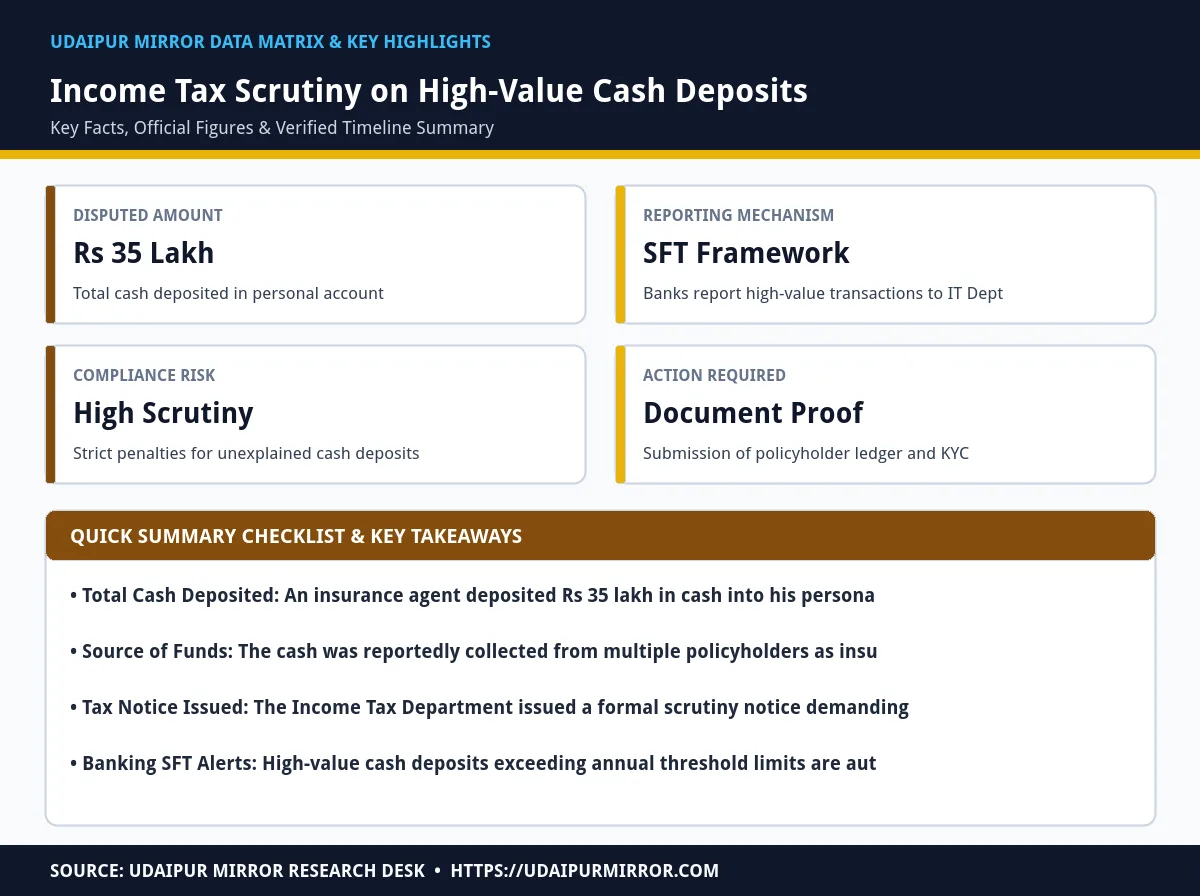
NEW DELHI / UDAIPUR: NEW DELHI / UDAIPUR — In an alarming reminder of strict financial tracking protocols in India, a local insurance agent has been served an official notice by the Income Tax Department after depositing insurance agent tax notice cash deposit totaling Rs 35 lakh into his personal savings bank account. The funds, which were purportedly collected from various policyholders over a period of time as premium payments, triggered automated red flags through the Statement of Financial Transactions (SFT) submitted by banking institutions, leading to intense scrutiny from tax authorities.
⚡ Quick Highlights: Insurance Agent Gets Tax Notice For Rs 35 Lakh Cash Deposit
The case came to light when the Income Tax Department’s data analytics wing flagged a sudden, substantial surge in cash deposits within a personal savings bank account belonging to an insurance agent. Under current financial regulations, banks and financial institutions are mandated to file a Statement of Financial Transactions (SFT) for cash deposits aggregating to Rs 10 lakh or more in a single financial year within a savings account.
When the agent deposited Rs 35 lakh in cash—accumulated over several months from various clients who handed over physical currency for their policy renewals—the banking system automatically mapped the anomaly. Because the PAN linked to the account did not justify such high-volume cash inflows based on previously filed tax returns, an automated query was generated, eventually translating into a formal scrutiny notice under the Income Tax Act.
While navigating personal financial management and regulatory compliance, investors often explore diverse asset classes and financial instruments. For instance, many retail participants also look into systematic investment plans, as detailed in our analysis of ICICI Pru MF IDCW Payouts Across Schemes, emphasizing the importance of transparent banking channels.
“Mixing personal savings accounts with business or client collections is a primary recipe for tax notices. Every rupee of cash deposited must be backed by verifiable ledger trails and legitimate source documentation.” — Senior Tax Consultant, New Delhi
The Income Tax Department monitors various financial transactions through automated data matching algorithms. The following matrix outlines the reporting thresholds and compliance requirements for cash deposits and financial dealings in India.
| Transaction Type | Threshold Limit | Reporting Entity | Compliance Requirement |
|---|---|---|---|
| Cash Deposit (Savings A/c) | Rs 10 Lakh / Financial Year | Scheduled Commercial Banks | Mandatory SFT Reporting to Tax Dept |
| Cash Deposit (Current A/c) | Rs 50 Lakh / Financial Year | Banks & Financial Institutions | Mandatory SFT Reporting to Tax Dept |
| Insurance Premium Cash Pay | Rs 2 Lakh per Policy | Insurance Companies | PAN Card & Source Verification Required |
| High-Value Property Deal | Rs 30 Lakh or More | Sub-Registrar Offices | Annual Information Statement (AIS) Tracking |
| Credit Card Bill Cash Pay | Rs 1 Lakh (Cash) / Rs 10 Lakh (Total) | Card Issuing Banks | Immediate Reporting under SFT Guidelines |
Insurance agents and financial intermediaries frequently encounter clients who prefer paying premiums in cash, especially in semi-urban and rural pockets where digital adoption is still evolving. However, accepting physical cash without routing it through proper business channels or company-authorized deposit mechanisms creates severe legal vulnerabilities.
When an agent deposits client cash into their own personal bank account, the Income Tax Department views the entire sum as unexplained income of the account holder unless concrete, verifiable proof is provided. This puts the onus entirely on the agent to prove that the money belongs to third parties—a cumbersome task if proper receipts, policy numbers, and policyholder KYC documents were not meticulously maintained.
Staying updated with modern technological tools and digital platforms is equally critical for professionals in today’s fast-paced environment. Readers interested in upgraded gadgets to streamline digital invoicing and client communications can check our review on the OnePlus 16 and 16T India Launch Specs.
“Intermediaries must never act as unofficial bank branches for cash collections. Always insist on direct digital payments from policyholders into official company accounts.” — Chartered Accountant & Compliance Expert
Receiving an income tax notice for high-value cash deposits should not cause panic, provided the taxpayer has clean and accurate records. The first step for the insurance agent in question is to consult a qualified chartered accountant or tax lawyer to draft a comprehensive response through the official e-filing portal.
The response must include a complete reconciliation statement showing how much cash was collected from which policyholder, supported by copies of temporary receipts issued, policy numbers, mobile numbers, and PAN details of the respective clients. Additionally, the agent must submit declarations from the policyholders confirming that they handed over cash for premium payments.
Furthermore, tax authorities examine whether the agent violated provisions of the Income Tax Act relating to cash transactions exceeding permissible limits under Section 269ST, which restricts accepting cash of Rs 2 lakh or more in a single day or against a single transaction. (Also read: OnePlus 16T And OnePlus 16 May Launch In India: Check Expected Specs And Price).
The Income Tax Department flagged the deposit because cash inflows exceeding Rs 10 lakh in a financial year within a savings account are automatically reported by banks via the Statement of Financial Transactions (SFT). The deposit did not match the agent’s declared income profile.
While insurance companies have strict limits and compliance rules regarding cash payments (usually discouraging cash above Rs 2 lakh), agents should ideally direct policyholders to pay premiums digitally or directly into official company accounts to avoid personal tax liability.
The agent must provide policyholder details including their names, PAN cards, policy numbers, written confirmation letters, copies of receipts issued, and a clear cash ledger reconciling every single transaction.
Under Section 68 of the Income Tax Act, unexplained cash credits can be taxed at steep rates up to 60% plus applicable surcharges and heavy penalties, alongside potential legal scrutiny.
Add Udaipur Mirror as a preferred source on Google to see more of our travel guides in your AI overviews.






[…] के नाम पर 12 लाख की धोखाधड़ी 59 minutes ago ⚡ Business Insurance Agent Deposits Rs 35 Lakh Cash Collected from Policyholders, Gets Income Tax Not… Cricket Rohit Sharma Score Today in 1st ODI Against New Zealand: Complete Match Analysis 2 hours […]