Office Address
14, Residency Road, Udaipur, Rajasthan 313001
Office Address
14, Residency Road, Udaipur, Rajasthan 313001


BHUBANESWAR: BHUBANESWAR — In a major push toward India’s 500 GW non-fossil fuel capacity target by 2030, the Solar Energy Corporation of India (SECI) and Odisha Hydro Power Corporation (OHPC) have formally announced plans to develop 3 gw floating solar and bess projects across various water bodies and reservoirs in Odisha. This landmark joint initiative is designed to harness vast unutilized water surfaces for clean power generation while utilizing advanced battery storage solutions to manage grid stability and peak load demands effectively.
⚡ Quick Highlights: SECI & OHPC Plan 3 GW Floating Solar & BESS Projects in Odisha
The collaboration between the Solar Energy Corporation of India (SECI) and the Odisha Hydro Power Corporation (OHPC) marks a pivotal turning point for eastern India’s renewable energy landscape. By leveraging large inland water reservoirs for floating photovoltaic installations, the partnership bypasses traditional land acquisition hurdles that often stall utility-scale solar projects. Floating solar arrays offer distinct thermodynamic advantages, as the cooling effect of the water beneath helps maintain higher module efficiency compared to land-based systems operating under extreme ambient temperatures.
Furthermore, as state DISCOMs and industrial consumers increasingly pivot toward sustainable power sources, similar state-level transformations are visible across the country—echoing successes like Gujarat Achieves 90% of PM Surya Ghar Target With 9.08 Lakh Rooftop Solar Installations, which highlights how aggressive policy backing accelerates grassroots green adoption. The Odisha initiative scales this momentum to the utility level, targeting multi-megawatt water bodies to supply clean electricity to regional grids.
“Floating solar paired with battery storage represents the next frontier of grid stability, allowing us to deliver reliable renewable power long after sunset.” — Senior SECI Project Director
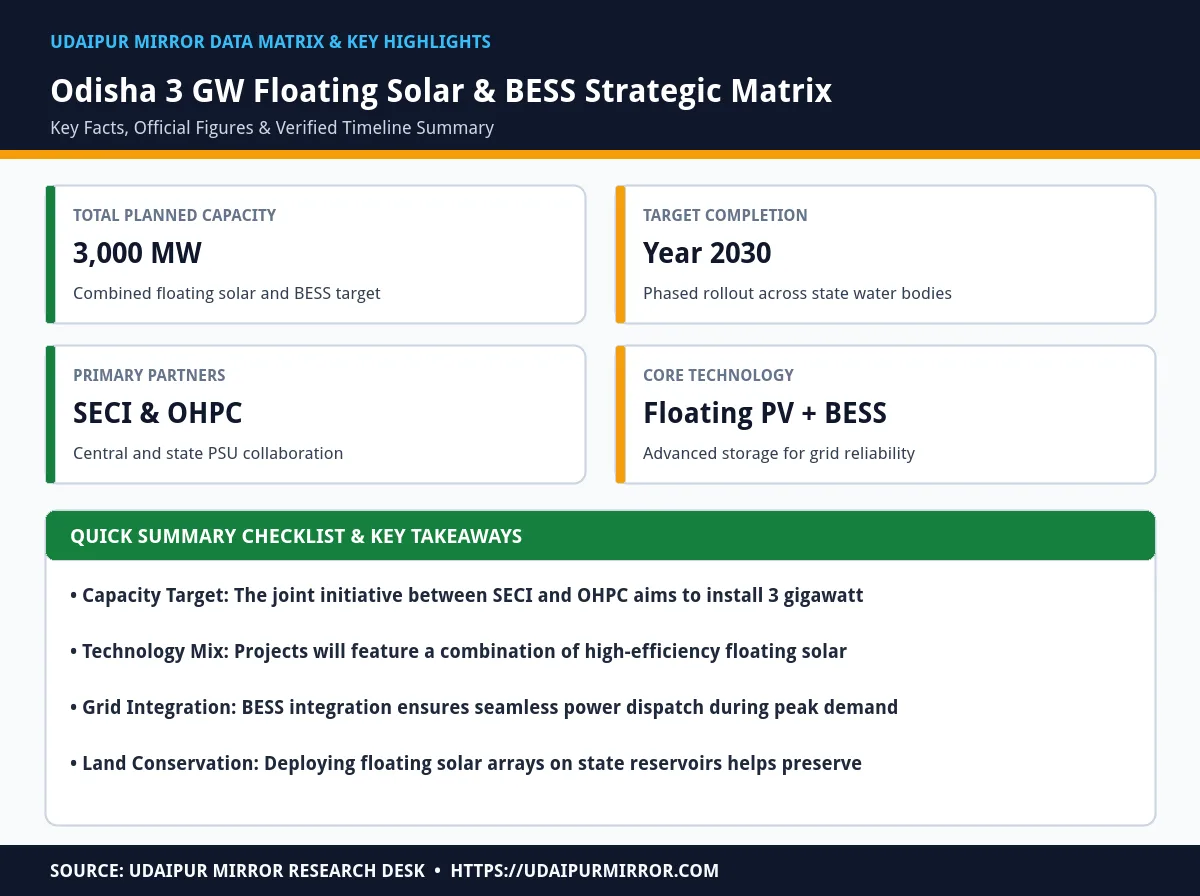
A comparative overview tracking the scale, technological composition, and execution timeline of major recent clean energy agreements across India, highlighting the strategic role of the SECI and OHPC collaboration in Odisha alongside wider national transitions.
| Project Initiative | Capacity & Scope | Key Technologies | Target Timeline | Strategic Impact |
|---|---|---|---|---|
| SECI-OHPC Odisha Project | 3,000 MW | Floating Solar, BESS | By 2030 | Optimizes reservoir use & peak load management |
| Essar & NHPC PPA | 300 MW | Utility-scale Solar/Wind | Active 2026 | Expands corporate green power procurement |
| RenewSys & Kosol Supply | 1,200 MW | Solar PV Modules | FY 2026-27 | Strengthens domestic manufacturing supply chain |
| Rajasthan Green Corridor | 28,000 MW | Solar, Wind, Hybrid | Achieved in 34 Mos | Sets benchmark for state-level RE capacity addition |
| ACME Solar Commissioning | 66.68 MW | Utility Solar Park | Operational Nov 2026 | Adds immediate generation to western grid |
A critical bottleneck in rapid renewable expansion has historically been solar intermittency. To counter this, the SECI-OHPC framework embeds large-scale Battery Energy Storage Systems (BESS) directly into the project architecture. These storage units absorb surplus solar generation during peak afternoon hours and seamlessly discharge clean electricity during evening peak demand periods, effectively flattening the load curve for grid operators.
As administrative frameworks evolve to monitor corporate compliance and financial transparency in infrastructure projects, strict oversight remains vital. Authorities frequently scrutinize high-value financial movements, reminiscent of recent administrative cases such as when an Insurance Agent Deposits Rs 35 Lakh Cash Collected from Policyholders, Gets Income Tax Notice, underscoring the broader regulatory rigor applied across all commercial and public sectors in India today.
“BESS integration is no longer optional for gigawatt-scale projects; it is the fundamental anchor that makes 100% renewable penetration viable.” — Energy Transition Analyst, New Delhi
The journey to 3 GW by 2030 will unfold through meticulously planned execution phases, beginning with comprehensive bathymetric and environmental surveys across major Odisha reservoirs. OHPC’s deep expertise in managing hydro assets provides a natural synergy, as existing transmission infrastructure near hydroelectric plants can often be co-utilized to evacuate solar power efficiently, drastically reducing capital expenditure on new transmission lines.
This massive influx of green infrastructure is projected to catalyze local manufacturing, engineering services, and long-term employment opportunities throughout Odisha. Technical workforce readiness is also scaling in tandem, with educational and vocational boards aligning curricula with modern green tech standards—much like candidates preparing for competitive technical certifications such as the upcoming RSSB Basic Computer Instructor Result 2026 Out Soon at rssb.rajasthan.gov.in, reflecting a digitally empowered workforce ready to manage automated renewable energy grids.
“Our partnership with SECI establishes a blueprint for state-central synergy, transforming Odisha into a powerhouse of green energy innovation.” — OHPC Technical Board Member
The primary objective is to develop 3 gigawatts (GW) of floating solar photovoltaic capacity and Battery Energy Storage Systems (BESS) across Odisha by the year 2030.
Floating solar panels conserve valuable agricultural land, reduce water evaporation on reservoirs, and deliver higher energy yields due to the natural cooling effect of the water.
Battery Energy Storage Systems store excess solar energy produced during peak sunlight hours and discharge it during evening peak demand periods, ensuring continuous grid stability and eliminating intermittency issues.
The project directly supports India’s national commitment to achieve 500 GW of non-fossil fuel energy capacity and move toward net-zero carbon emissions by 2030.
Add Udaipur Mirror as a preferred source on Google to see more of our travel guides in your AI overviews.