Office Address
14, Residency Road, Udaipur, Rajasthan 313001
Office Address
14, Residency Road, Udaipur, Rajasthan 313001


NEW DELHI / NEW YORK: NEW DELHI / NEW YORK — As global macroeconomic landscapes undergo rapid restructuring, the growing influence of brics nations has emerged as a defining geopolitical narrative of late 2026. From expanding economic partnerships across Asia, Africa, and Latin America to concerted policy pushes toward localized currency settlements, the bloc is systematically challenging legacy Western-dominated financial architectures. International investors and central banks are closely monitoring these shifts, especially as commodity trade corridors adjust to concurrent pressures from ongoing Middle Eastern conflicts, fluctuating Brent crude oil pricing, and evolving US trade policies.
⚡ Quick Highlights: The Growing Influence of BRICS in Global Economy & Trade 2026
The ongoing expansion of the economic bloc has accelerated discussions around alternative payment rails. While the US dollar remains the undisputed anchor of international liquidity, central banks across the Global South are systematically diversifying their reserve assets. Gold accumulations by emerging market central banks have soared, mirroring trends seen when Diwali Dhamaka on Dalal Street: Sensex Jumps 2,009 Points in Historic Rally highlighted domestic investor optimism amid global cross-currents.
Bilateral trade pacts settled in local currencies have reduced transactional friction for manufacturing powerhouses. This evolution protects member states from external currency shocks, creating a more resilient trade ecosystem that functions independently of traditional Western banking sanctions and clearing houses. (Also read: OpenAI Launches GPT-6 Cyber With Critical Cybersecurity Rating Amid Volatile Markets).
“The structural realignment of global trade corridors is no longer a theoretical debate; it is an active market reality shaping every commodity shipment today.” — Global Macro Strategist, Asian Financial Summit
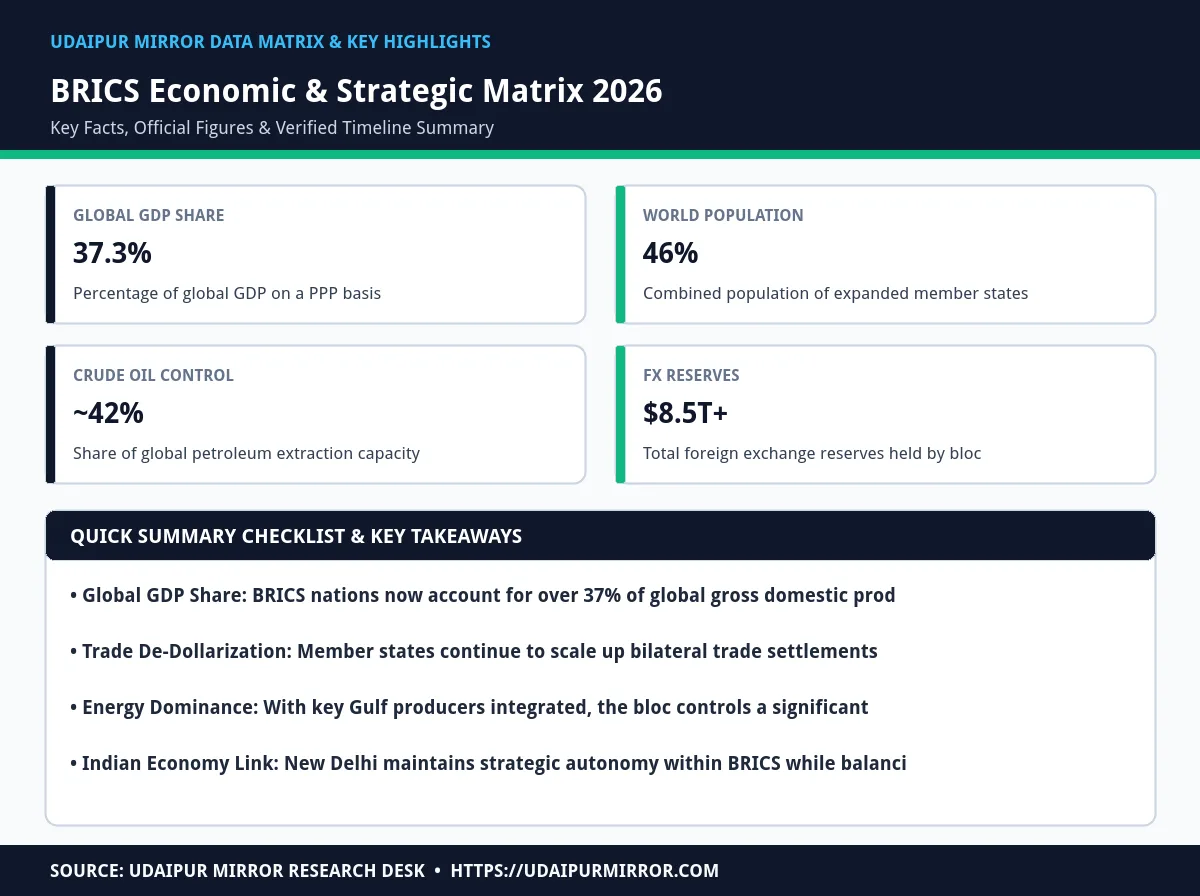
The following matrix compares key macroeconomic indicators across the core BRICS economies, illustrating their collective weight in global trade, foreign reserves, and purchasing power parity.
| Metric / Indicator | Core Status (2026) | Global Standing | Strategic Focus |
|---|---|---|---|
| Combined GDP (PPP) | ~$32 Trillion | Exceeds G7 on PPP basis | Infrastructure & Industrial Growth |
| Foreign Exchange Reserves | $8.5 Trillion+ | Dominant global pool | Reserve diversification & stability |
| Energy Production | Over 40% of Global Oil | Critical supply hub | Energy security & local currency trade |
| Intra-Bloc Trade Growth | Up 18% YoY | Accelerating corridor | Supply chain resilience & self-reliance |
| Technology Cooperation | Active AI & Cyber Pacts | Emerging tech alliance | Digital public infrastructure sharing |
Geopolitical flashpoints, particularly ongoing tensions in the Middle East and the Strait of Hormuz, have injected significant volatility into international energy markets. As crude oil pricing fluctuates wildly between WTI and Brent benchmarks, energy-importing nations within the bloc face heightened fiscal risks. Maintaining strategic neutrality has become paramount for economies navigating simultaneous trade negotiations with both Western partners and BRICS allies.
In tandem with rapid macroeconomic shifts, technological advancements continue to transform enterprise operations worldwide. Innovations mirror the disruptive momentum seen when OpenAI Launches GPT-6 Cyber With Critical Cybersecurity Rating Amid Volatile Markets, underscoring how modern security frameworks must adapt to both digital and geopolitical uncertainties.
“Energy security and supply chain diversification are the twin pillars determining national sovereignty in this decade of transition.” — International Energy Security Analyst
For India, the growing influence of BRICS presents a complex matrix of opportunities and challenges. On one hand, enhanced access to alternative energy suppliers and expanding trade corridors in local currencies insulate the domestic market from sudden dollar liquidity crunches. On the other hand, managing trade deficits and maintaining robust foreign institutional investment (FII) inflows requires diplomatic finesse.
As domestic urban growth corridors expand—drawing parallels with developments like Debari Growth Corridor 2026: Ring Road Connectivity, Industrial Land & Residential Plots—investors are increasingly factoring global macro stability into long-term asset allocation strategies.
“India's unique position allows it to act as a bridge between developed market capital and emerging market resource powerhouses.” — Senior Economic Advisor, New Delhi
The growing influence of BRICS is driven by its expanding economic GDP share, coordinated efforts toward de-dollarization, inclusion of major energy exporters, and the collective push by developing nations for a multipolar global order.
With several leading petroleum-producing nations integrated into the bloc, BRICS accounts for a vast portion of global oil output, allowing members to explore alternative settlement currencies and secure stable long-term energy supplies.
It provides India with diversified energy sourcing, opportunities for bilateral trade settlement in local currencies, and enhanced geopolitical leverage while maintaining strategic ties with Western economies.
While the US dollar remains the dominant global reserve currency, BRICS nations are actively scaling up bilateral trade in local currencies and increasing gold reserves to insulate themselves from external financial sanctions.
Add Udaipur Mirror as a preferred source on Google to see more of our travel guides in your AI overviews.




[…] Startup OneStack Secures Rs 12.5 Crore to Bring Cooperative Banks Onto UPI 5 seconds ago ⚡ Business The Growing Influence of BRICS: Geopolitical Shifts and Global Economic Impact 20 minutes … Apps OpenAI Launches GPT-6 Cyber With Critical Cybersecurity Rating Amid Volatile Markets 56 […]