Office Address
14, Residency Road, Udaipur, Rajasthan 313001
Office Address
14, Residency Road, Udaipur, Rajasthan 313001


JAIPUR: The Social Justice and Empowerment Department (SJED) of the Rajasthan government has ramped up the implementation of its flagship social security initiative, ensuring continuous support for vulnerable demographics across the state. Under the updated guidelines for rajasthan palanhar yojana 2026, thousands of orphaned, destitute, and vulnerable children receive structured direct benefit transfers to cover their basic living, educational, and developmental needs. As citizens navigate digital portals for welfare, ensuring proper documentation through Jan Aadhaar remains a top priority for timely disbursals. Families seeking broader medical security alongside welfare benefits can also review the Mukhyamantri Ayushman Arogya Yojana framework to secure comprehensive health coverage for their households.
⚡ Quick Highlights: Rajasthan Palanhar Yojana 2026: Financial Aid & Online Form
The Rajasthan Palanhar Yojana stands as a pillar of social protection, designed to provide financial and moral backing to children who have lost parental care or whose parents face severe socio-economic and medical hardships. Managed actively by the Social Justice and Empowerment Department (SJED), the scheme ensures that institutional care is replaced by family-based upbringing, allowing children to grow up within their own communities while pursuing uninterrupted education.
With administrative mechanisms streamlined for 2026, the state government emphasizes transparent digital processing and direct benefit transfers (DBT). Families residing across rural and urban pockets of Rajasthan can seamlessly register by linking their mandatory Jan Aadhaar IDs. Citizens interested in exploring scenic rural getaways during holidays can also check our guide on Rayta Hills Udaipur road trip route for weekend travel planning.
“Our primary objective under Palanhar Yojana is to ensure that no child in Rajasthan drops out of school due to financial destitution or lack of guardian support.” — SJED Senior Official, Government of Rajasthan
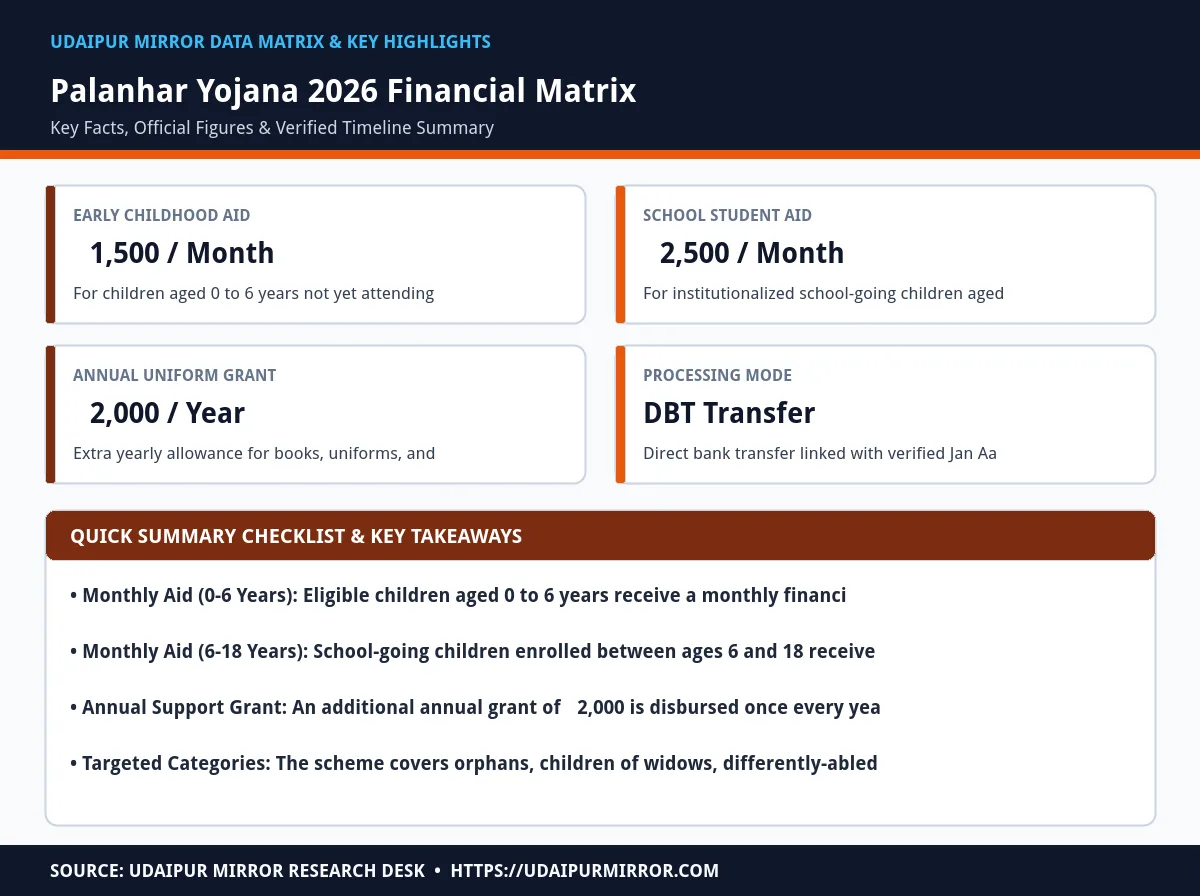
The Rajasthan government structures financial aid under the Palanhar scheme based on the age of the child, educational enrollment status, and specific vulnerable category definitions. Review the table below for a detailed overview of monthly allowances and annual grants.
| Beneficiary Age Group | Monthly Financial Aid | Annual Uniform/Book Allowance | Mandatory Condition | Target Category |
|---|---|---|---|---|
| 0 to 6 Years | ₹1,500 per month | Not Applicable | Anganwadi registration / Home care | Orphans, Widows’ children, Special cases |
| 6 to 18 Years | ₹2,500 per month | ₹2,000 per year | Regular school admission & attendance | Orphans, Widows’ children, Special cases |
| Differently-Abled Parents | ₹1,500 / ₹2,500 | ₹2,000 per year | Medical disability certificate verification | Children of physically challenged parents |
| HIV / Leprosy Patients | ₹1,500 / ₹2,500 | ₹2,000 per year | Medical board health certificate | Children of affected parents |
| Widow Remarriage Cases | ₹1,500 / ₹2,500 | ₹2,000 per year | Valid remarriage and custody records | Children of destitute widows |
To qualify for financial assistance under the scheme, applicants must satisfy strict criteria established by the Rajasthan government. The scheme primarily targets children who belong to economically disadvantaged backgrounds and fit into specific vulnerability umbrellas defined by the state administration.
The eligible beneficiary groups include absolute orphans, children of registered widows, children whose parents are suffering from terminal illnesses like HIV/AIDS or Leprosy, children of differently-abled parents, and daughters of destitute divorcee or deserted women. Additionally, income ceilings apply to ensure that benefits reach families genuinely in need of state intervention.
“Strict verification protocols guarantee that financial assistance reaches every eligible orphan and widow's child without administrative delays.” — District Social Welfare Officer
The financial architecture of the scheme is divided into two distinct age brackets to cater to developmental and educational expenses accurately. Children between the ages of 0 and 6 years—who are not yet school-going—are allocated a monthly stipend of ₹1,500 to support early childhood nutrition and care.
For children aged between 6 and 18 years who are formally enrolled in educational institutions, the monthly financial support increases to ₹2,500. Furthermore, an additional lump-sum annual allowance of ₹2,000 is credited once every year to cover essential expenses like school uniforms, sweaters, shoes, school bags, and textbooks. (Also read: Election Commission Restores Oversight of IT Chief in Major Administrative U-Turn).
“The ₹2,000 annual uniform and book allowance acts as vital financial relief for guardians at the beginning of every academic session.” — State Welfare Directorate
A critical mandate for sustaining financial aid for children aged 6 to 18 years is regular school admission and attendance verification. Guardians must submit verified school enrollment certificates or attendance logs issued by the headmaster or principal of the recognized educational institution every academic year.
Failure to update school verification documents on the SJED portal can result in the temporary suspension of monthly disbursements. The department cross-verifies school records digitally to curb fraudulent claims and ensure active educational engagement for every beneficiary child.
“School attendance verification is compulsory. Educational tracking ensures that government funds effectively translate into student retention and academic success.” — District Education Officer
Eligible citizens can apply for the scheme conveniently through online channels without visiting government offices repeatedly. Applications can be submitted directly through the official SJED Rajasthan portal, RajSSO login, or via nearest e-Mitra kiosks operating across urban and rural districts.
Applicants must keep necessary paperwork ready, including the child’s birth certificate, death certificate of parents (if applicable), widow pension PPO (if applicable), medical board certificates (for disability or terminal illness), bank passbook seeded with Aadhaar, and the family Jan Aadhaar card.
“Digital integration via e-Mitra and SJED portals has simplified application submissions, making welfare outreach faster and completely transparent.” — e-Mitra Project Directorate
Children aged 0 to 6 years receive ₹1,500 per month, while school-going children aged 6 to 18 years receive ₹2,500 per month.
Yes, an annual grant of ₹2,000 is provided once every year to school-going children aged 6 to 18 years for uniforms, books, and stationery.
Eligible categories include orphans, children of widows, children of parents living with HIV/AIDS or Leprosy, children of differently-abled parents, and daughters of destitute divorcee women.
Guardians can apply online through the official SJED Rajasthan portal, RajSSO login, or by visiting any authorized e-Mitra kiosk with necessary documents and Jan Aadhaar details.
Add Udaipur Mirror as a preferred source on Google to see more of our travel guides in your AI overviews.