Office Address
14, Residency Road, Udaipur, Rajasthan 313001
Office Address
14, Residency Road, Udaipur, Rajasthan 313001

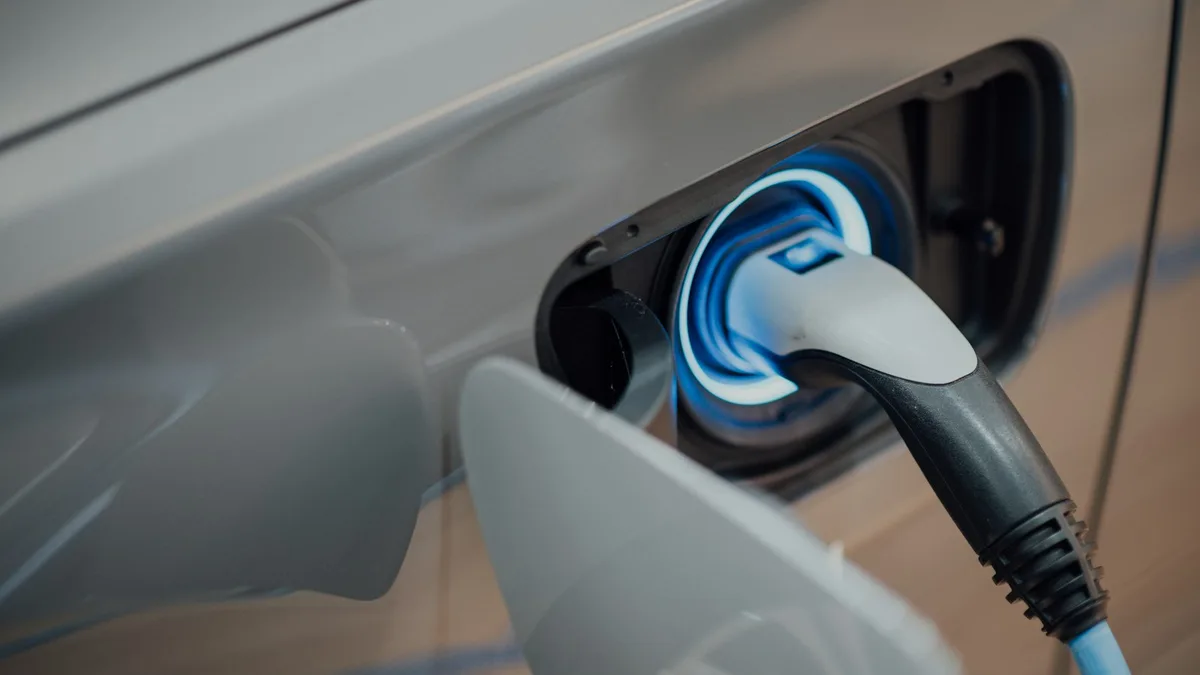
NEW DELHI / UDAipur: NEW DELHI / UDAIPUR — The Indian passenger vehicle market is gearing up for a monumental shift as automakers accelerate their battery-powered lineups. Over the coming twelve months, 10 new electric cars launching across various price segments are set to hit dealership floors, promising enhanced driving ranges, faster charging infrastructure compatibility, and cutting-edge digital cockpits. Industry analysts note that festive season momentum and surging urban demand have created an ideal window for these upcoming zero-emission rollouts.
⚡ Quick Highlights: 10 New Electric Cars Launching in India Over Next 1 Year
The transition toward sustainable transport has officially crossed the tipping point in India. With recent data from the Federation of Automobile Dealers Associations (FADA) highlighting record-breaking registrations across all four electric vehicle segments in October, manufacturers are wasting no time expanding their portfolios. The announcement of 10 new electric cars launching over the next year underscores a decisive pivot by legacy automakers and EV specialists alike to capture early market dominance.
Policy incentives, expanding highway charging corridors, and lowering battery production costs have collectively dissolved range anxiety for the average car buyer. Transport experts frequently emphasize that reducing pollution will be biggest challenge in future urban planning, making passenger vehicle electrification an imperative rather than an optional corporate strategy. Consequently, brands are introducing models tailored precisely to Indian driving conditions, incorporating robust thermal management systems to withstand peak summer temperatures in regions like Rajasthan.
“Electric vehicle adoption in India is no longer an urban niche; it is a nationwide movement backed by infrastructure and robust consumer demand.” — Automotive Industry Analyst
The following comparative table details the expected battery options, estimated driving ranges, and launch timelines for the upcoming electric vehicles heading to Indian showrooms.
| Model Name | Estimated Battery Pack | Target Driving Range | Expected Launch Window |
|---|---|---|---|
| Hyundai IONIQ P | 73.0 kWh – 84.0 kWh | Up to 650 Km | Mid 2027 |
| BYD Seal 07 | 82.5 kWh Blade Battery | 570 Km – 650 Km | Early 2027 |
| Tata Mass-Market EV | 40.2 kWh Pack | 465 Km | Late 2026 / Early 2027 |
| Mahindra Born Electric SUV | 60.0 kWh – 79.0 kWh | 500 Km+ | Q1 2027 |
| Upcoming MG S5 EV | 50.0 kWh Pack | 430 Km | Early 2027 |
Diversity defines this upcoming wave of electric vehicles. While budget-conscious buyers look forward to sub-six-lakh city runabouts offering practical daily ranges, luxury enthusiasts have plenty to celebrate as premium marques expand their electric footprints. Models like the Hyundai IONIQ variants and the aerodynamic BYD Seal 07 demonstrate that international platforms are being calibrated specifically for Indian tarmac, ride comfort, and ground clearance requirements.
Concurrently, traditional internal combustion engine stalwarts are receiving electric makeovers or running parallel green architectures. For instance, while brands push battery-electric platforms, enthusiasts eagerly monitor parallel updates like the Volkswagen Virtus facelift to gauge broader design trends influencing modern automotive styling across segments.
“The breadth of choices arriving in showrooms over the next year means consumers can find an EV for every budget and utility need.” — Senior Automotive Journalist
One of the defining characteristics of the vehicles on this upcoming roster is the leap in battery chemistry and energy density. Lithium-iron-phosphate (LFP) blade batteries and nickel-manganese-cobalt (NMC) cells are pushing real-world driving ranges comfortably past the 400-kilometer mark, even on entry-level mid-size models. Furthermore, architecture voltages are shifting toward 800V systems in premium segments, allowing for lightning-fast replenishments at DC fast-charging stations.
Buyers evaluating these choices can also look at benchmarks set by luxury segment leaders. For context on high-end range capabilities and charging perks, industry watchers often reference milestones like the Mercedes-Benz GLC Electric debut in India, which set new standards for luxury EV ownership packages and complimentary charging inclusions.
“Range anxiety is rapidly fading into history as next-generation battery management systems extract maximum efficiency from every watt-hour.” — EV Powertrain Engineer
While ex-showroom pricing dictates initial headlines, the true cost of ownership is heavily influenced by state-level policies. In Rajasthan, prospective buyers of these upcoming electric vehicles benefit significantly from state EV policies that waive road tax entirely and offer simplified financing options through major nationalized and private banks. These financial buffers make higher-variant trims considerably more accessible to middle-class and upper-middle-class households in cities like Jaipur, Udaipur, Jodhpur, and Kota.
Dealership networks across the region are aggressively upgrading their service bays, installing heavy-duty high-voltage chargers on-site, and training specialized technicians to handle high-voltage electrical architecture safely. As these ten new models roll out sequentially, dealerships expect waiting periods to stabilize as local supply chains mature throughout 2027.
“State-level road tax exemptions in Rajasthan are the single biggest catalyst converting traditional fuel vehicle buyers into EV owners.” — Automotive Retail Association President
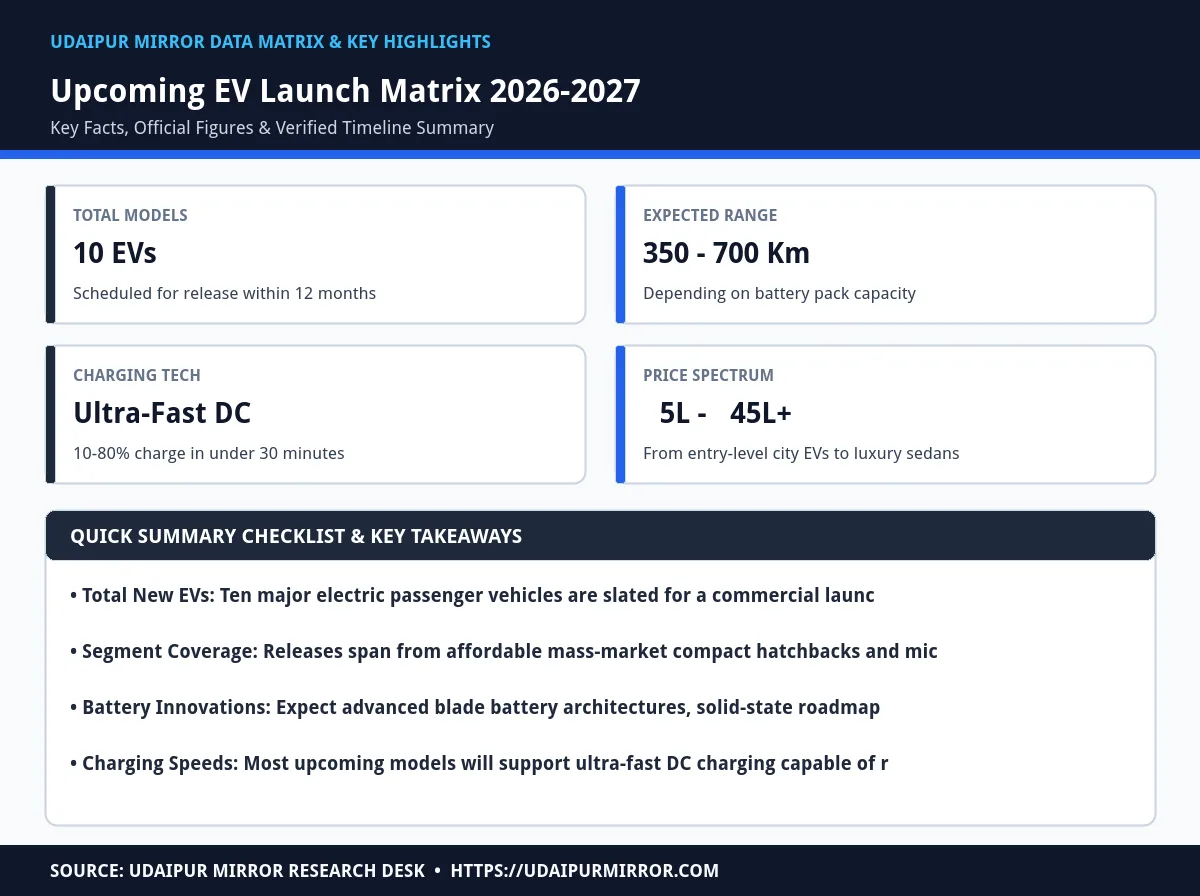
A total of 10 major new electric passenger vehicles are officially slated for launch across India within the next 12 months, spanning budget, mid-size, and luxury segments.
Depending on the battery pack size and vehicle segment, the expected real-world driving range varies from approximately 350 kilometers for compact city EVs up to 650+ kilometers for executive sedans and SUVs.
Yes, buyers in Rajasthan benefit from 100% road tax waivers and registration fee exemptions on battery electric vehicles, significantly reducing the on-road price.
Most of these upcoming models will support DC fast charging, allowing drivers to replenish their battery packs from 10% to 80% in under 30 minutes at compatible charging stations.
Add Udaipur Mirror as a preferred source on Google to see more of our travel guides in your AI overviews.