Office Address
14, Residency Road, Udaipur, Rajasthan 313001
Office Address
14, Residency Road, Udaipur, Rajasthan 313001


UDAIPUR: Udaipur — As Dalal Street scales new heights in late 2026, retail investors are increasingly looking toward high-beta equities for accelerated wealth creation. However, entering this volatile segment requires rigorous risk management, especially when setting up a disciplined small-cap mutual funds sip. Elevated price-to-earnings multiples across the broader market necessitate a cautious, automated approach rather than aggressive lump-sum deployments.
⚡ Quick Highlights: Small-Cap Mutual Funds SIP Strategy 2026: Risks & Horizon Rules
The small-cap segment of the Indian stock market has witnessed robust capital inflows over recent years. While strong domestic liquidity has driven earnings growth for many emerging businesses, aggregate valuation multiples have stretched significantly above historical median levels. Investors entering this space must recognize that high P/E ratios leave little margin for operational disappointment.
When corporate earnings fail to keep pace with soaring stock prices, valuation compression can trigger sharp corrections. For local investors planning weekend financial reviews, balancing aggressive equity bets with stable assets—much like checking serene evening getaways such as the Dudh Talai Lake & Musical Garden Udaipur Guide 2026 for peace of mind—is critical for emotional and financial stability.
“In small-caps, valuation is your primary safety buffer. Overpaying for high growth during market exuberance severely restricts future alpha generation.” — Senior Portfolio Analyst, Dalal Street
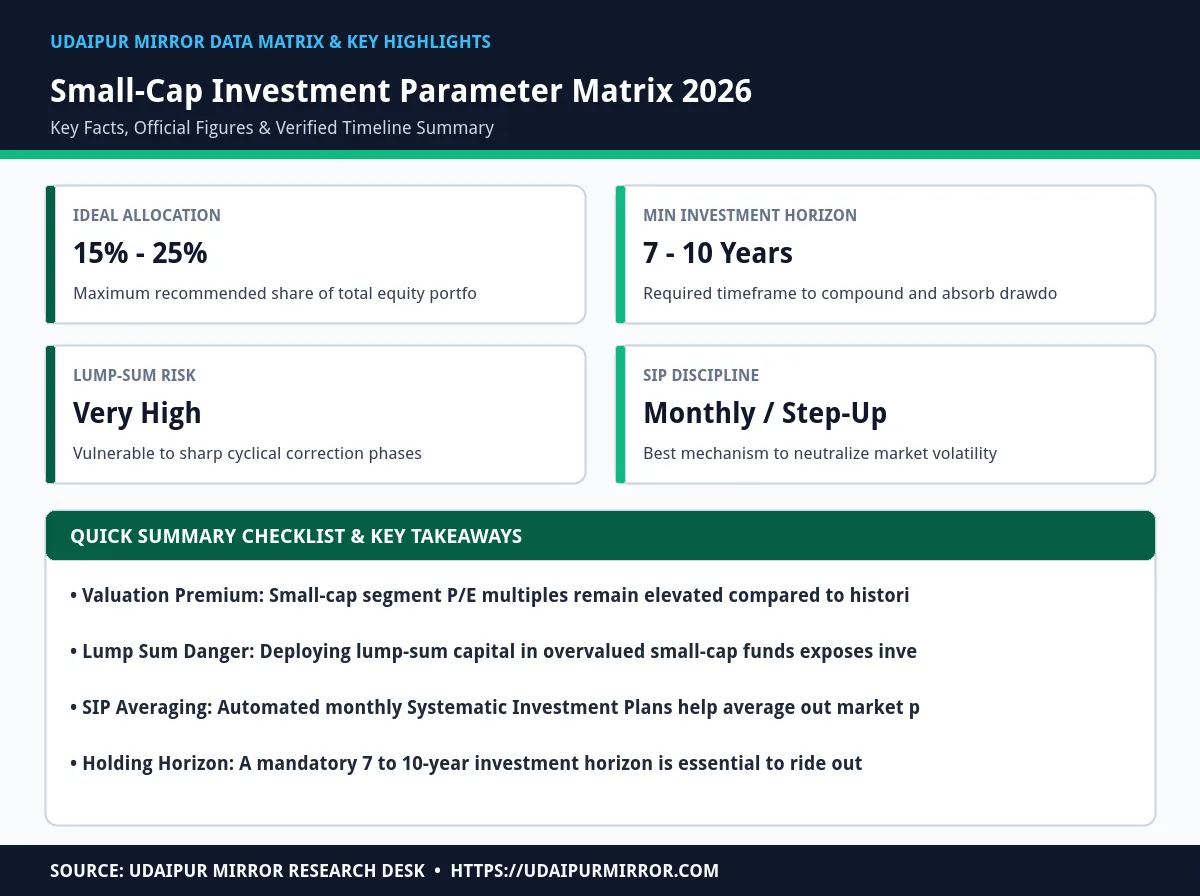
Evaluating asset class characteristics helps investors determine the right percentage of high-beta exposure suitable for their risk appetite and financial goals in FY 2026-27.
| Market Segment | Typical P/E Multiple | Volatility Level | Recommended Horizon | Suggested Portfolio Weight |
|---|---|---|---|---|
| Large-Cap Funds | Moderate (22x – 26x) | Low to Moderate | 3 to 5 Years | 50% – 60% |
| Mid-Cap Funds | Elevated (28x – 34x) | Moderate to High | 5 to 7 Years | 20% – 30% |
| Small-Cap Funds | High / Extended (35x+) | Very High | 7 to 10+ Years | 15% – 25% |
| Flexi-Cap Funds | Dynamic (24x – 28x) | Moderate | 5+ Years | As Core Holding |
Deploying a large lump sum of capital into small-cap mutual funds during market peaks is a high-stakes gamble. Because small-cap stocks possess lower daily trading volumes and higher beta coefficients, any macroeconomic shock or foreign institutional investor (FII) outflow can lead to disproportionate price drops.
A lump-sum deployment leaves zero room for cost averaging. If the market corrects by 20% to 30% immediately after your investment, recovering the principal can take several quarters, testing the patience of even seasoned investors. Therefore, phasing your capital entry remains the gold standard for navigating this asset class.
“Lump-sum investing in overvalued high-beta segments turns long-term compounding into an uphill recovery battle.” — Chief Wealth Strategist
Systematic Investment Plans (SIPs) act as a natural antidote to market volatility. By allocating a fixed amount every month, investors automatically buy fewer units when prices are high and more units when the market corrects. This rupee-cost averaging mechanism eliminates emotional decision-making.
Furthermore, implementing an annual ‘Step-Up SIP’—where you increase your monthly contribution by 10% to 15% every year—helps match your growing salary and combats inflationary pressures. For those tracking broader economic momentum, entrepreneurial funding trends like those outlined in the From GIVA To EloElo Group — Indian Startups Raised $255 Mn This Week report highlight how private capital fuels ecosystem expansion that eventually trickles down to public markets.
“Discipline beats timing every single time in equity investing. Automated SIPs turn market volatility into your greatest ally.” — Personal Finance Expert
Small-cap funds are not meant for short-term parking of funds or milestone goals maturing within 2 to 3 years. Because small businesses take time to scale operations, expand distribution networks, and mature into mid-cap leaders, a mandatory investment horizon of 7 to 10 years is non-negotiable.
Additionally, prudent asset allocation dictates that small-cap exposure should be strictly capped between 15% and 25% of your total equity portfolio, depending on your risk tolerance. The remaining core should be anchored in large-cap, flexi-cap, or index funds to provide ballast during stormy market phases.
“Time in the market always trumps timing the market, especially when dealing with high-growth emerging enterprises.” — Equity Research Head
Financial advisors recommend capping small-cap exposure to 15% to 25% of your overall equity portfolio, keeping the core allocation in large-cap or flexi-cap funds to cushion against volatility.
Due to elevated P/E valuation multiples across the small-cap segment, lump-sum investments made near market peaks carry high downside risk and vulnerability to sharp cyclical corrections.
A mandatory investment horizon of 7 to 10 years is required to allow emerging businesses to scale, absorb short-term market drawdowns, and generate meaningful long-term alpha.
A Step-Up SIP allows you to automatically increase your monthly contribution every year, neutralizing inflation, boosting your compounding rate, and accumulating more units during market dips.
Add Udaipur Mirror as a preferred source on Google to see more of our travel guides in your AI overviews.






[…] Temple Nikumbh Guide 2026: Faith Healing Heritage, Baori & Darshan Timings 4 seconds ago ⚡ Articles Small-Cap Mutual Funds SIP Strategy 2026: Valuation Multiples, Correction Risks & Hori… Articles Dudh Talai Lake & Musical Garden Udaipur Guide 2026: Boating, Rock Garden, Sunset […]