Office Address
14, Residency Road, Udaipur, Rajasthan 313001
Office Address
14, Residency Road, Udaipur, Rajasthan 313001


NEW DELHI / MUMBAI: Global supply chain logistics are facing renewed scrutiny as macroeconomic developments shape international trade routes. Addressing industry stakeholders, DP World’s Chief Operating Officer has noted that ocean freight rates will come down eventually, drawing parallels from past shipping cycles and historical market behavior. This commentary arrives at a critical juncture for international investors and Indian manufacturers navigating volatile freight costs, energy markets, and shifting monetary policies across global central banks.
⚡ Quick Highlights: DP World COO: Ocean Freight Rates Will Come Down Eventually
As international commerce undergoes structural adaptations, commentary from logistics leaders provides essential guidance for corporate treasurers and supply chain planners. The recent observations from DP World highlight a pragmatic view on container shipping economics. While geopolitical tensions and regional maritime bottlenecks have periodically inflated transport expenditures, market fundamentals invariably reassert themselves through capacity adjustments and vessel deployments.
For domestic enterprises, understanding these global shifts is as crucial as monitoring domestic retail transformations, such as the digital changes highlighted in studies on how artificial intelligence is transforming the retail industry at Great India Retail Summit. When logistics costs moderate, retail margins expand, providing a healthier cushion against external inflationary pressures.
“Ocean freight rates will come down eventually, we have seen this before. Markets always find an equilibrium when capacity matches demand.” — DP World Chief Operating Officer
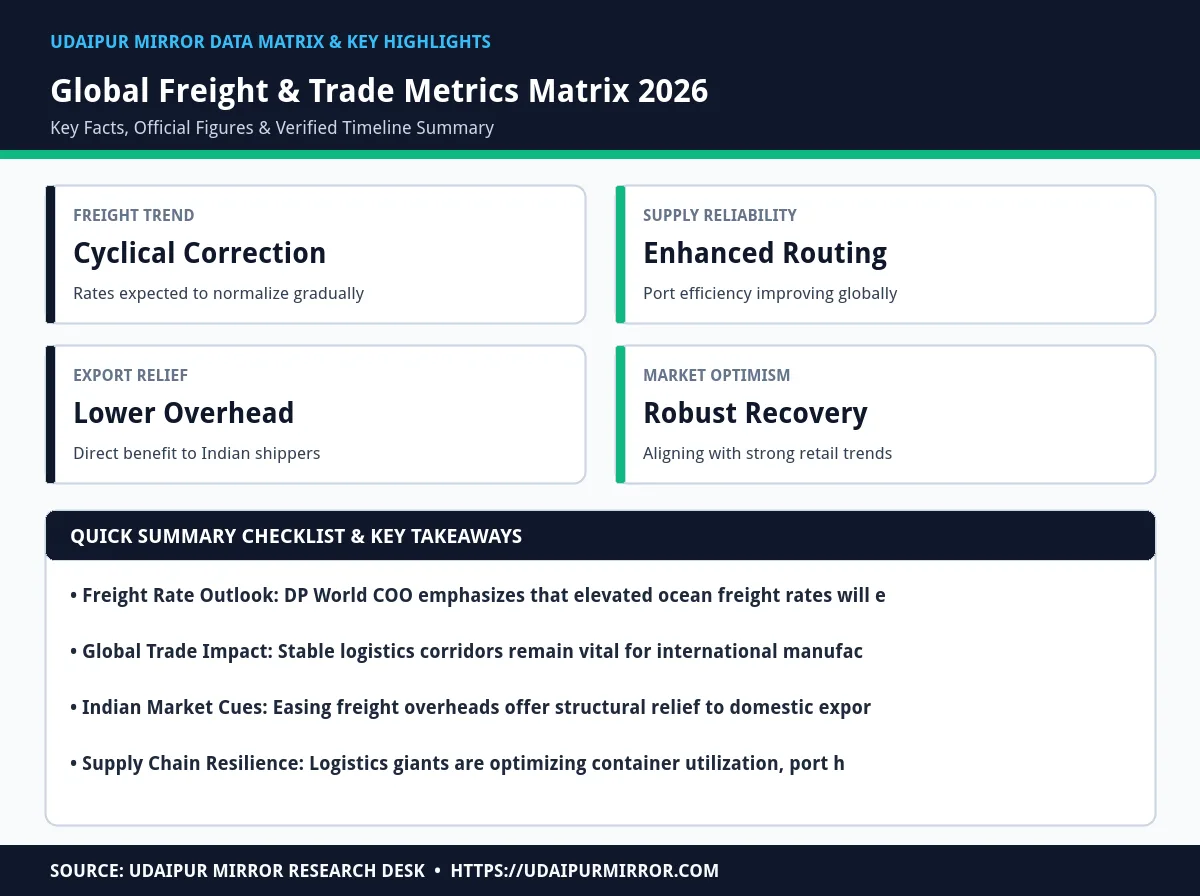
The following comparative overview outlines recent movements across major international shipping corridors, container availability indexes, and projected cost adjustments for the upcoming quarters of FY 2026-27.
| Shipping Route | Primary Index Benchmark | Quarterly Trend | Expected Normalization |
|---|---|---|---|
| Asia to North America | Drewry WCI Composite | Moderate Stabilization | Q2 2027 |
| Asia to Europe | SCFI Spot Freight Rate | Flattening Curve | Q1-Q2 2027 |
| Middle East to India | Regional Feeders Index | Stable Chokepoints | Immediate |
| Transatlantic Trade | FBX Global Container Index | Marginal Retracement | Q3 2027 |
| Domestic Coastal Shipping | ISMA Freight Metrics | Consistent Growth | Active Now |
India’s export sector, spanning engineering goods, textiles, and specialty chemicals, stands to gain substantially from stabilizing logistics expenses. High shipping overheads have historically compressed operating margins for export-oriented units. A predictable downward trajectory in ocean freight rates will enhance price competitiveness in Western markets, counterbalancing currency fluctuations and raw material price volatility.
Furthermore, capital markets are closely monitoring these developments alongside corporate financing milestones, including tech listings like those analyzed in discussions surrounding the Razorpay IPO issue size valuation reverse flip listing details. Macroeconomic stability across trade routes directly feeds into corporate profitability and investor sentiment on Dalal Street.
“Logistics normalization acts as an invisible stimulus for emerging market exporters, lowering landed costs and boosting international demand.” — Senior Macroeconomic Strategist
Beyond maritime logistics, global investors remain hyper-focused on central bank liquidity actions, crude oil benchmarks, and geopolitical outcomes. Recent policy discussions from institutions like the US Federal Reserve, coupled with political shifts in Western economies, continue to dictate risk-on and risk-off sentiment. Brent crude and international gold rates have experienced fluctuating momentum, testing portfolio allocations across institutional funds.
For Indian investors, aligning portfolio strategies with global macroeconomic indicators ensures resilience against sudden capital outflows. As supply chains regain predictability and logistics bottlenecks dissolve, domestic markets are well-positioned to sustain their structural growth trajectory through the remainder of fiscal year 2026-27. (Also read: Diwali Rally Delivers Best Market Performance in Six Years, Investors Richer by Rs 30 Lakh Crore).
“The synchronization of easing freight rates and stable central bank policies creates a highly favorable backdrop for risk assets.” — Global Markets Analyst
The DP World COO stated that ocean freight rates will come down eventually, noting that historical market cycles consistently show a return to equilibrium as shipping capacity catches up with demand.
Lower ocean freight rates reduce landed costs for international buyers, improve operating margins for Indian export-oriented units, and enhance price competitiveness in global markets.
Historical cycles demonstrate that periods of high freight rates stimulate new vessel investments and operational efficiencies, which naturally drive down transport costs over time.
Stabilizing freight rates helps eliminate imported cost pressures, contributing to lower input expenses for manufacturers and easing retail inflation over the medium term.
Add Udaipur Mirror as a preferred source on Google to see more of our travel guides in your AI overviews.