Office Address
14, Residency Road, Udaipur, Rajasthan 313001
Office Address
14, Residency Road, Udaipur, Rajasthan 313001

UDAIPUR: Udaipur and the broader Mewar region are experiencing an unseasonal spell of warmth as rajasthan weather winter chill weakens significantly heading into the second week of November 2026. Meteorological charts indicate that surface winds and lingering atmospheric moisture have kept minimum temperatures several notches above normal, delaying the arrival of crisp winter conditions that residents typically witness at this time of the year. While early mornings still retain a faint touch of mist around Fatehsagar and Lake Pichola, the afternoon sun remains sharp, driving maximum temperatures higher across Udaipur, Chittorgarh, and Banswara.
⚡ Quick Highlights: Rajasthan Weather: Winter Chill Weakens & Mercury Stays High
The current atmospheric setup across northwestern India is defined by a sluggish transition phase between the retreating monsoon circulation and the establishment of stable winter anticyclones. Meteorological experts explain that the absence of active Western Disturbances over the higher Himalayan latitudes has prevented the influx of cold, dry winds from descending into the plains of Rajasthan. Consequently, heat retention in the lower troposphere continues to keep the mercury elevated. Sports enthusiasts following regional events noted similar disruptions recently, much like how the IND vs NZ 3rd ODI Abandoned Due to Rain as India Retains 2-0 Series Lead highlighted unexpected meteorological interventions in sporting schedules.
Furthermore, surface soil moisture remaining from late monsoon spells has contributed to higher daytime humidity, trapping terrestrial radiation during nighttime hours. This dynamic explains why minimum temperatures in Udaipur and surrounding districts have refused to drop below the 16-degree mark, disappointing residents who look forward to the brisk November evenings characteristic of Mewar winters. (Also read: RSSB Rajasthan Contractual Teaching Associate (Raj-CES) 2026: Detailed Advertisement).
“The persistent warmth across southern Rajasthan is primarily driven by weak northwesterly airflow and delayed upper-air troughs.” — Regional Meteorological Centre Analyst
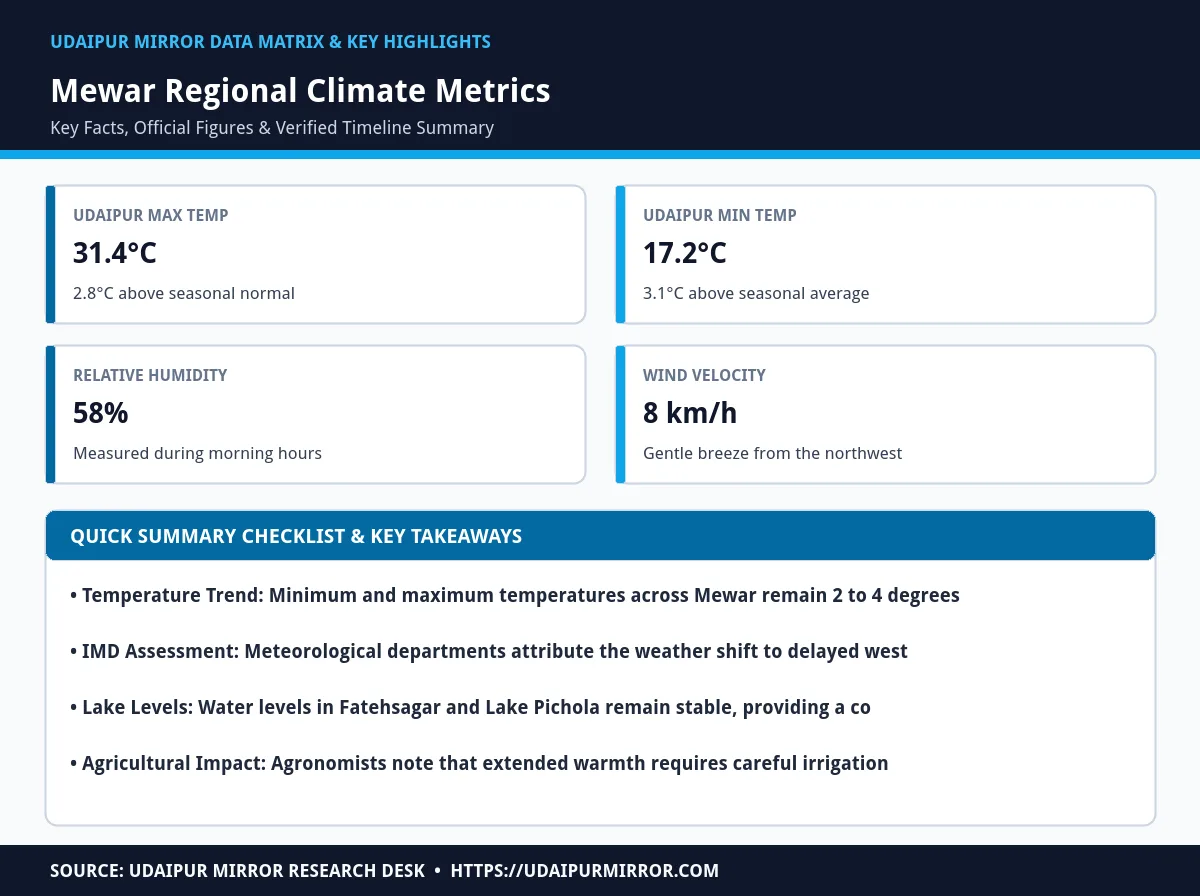
Review the detailed 5-day meteorological outlook for Udaipur division, featuring projected day-night temperature bands, humidity percentages, and current water gauge benchmarks for major local water bodies as of November 10, 2026. While studying regional educational updates, candidates may also review the RSSB Rajasthan Contractual Teaching Associate (Raj-CES) 2026: Detailed Advertisement for upcoming job opportunities.
| Date | Max Temp | Min Temp | Humidity | Lake Gauge (Pichola) |
|---|---|---|---|---|
| Tue, Nov 10 | 31.4°C | 17.2°C | 58% | 31.2 ft |
| Wed, Nov 11 | 31.0°C | 16.8°C | 60% | 31.2 ft |
| Thu, Nov 12 | 30.5°C | 16.5°C | 62% | 31.1 ft |
| Fri, Nov 13 | 30.2°C | 16.0°C | 59% | 31.1 ft |
| Sat, Nov 14 | 29.8°C | 15.7°C | 55% | 31.0 ft |
While urban residents notice the delay in winter garments, the agricultural sector in the Mewar belt is closely monitoring these temperature anomalies. Farmers preparing fields for wheat, mustard, and other rabi crops are advised to adjust irrigation schedules to protect young saplings from unseasonal midday thermal stress. Horticultural crops, including citrus orchards around Mavli and Vallabhnagar, require balanced watering to cope with the prolonged daytime heat.
On the ecological front, Udaipur’s iconic lakes—including Fatehsagar, Lake Pichola, and Badi Lake—maintain robust water tables following a bountiful monsoon season. The stable water volume acts as a natural thermal buffer, moderating lakeside microclimates even as inland areas experience higher daytime temperatures. Cultural observers note that traditions such as the Udaipur Observes 40-Year-Old Govardhan Tradition: 12-Foot Cow Dung Mountain and Cattle Run Spark Public Debate took place amidst similarly mild seasonal weather conditions earlier this festival season.
“Our lake ecosystems are stable, and current water levels provide an effective thermal buffer against sharp diurnal temperature swings.” — Water Resources Department Official, Udaipur
The climatic shift in Rajasthan is part of a larger, pan-India weather pattern. Neighboring states are witnessing distinct meteorological shifts, with recent advisories warning of unseasonal storms and weather disturbances spanning across 15 states. While Rajasthan remains largely dry with clear skies, adjacent regions in central and northern India are experiencing variable cloud cover and sudden wind patterns.
Meteorologists anticipate that true winter chill will make a gradual entry into Rajasthan only by the third week of November, once upper-air cyclonic circulations establish a clear pathway for Himalayan winds to sweep down the Aravalli range. Until then, tourists visiting Udaipur can enjoy pleasant daytime sightseeing without the biting cold of peak winter. (Also read: IND vs NZ 3rd ODI Abandoned Due to Rain as India Retains 2-0 Series Lead).
“A noticeable drop in night temperatures is expected across Rajasthan once active western disturbances impact northern mountain ranges later this month.” — IMD Jaipur Directorate
The delay is primarily caused by weak northwesterly winds, an absence of active Western Disturbances in the northern latitudes, and residual soil moisture trapping heat during nighttime hours.
As of November 10, 2026, maximum temperatures hover around 31°C while minimum temperatures stay near 17°C, both remaining 2 to 4 degrees above normal.
Lake water levels remain highly stable, with Lake Pichola gauging steady at 31.2 feet, providing a natural thermal buffer for the city.
Meteorological models suggest that genuine winter chill will likely set in across Rajasthan by the third week of November as upper-air weather patterns shift.
Add Udaipur Mirror as a preferred source on Google to see more of our travel guides in your AI overviews.