Office Address
14, Residency Road, Udaipur, Rajasthan 313001
Office Address
14, Residency Road, Udaipur, Rajasthan 313001


MUMBAI / UDAIPUR: MUMBAI / UDAIPUR — Indian equity benchmarks witnessed aggressive selling pressure on Tuesday as global macroeconomic headwinds and institutional capital outflows triggered a severe correction. For retail investors navigating turbulent market cycles, having a clear sensex crash survival guide is no longer optional—it is an absolute necessity to safeguard hard-earned capital while positioning portfolios for long-term compounding. Rather than succumbing to panic-driven liquidations, financial advisors recommend focusing on asset allocation, disciplined systematic investment plans (SIPs), and strategic tax-saving actions to turn market volatility into an accumulation opportunity.
⚡ Quick Highlights: Sensex Crash Survival Guide: 10 Ways to Protect Your Savings
Market downturns are an inevitable part of economic cycles. When major indices like the BSE Sensex experience a sudden correction, retail investors often feel the psychological urge to exit their positions to prevent further erosion of capital. However, seasoned wealth managers emphasize that panicking during a sell-off locks in notional losses and disrupts the compounding engine. Understanding that volatility is the price of admission for higher equity returns helps maintain emotional composure.
As economic landscapes shift globally, external pressures frequently spill over into domestic markets, leading to sudden liquidity crunches and Foreign Institutional Investor (FII) outflows. During such phases, studying macroeconomic trends becomes vital, much like analyzing how broader shifts impact industrial sectors or regional economies such as India’s emissions and economic trade-offs. Staying grounded in fundamental investing principles ensures that short-term market noise does not derail your long-term financial goals.
“The stock market is a device for transferring money from the impatient to the patient. A correction is simply a clearance sale on quality businesses.” — Senior Wealth Strategist
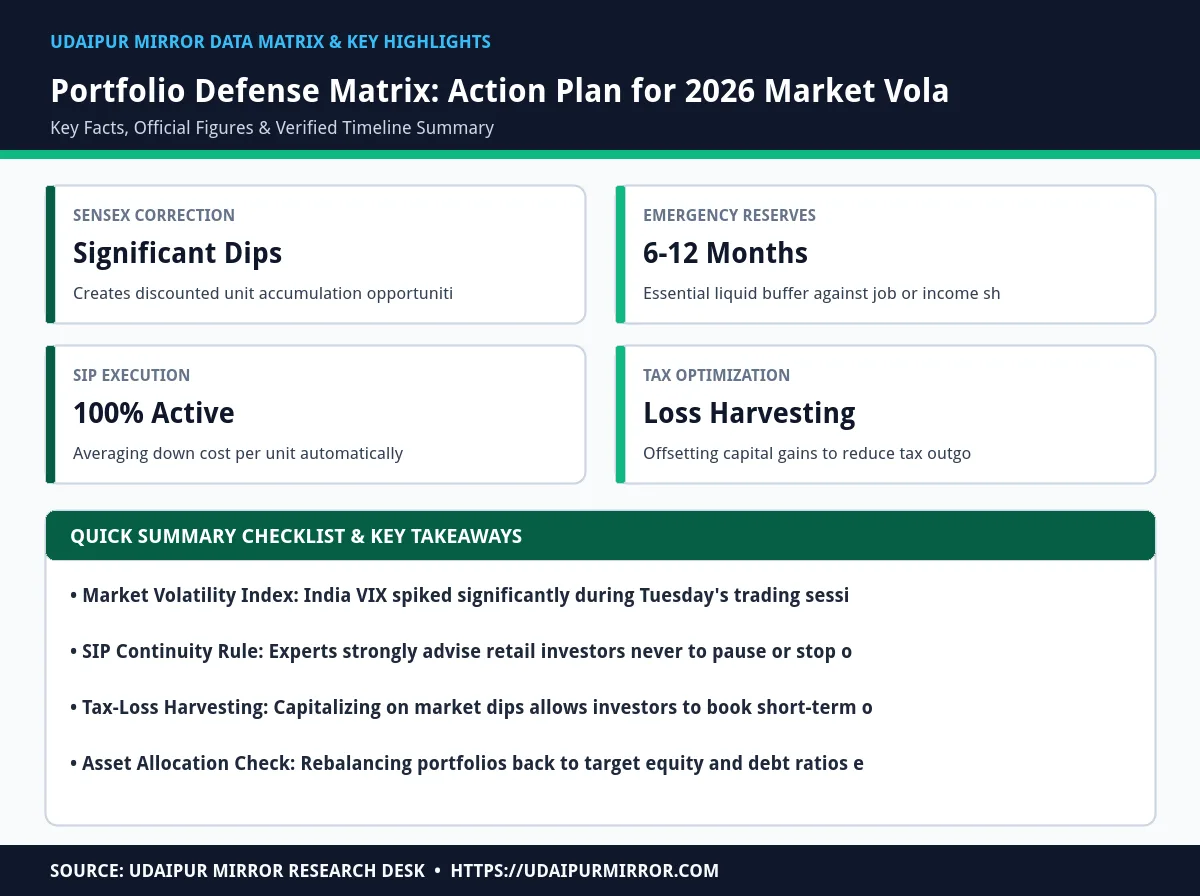
When benchmarks drop sharply, different asset classes react differently. Use this structured reference table to understand how to handle each component of your personal finance portfolio during the November 2026 downturn, balancing risk mitigation with opportunistic buying.
| Asset Class | Immediate Action | Strategy Rationale | Tax Implication (FY 2026-27) |
|---|---|---|---|
| Equity Mutual Funds | Continue SIPs / Top-up | Lower Net Asset Values (NAVs) enable higher unit accumulation for long-term wealth creation. | LTCG above ₹1.25L taxed at 12.5%; STCG taxed at 20%. |
| ELSS Tax Savers | Strategic Allocation | Combines Section 80C tax-saving benefits with equity exposure at attractive valuations. | 3-year lock-in applies; LTCG rules apply upon redemption. |
| Debt Instruments | Hold & Rebalance | Provides portfolio stability and acts as dry powder for future equity rebalancing. | Taxed as per individual income tax slab rates. |
| Gold & SGBs | Maintain Core Allocation | Acts as a traditional hedge against currency depreciation and geopolitical instability. | Capital gains on maturity of SGBs remain tax-free. |
| Emergency Funds | Keep in Liquid/Arbitrage | Ensures immediate liquidity without incurring exit loads or distress selling. | Short-term debt fund taxation rules apply. |
Implementing a structured action plan during market turbulence can safeguard your financial health and optimize your tax liabilities. The following ten moves form the core of this sensex crash survival guide for retail investors in November 2026.
First, never stop your Systematic Investment Plans (SIPs). Market crashes mean your fixed monthly installment purchases more units at lower prices, boosting your future XIRR. Second, review your emergency fund to ensure you have at least six months of living expenses parked safely in liquid instruments. Third, practice tax-loss harvesting by booking capital losses in underperforming assets to offset realized gains, thereby lowering your overall tax outgo. Fourth, rebalance your asset allocation if equity exposure has drifted significantly from your target weight. Fifth, avoid taking high-interest unsecured loans or leveraging positions to buy the dip. Sixth, prioritize quality large-cap and flexi-cap funds over speculative small-cap stocks facing severe FII sell-offs. Seventh, maximize your Section 80C deductions using Equity Linked Savings Schemes (ELSS) at discounted valuations. Eighth, maintain a disciplined documentation trail for all financial transactions. Ninth, consult certified fee-only financial planners before making drastic portfolio alterations. Tenth, keep learning and expanding your financial literacy to stay resilient against future shocks, drawing parallel insights from diverse sectors such as strategic investments in emerging industries.
“Discipline in a bear market determines your wealth in the subsequent bull run.” — Chief Investment Officer
Market corrections present a unique window for smart tax planning. Under current tax regulations for FY 2026-27, long-term capital gains (LTCG) on equity mutual funds exceeding ₹1.25 lakh per financial year are taxed at 12.5%, while short-term capital gains (STCG) attract a 20% tax rate. By strategically booking losses in lagging funds, investors can offset taxable gains, thereby reducing their net tax liability.
Furthermore, investing in tax-saving ELSS funds during a market crash allows investors to lock in lower NAVs while claiming deductions under Section 80C. This dual benefit of tax savings and discounted equity accumulation makes market corrections an ideal period for annual tax planning reviews. (Also read: Kumbhalgarh Fort Day Trip from Udaipur Guide 2026: Great Wall of India, Light & Sound Show, Timings & Taxi Fare).
“Tax efficiency is as important as gross returns when building generational wealth.” — Taxation Expert
The hardest part of surviving a Sensex crash is psychological rather than financial. Watching portfolio values decline can trigger fight-or-flight responses, leading to impulsive decisions. Successful investors treat market crashes like scheduled maintenance—unpleasant to look at, but essential for long-term structural integrity.
To maintain mental peace, limit how frequently you check your portfolio tracking apps during high-volatility weeks. Focus instead on your career, income generation, and personal milestones. Wealth creation is a marathon, not a sprint, and temporary paper losses vanish once economic cycles complete their recovery phase.
“In investing, what is comfortable is rarely profitable.” — Behavioral Finance Researcher
No, you should never stop your SIPs during a market crash. A crash allows your fixed monthly installment to purchase more units at lower NAVs, which significantly boosts your long-term returns through rupee-cost averaging.
Tax-loss harvesting involves selling underperforming investments that are currently in a loss position to offset capital gains realized elsewhere in your portfolio. This reduces your overall tax liability for the financial year.
Financial experts recommend holding an emergency corpus equivalent to 6 to 12 months of essential living expenses in highly liquid instruments like liquid mutual funds or sweep-in fixed deposits, ensuring you never have to sell equities during a crash.
Yes, investing in Equity Linked Savings Schemes (ELSS) during a market correction allows you to secure Section 80C tax deductions while purchasing equity units at attractive, discounted valuations.
Add Udaipur Mirror as a preferred source on Google to see more of our travel guides in your AI overviews.






[…] IND vs NZ 3rd ODI Abandoned Due to Rain as India Retains 2-0 Series Lead 45 minutes ago ⚡ Articles Sensex crash survival guide: 10 moves to protect your savings, save tax and keep investing… Business Shortgun Games Secures Strategic Investment from Actor Mahesh Babu to Boost Indian Gaming […]