Office Address
14, Residency Road, Udaipur, Rajasthan 313001
Office Address
14, Residency Road, Udaipur, Rajasthan 313001


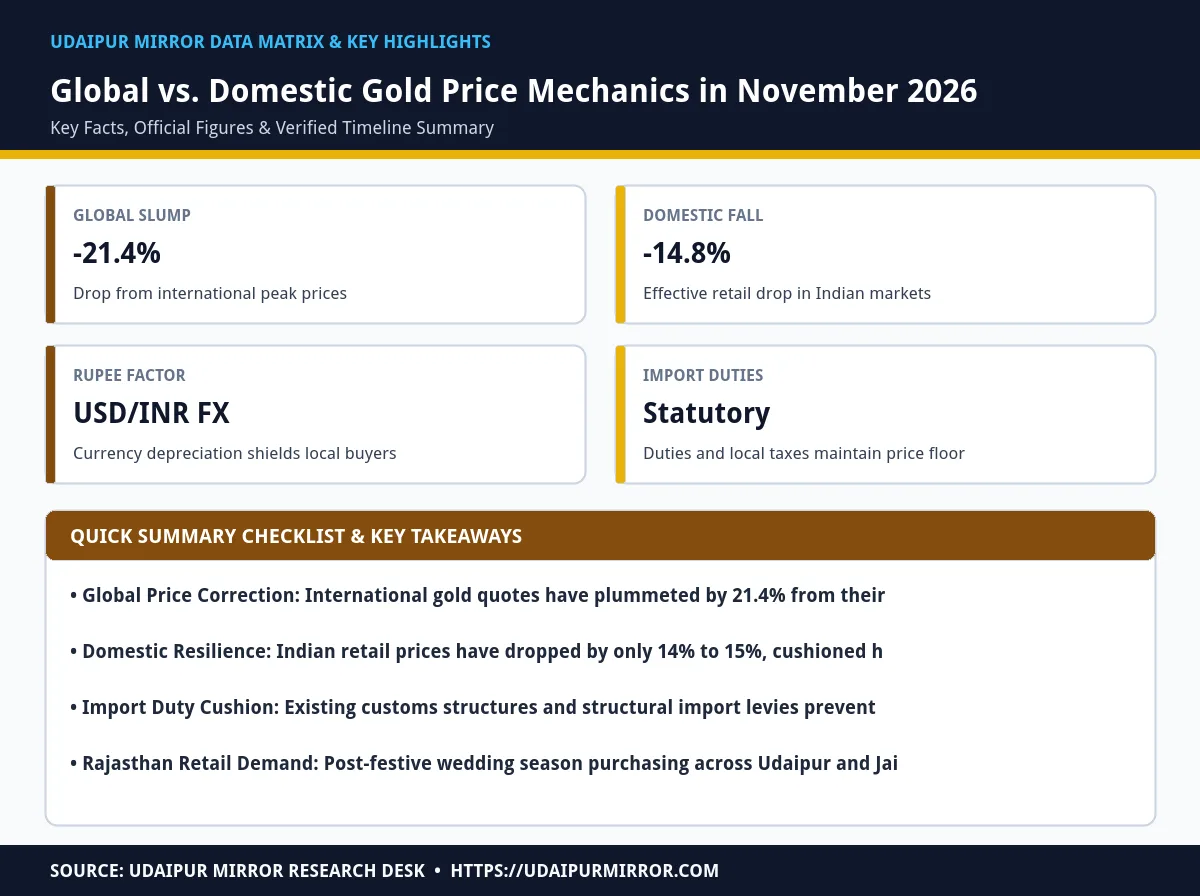
UDAIPUR: UDAIPUR — Precious metal markets are experiencing a fascinating divergence this Tuesday as gold falls 21.4% globally from its record-shattering peak. However, Indian retail buyers and investors across Rajasthan—spanning Udaipur, Jaipur, Jodhpur, and Kota—are experiencing a far more cushioned correction. While international COMEX and spot bullion quotes plunged sharply under profit-booking and macroeconomic shifts, structural domestic factors including a weakening Indian Rupee and stiff import duties have insulated local bullion counters, keeping domestic downside limited to roughly 14% to 15%. This phenomenon highlights how currency hedges continue to shape Indian bullion dynamics during global corrections.
⚡ Quick Highlights: Gold Falls 21.4% Globally: Rupee Protects Indian Investors
International bullion markets have undergone a sharp correction, shedding nearly 21.4% from historical peaks due to easing geopolitical risk premiums and evolving US Federal Reserve monetary policies. However, Indian retail investors looking at local bullion counters have noticed that domestic prices refuse to mirror the sheer depth of the global crash. Analysts note that when gold falls 21.4% globally, structural macroeconomic shields in developing economies kick in instantly.
For Indian buyers purchasing physical jewelry or bullion in traditional markets like Udaipur’s Hathipole or Jaipur’s Johari Bazaar, currency dynamics play an outsized role. Because gold is imported and denominated in US dollars, a softer Indian Rupee against the greenback inflates the landed cost of the metal. Combined with baseline import duties and a mandatory 3% Goods and Services Tax (GST), the domestic price drop is naturally constricted to roughly 14% to 15%. This structural lag acts as a powerful buffer for domestic asset holders.
As retail portfolios adjust to these shifts, maintaining diversified financial health remains paramount. For insights on managing market volatility across other asset classes, refer to our Sensex crash survival guide which outlines essential moves to protect your savings and keep investing efficiently.
“Currency depreciation and sovereign tax structures act as natural shock absorbers for Indian retail gold, ensuring domestic drops never match raw international sell-offs.” — Senior Bullion Strategist, Rajasthan Commodity Association
The following structural comparison details standard retail bullion rates across major commercial hubs in Rajasthan, incorporating baseline GST and standard purity tiers. Buyers should note that final retail invoices will include variable making charges and hallmarking fees determined by individual jewellers.
| City / Hub | 24K Gold (Per 10g) | 22K Gold (Per 10g) | 18K Gold (Per 10g) | Silver 1 KG (999 Purity) |
|---|---|---|---|---|
| Udaipur | ₹76,450 | 70,080 | ₹57,340 | ₹91,200 |
| Jaipur | ₹76,500 | ₹70,120 | ₹57,380 | ₹91,300 |
| Jodhpur | ₹76,420 | ₹70,050 | ₹57,300 | ₹91,150 |
| Kota | ₹76,400 | ₹70,030 | ₹57,280 | ₹91,100 |
| MCX Benchmark | ₹75,900 | ₹69,580 | ₹56,920 | ₹90,850 |
To truly understand why your local jeweller’s bill in Rajasthan does not reflect the steep international percentage crash, one must examine the mathematics of landed bullion cost. When global bullion quotes slide, domestic importers must still factor in currency conversion rates. If the rupee loses ground against the dollar during the exact trading window of a global dip, the cost equation neutralizes much of the international decline.
Furthermore, India maintains robust import duties and agricultural infrastructure cesses on precious metals. These statutory payments are calculated on the assessable value of incoming shipments. Consequently, when international prices contract, the fixed tax components take up a larger percentage share of the retail price tag, softening the blow for end consumers who continue purchasing physical ornaments for weddings and auspicious occasions.
Beyond traditional physical assets, tech-forward investors are constantly monitoring global consumer electronics and digital investment tools that respond to macroeconomic currents. For instance, global pricing shifts frequently affect hardware sectors worldwide, similar to how the Samsung Galaxy Z Fold 8 Ultra price drop reflects broader international supply chain adjustments.
“The combination of import tariffs and currency weakness means Indian investors essentially hold a hedged gold asset class during global sell-offs.” — Commodity Research Head, Mumbai Bullion Exchange
Across key commercial centers in Rajasthan, retail consumer sentiment remains surprisingly buoyant. In Udaipur, local bullion merchants report steady footfall as families take advantage of the post-festive price correction to secure gold for upcoming winter weddings. Rather than viewing the 15% domestic dip as a sign of weakness, retail buyers perceive it as a calculated buying window following the historic highs earlier in the year.
Comparing regional hubs reveals minor spatial arbitrage. Jaipur and Jodhpur trade with slight premiums due to higher wholesale logistics and transportation overheads, whereas Udaipur and Kota maintain competitive local pricing aligned closely with MCX benchmark futures. Buyers across the state are increasingly demanding Bureau of Indian Standards (BIS) hallmark certification, ensuring 999 purity for 24K and 916 purity for 22K variants.
Jewelry associations across Mewar and Marwar emphasize that while spot prices fluctuate daily, gold’s long-term utility as an inflation hedge remains uncompromised. Consumers are advised to carefully evaluate making charges—which can range anywhere from 6% to 20% depending on intricate craftsmanship—before finalizing their retail purchases. (Also read: Shortgun Games Secures Strategic Investment from Actor Mahesh Babu to Boost Indian Gaming).
“Local demand in Udaipur and Jaipur has absorbed the recent correction seamlessly, proving that retail buyers view dips as accumulation opportunities.” — Udaipur Jewellers Association Representative
With global bullion experiencing a 21.4% retracement and domestic prices down roughly 15%, investors face a strategic crossroads regarding asset allocation. Financial advisors recommend evaluating whether to accumulate physical jewelry, sovereign gold bonds, or electronic gold products based on individual liquidity goals and holding horizons.
Physical gold remains deeply ingrained in Indian cultural traditions, particularly across Rajasthan, but it carries storage risks and making charges. Conversely, Gold ETFs and sovereign instruments eliminate storage hurdles while offering frictionless exit pricing tied directly to domestic spot benchmarks. With global macroeconomic uncertainties expected to persist into early 2027, maintaining a balanced portfolio allocation of 10% to 15% in precious metals is widely considered prudent by wealth managers.
As investors navigate these financial decisions, staying informed about broader economic stimulus and investment trends is essential for preserving long-term wealth across diverse market cycles.
“Diversifying between physical ornaments and sovereign digital gold instruments ensures optimal liquidity and zero storage risk during volatile cycles.” — Certified Financial Planner, Jaipur
Indian retail gold prices dropped by only 14% to 15% because the decline in international spot prices was significantly offset by the depreciation of the Indian Rupee against the US dollar and mandatory domestic import duties and taxes.
In Udaipur retail bullion markets, 24 Karat gold (999 purity) trades around ₹76,450 per 10 grams, while 22 Karat gold trades at approximately ₹70,080 per 10 grams, excluding making charges and 3% GST.
Import duties and statutory cesses form a fixed baseline cost on incoming foreign bullion shipments. When international prices drop, these taxes account for a larger share of the total valuation, preventing domestic prices from plunging equally.
Buyers must verify the mandatory 6-digit Bureau of Indian Standards (BIS) Hallmark Unique Identification (HUID) code, check the gold purity karat (e.g., 916 for 22K), and scrutinize itemized making charges and GST on the invoice.
Add Udaipur Mirror as a preferred source on Google to see more of our travel guides in your AI overviews.