Office Address
14, Residency Road, Udaipur, Rajasthan 313001
Office Address
14, Residency Road, Udaipur, Rajasthan 313001


NEW DELHI: NEW DELHI — In a major policy push that could significantly reshape India’s capital markets landscape, markets regulator the Securities and Exchange Board of India (Sebi) has reportedly backed the removal of Long-Term Capital Gains (LTCG) tax for foreign investors. As international funds evaluate emerging market allocations, market participants note that sebi backs removal of ltcg to maintain competitive advantage, mirroring shifts seen in domestic infrastructure developments like clean energy funding, as highlighted in initiatives such as Two Point O Capital Secures $10 Million in Series A Funding.
⚡ Quick Highlights: Sebi Backs Removal of LTCG for Foreign Investors: Report
The recent reports regarding Sebi’s stance have generated significant discussion among institutional brokers, portfolio managers, and retail investors alike. By advocating for the removal of Long-Term Capital Gains (LTCG) tax for foreign investors, the regulator aims to remove friction that often deters large-scale institutional participation. This policy direction aligns with broader economic goals of deepening domestic capital markets and ensuring adequate liquidity across diverse asset classes.
Furthermore, retail investors examining mutual funds, systematic investment plans (SIPs), and tax planning should note how macro-level regulatory changes influence overall market sentiment. Just as energy sector transitions require clear policy incentives—similar to municipal updates like the Delhi Government yet to Finalise Vendors for Rooftop Solar Scheme—capital markets thrive on transparent, competitive fiscal policies.
“Rationalizing tax frameworks for foreign capital is essential to maintain India's position as a premier global investment hub.” — Senior Market Analyst
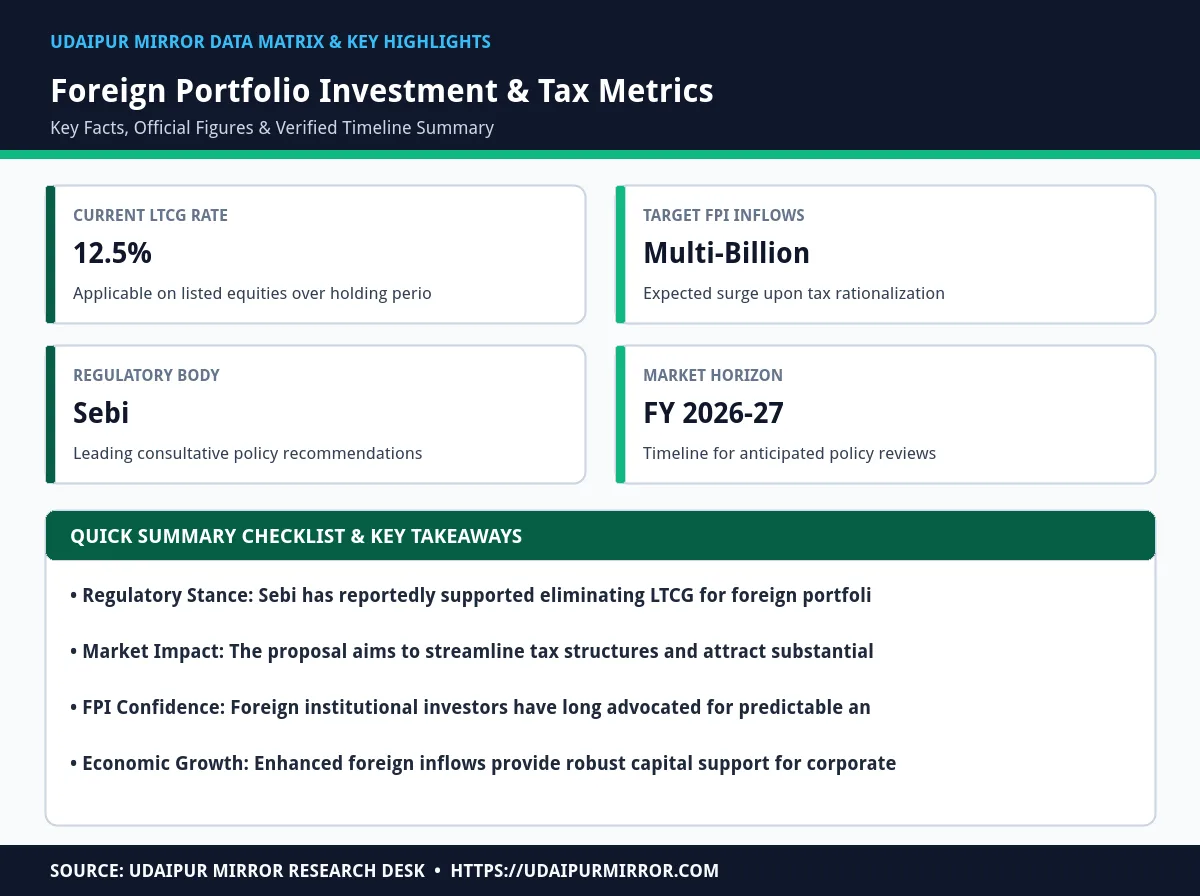
The following table illustrates the comparative capital gains tax structure under current guidelines and the potential adjustments under discussion by regulatory authorities for FY 2026-27.
| Investor Category | Asset Class | Holding Period | Current Tax Rate | Proposed Direction |
|---|---|---|---|---|
| Foreign Portfolio Investor | Listed Equities | More than 1 Year | 12.5% LTCG | Consideration for Removal |
| Domestic Retail Investor | Listed Equities | More than 1 Year | 12.5% LTCG | No Change Indicated |
| Foreign Investor | Debt Instruments | As per Slab / Rules | Varies by Instrument | Streamlined Compliance |
| Domestic Institutional | Equity Mutual Funds | More than 1 Year | 12.5% LTCG | Standardized Taxation |
While the proposed removal specifically targets foreign investors, retail participants must understand the broader ecosystem effects. When foreign institutional inflows stabilize and increase, overall market valuations and index movements experience positive momentum. This creates a favorable environment for systematic investment plans (SIPs) and equity mutual funds.
Investors are advised to maintain a disciplined approach, balancing their equity exposure with debt instruments, Public Provident Fund (PPF), or ELSS tax-saving funds under the appropriate tax regime for FY 2026-27.
“Retail investors should focus on asset allocation and long-term financial goals rather than short-term tax adjustments.” — Wealth Management Expert
Sebi has reportedly backed the removal of Long-Term Capital Gains (LTCG) tax for foreign investors to boost institutional liquidity and attract foreign capital inflows.
No, the current policy discussions and reports primarily focus on foreign portfolio investors (FPIs) to enhance global competitiveness.
Increased foreign capital inflows generally improve market liquidity and overall stock market performance, which indirectly benefits equity mutual fund returns.
The proposal is currently under discussion and review among regulatory bodies and the finance ministry, with no official timeline finalized yet.
Add Udaipur Mirror as a preferred source on Google to see more of our travel guides in your AI overviews.