Office Address
14, Residency Road, Udaipur, Rajasthan 313001
Office Address
14, Residency Road, Udaipur, Rajasthan 313001


MUMBAI: MUMBAI — Financial markets across the country are abuzz following recent strategic insights from institutional desks, with india bond market yields drawing intense focus after whisper numbers touching the coveted 8% mark surfaced. As global macroeconomic shifts intersect with domestic liquidity realities, fixed-income investors and institutional portfolio managers are recalibrating their risk-reward matrices. This unexpected pricing signal comes at a time when equity markets are experiencing divergent trends, prompting a deeper look into debt instruments as stable alternatives for capital preservation and long-term growth.
⚡ Quick Highlights: Axis Bank 8% Bond Yield Whispers In India's Debt Market
The financial corridor in Mumbai has been intensely discussing commentary emerging from Axis Bank regarding debt market valuations. Touching an 8% yield threshold in certain high-grade corporate or specialized instrument segments is a milestone that India’s bond market hasn’t witnessed in years. Analysts note that this development reflects a tighter liquidity environment and shifting corporate funding requirements as businesses look beyond traditional bank credit.
While equity markets experience fluctuations—as seen recently in tech sectors and major listings such as the Jio Platforms Listing Today: Rs 30,213 Crore IPO Eyes Strong Debut on Dalal Street—fixed-income investors are finding renewed value in debt securities offering inflation-beating returns. This strategic shift highlights a maturing domestic bond market where institutional savvy meets attractive coupon rates.
“An 8% yield tier creates an entirely new entry point for long-term institutional capital seeking predictable cash flows without taking aggressive equity bets.” — Senior Debt Strategist, Mumbai Financial District
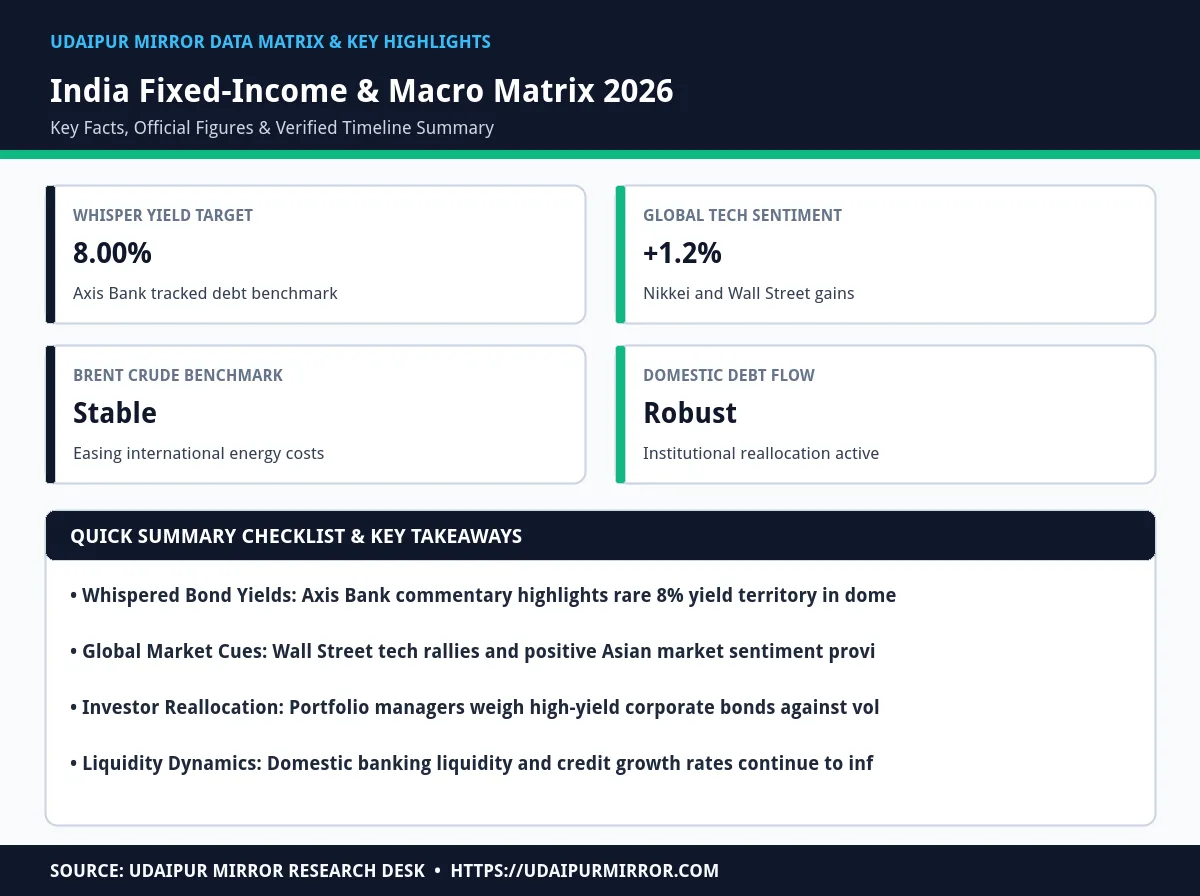
To understand the significance of the recent 8% yield whispers from Axis Bank, investors must examine how corporate bond yields stack up against traditional government securities and prevailing lending benchmarks in the Indian financial ecosystem.
| Instrument Category | Average Yield Range | Risk Profile | Tenure Profile | Market Outlook |
|---|---|---|---|---|
| Axis Bank Whispered Paper | 7.85% – 8.10% | Moderate to High | Medium-Term | Bullish Interest |
| 10-Year Government Security | 6.75% – 6.85% | Low (Sovereign) | Long-Term | Stable |
| AAA-Rated Corporate Bonds | 7.40% – 7.65% | Low to Moderate | Medium-Term | Attractive |
| Bank Fixed Deposits | 6.50% – 7.25% | Very Low | Flexible | Plateauing |
| High-Yield NBFC Debt | 8.50% – 9.20% | Elevated | Short to Medium | Selective |
Domestic bond movements do not occur in a vacuum. Global market cues, including Japan’s Nikkei jumping over 1% and positive tech rallies on Wall Street, have infused optimism into risk assets globally. However, these international liquidity flows also exert pressure on domestic bond yields as foreign portfolio investors constantly evaluate emerging market debt against US Treasury yields.
Furthermore, international commodity trends, particularly softening Brent crude oil prices and stable international gold rates, provide a cushioning effect against domestic inflationary spikes. This macroeconomic stability enables local debt markets to price risk more efficiently, paving the way for competitive yields that appeal to discerning investors navigating complex global geopolitics.
“Global tech rallies and falling oil prices create a unique window where domestic fixed income can offer high yields without runaway inflation fears.” — Global Macroeconomist
As investors weigh the implications of high-yielding debt instruments, equity sectors—particularly technology and specialized manufacturing—are experiencing varied performance. While some indices face profit booking, as noted in analyses regarding the Nifty IT Index Slips 4% As Infosys, TCS, Coforge Tank Up To 5%: Here Is Why, capital is increasingly rotating into secure fixed-income avenues.
This reallocation helps stabilize overall portfolio returns. Financial advisors recommend a balanced approach where high-yield corporate bonds complement equity exposure, ensuring that investors are insulated from sudden market corrections while still capturing growth upside. (Also read: Jio Platforms Listing Today: Rs 30,213 Crore IPO Eyes Strong Debut on Dalal Street).
“Diversification is back in vogue as smart money splits exposure between volatile equity tech plays and high-yielding corporate bonds.” — Wealth Management Head
For institutional investors, the prospect of securing 8% yields on high-quality domestic debt provides an ideal vehicle for matching long-term liabilities. Insurance companies, pension funds, and mutual fund debt desks are actively evaluating these opportunities to enhance portfolio yields without compromising on credit quality.
Retail investors, too, are gaining better access to secondary bond markets and corporate debt offerings through digital platforms and specialized mutual fund categories. As transparency improves and regulatory frameworks streamline debt trading, participating in India’s evolving fixed-income landscape has never been more accessible.
“Democratization of bond markets means retail investors can finally access institutional-grade yields that were previously restricted to big banks.” — Fintech Debt Platform CEO
The 8% yield reference indicates that select high-grade corporate or debt instruments are offering premium returns not seen in recent years, reflecting shifting liquidity and funding dynamics in India.
Global factors such as US Treasury yields, Wall Street tech rallies, and international crude oil prices influence foreign portfolio flows and domestic inflation expectations, directly affecting local bond pricing.
While high-yield bonds offer attractive returns, investors should evaluate the credit rating of the issuing institution, underlying collateral, and their own risk tolerance before investing.
Retail investors can access corporate bonds through specialized debt mutual funds, online bond platform providers (OBPPs), and secondary market transactions on stock exchanges.
Add Udaipur Mirror as a preferred source on Google to see more of our travel guides in your AI overviews.






[…] $14 Mn In Series B Led By Dallas Venture Capital To Scale AI Infrastructure 3 seconds ago ⚡ Business Axis Bank Whispers 8% Yield In India's Bond Market As Macro Headwinds Shift Fixed Inc… Apps Nifty IT Index Slips 4% As Infosys, TCS, Coforge Tank Up To 5%: Here Is Why 2 hours ago ⚡ […]