Office Address
14, Residency Road, Udaipur, Rajasthan 313001
Office Address
14, Residency Road, Udaipur, Rajasthan 313001

SINGAPORE: A brutal unwinding of crowded long positions across the semiconductor and enterprise software complex has triggered deep quarterly losses across international asset managers, as global hedge funds ai trade unwinds rapidly following unexpected earnings frictions and infrastructure bottlenecks.
⚡ Quick Highlights: Global Hedge Funds Hit as AI Trade Unwinds Across Asia
The global equity landscape faced an aggressive liquidity squeeze as prime brokerages began executing risk-mitigation calls across several top-tier multi-manager platforms. The rapid retreat has dismantled what had been 2026’s most profitable momentum trade: leveraged long positions in upstream artificial intelligence semiconductor designers, memory foundries, and high-density liquid cooling specialists across Taipei, Seoul, and Tokyo.
Market participants pointed to compounding vulnerabilities within specialized funds that held heavy concentration ratios. When mid-tier cloud infrastructure providers faced capacity constraints and high amortisation bills, valuations that had priced in unhindered compounding through 2028 underwent an abrupt repricing. In contrast to domestic equity corrections such as seen when evaluating how Indian IT stocks staged a Rs 2.6 lakh crore revival this week, Asian tech portfolios were systematically forced into margin defense.
“The concentration of capital in five to seven semiconductor names across Asia was running at historic highs. Once the CoreWeave shock rippled through tier-two suppliers, managers were forced to liquidate liquid winners to cover illiquid high-beta bets.” — Marcus Vance, Chief Investment Strategist at Meridian Capital Partners
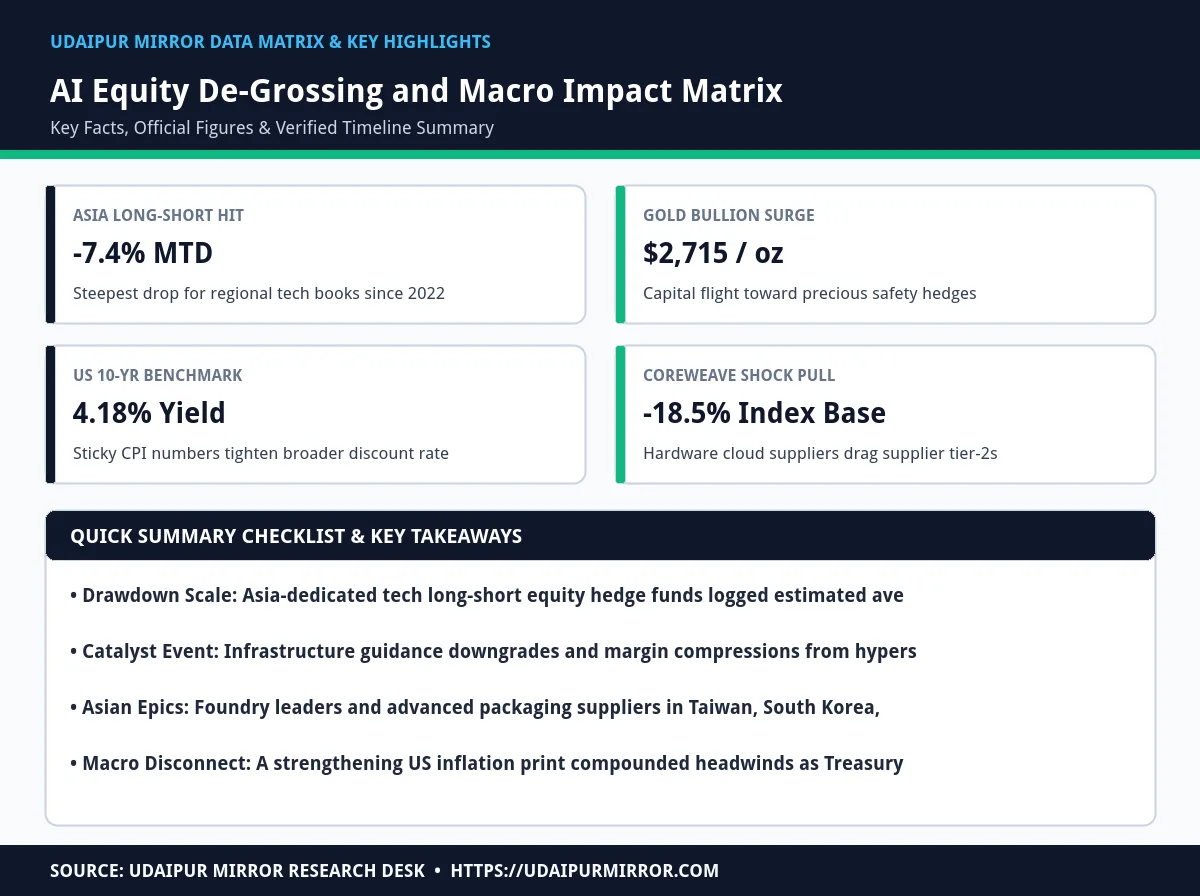
Institutional prime brokerage desks reported unprecedented gross leverage reductions during the third week of October 2026 as risk parity and systematic trend-following strategies trimmed tech exposure:
| Market Segment | Weekly Performance | Peak-to-Trough Drawdown | Primary Capital Flow Trigger |
|---|---|---|---|
| Asia Tech Hedge Fund Index | -6.82% | -11.40% | Forced margin liquidation in packaging & memory chipmakers |
| North American Long-Short Tech | -4.15% | -7.90% | CoreWeave guidance revision and hyperscaler capex reassessment |
| European Multi-Strategy Funds | -2.30% | -4.60% | Systematic de-risking and peripheral FX volatility |
| Spot Gold & Bullion Assets | +2.85% | +0.40% | Safe-haven rotation escaping tech equity high multiples |
| LME Industrial Base Metals | -3.90% | -8.20% | Demand deceleration fears in hardware assembly corridors |
| Brent Crude Global Benchmark | +1.75% | -1.10% | Geopolitical supply insurance against persistent inflation |
The tipping point for the liquidation was sparked by structural shifts in cloud compute procurement cycles. Infrastructure provider CoreWeave’s downstream forecasts sent warning flares through institutional trading rooms, indicating that data center power bottlenecks, grid connection delays, and chip allocation backlogs are beginning to curb actual cash-flow conversions for mid-tier AI compute operations.
While Tier-1 technology titans continue to post robust capital expenditure budgets, long-short managers holding secondary tier suppliers discovered that hardware orders were being delayed into late 2027. This operational hiatus broke the narrative of perpetual quarterly revenue upgrades, triggering automatic stop-losses across algorithmic and quantitative quant-hedge portfolios.
“Investors have moved from asking 'How many GPUs can you buy?' to 'What is your free cash flow per kilowatt consumed?' The multiple compression underway is an inevitable reckoning for enterprise compute balance sheets.” — Elena Sforza, Senior Semiconductor Analyst at Geneva Asset Research
Compounding the equity shock was a resilient US inflation print that battered interest rate futures. As US consumer price indicators moved higher, market wagers on aggressive Federal Reserve interest rate reductions were dismantled, lifting the 10-year US Treasury yield past 4.18% and increasing discount rates applied to long-duration tech cash flows.
The macro backdrop forced global asset allocators into safe-haven asset classes. Spot gold crossed $2,715 per ounce, moving inversely to industrial metals like LME copper and nickel, which plunged under the weight of expected hardware assembly deceleration. For retail market participants watching new listing sentiment, including those tracking retail issues like the Shellz India IPO GMP trends, broader macroeconomic liquidity tightening offers a sober reminder of cross-border sensitivity.
“When bond yields rise concurrently with tech valuation resets, equity hedge funds have no choice but to slash gross leverage to safeguard institutional mandates.” — Devashish Ray, Global Macro Head at AlphaShield Advisers
Despite the acute pain absorbed by regional long-short funds, broad Asian equity benchmarks staged an unexpected stabilization during late morning trade on Friday. The Nikkei 225 in Tokyo and the Kospi in Seoul both rebounded off intra-week troughs, supported by sovereign pension fund rebalancing and aggressive dip-buying by domestic retail accounts.
While hedge funds were compelled sellers due to risk thresholds, long-only real money institutions stepped in to absorb high-grade semiconductor champions at valuation multiples not seen since late 2025. This divergence created a two-speed market, where liquid benchmark constituents held firm even as hedge-fund-dominated secondary hardware equities slumped into correction territory.
“Fundamental sovereign buyers are viewing this drawdown as an entry window for generational technology themes, distinguishing durable market leaders from over-hyped financial engineering.” — Kenji Takahashi, Head of Asian Equities at Sumitomo Wealth Management
Institutional asset managers now face the task of reconstituting their mandates as the speculative phase of the artificial intelligence boom matures into an execution-driven cycle. The immediate priority for hedge fund chiefs across Hong Kong, Singapore, and New York remains reducing tail risk and adjusting beta exposures to prevent further redemption pressure heading into the final quarter.
Analysts suggest that the current unwinding is healthy for the long-term sustainability of the sector, purging extreme financial leverage and realigning capital allocations with genuine corporate earnings power. Until cloud hyperscalers demonstrate unmistakable monetization from their massive software rollouts, equity flows are anticipated to remain cautious, defensive, and acutely selective across both developed and emerging bourses.
“This is not the end of the AI structural transformation, but it marks the absolute end of indiscriminate momentum investing where anything tagged with compute attracted a 30-times sales multiple.” — Alistair Campbell, Managing Director at Vanguard International Markets
Global hedge funds suffered sharp drawdowns due to an unwinding of heavily leveraged long positions in AI semiconductor and hardware suppliers. Valuation concerns, combined with infrastructure guidance downgrades from cloud companies like CoreWeave and sticky US inflation yields, sparked widespread margin calls and forced de-leveraging.
Asia-focused funds held concentrated, highly leveraged exposure to foundry, memory chip, and server packaging suppliers located in Taiwan, South Korea, and Japan. When mid-tier cloud demand showed signs of bottlenecks, these upstream hardware manufacturing stocks bore the heaviest institutional liquidation.
As speculative capital fled inflated equity multiples, investors moved into safe havens. Gold climbed past $2,715 per ounce, and silver strengthened concurrently, even as industrial base metals such as copper and zinc fell on concerns over factory hardware demand.
While hedge funds logged steep portfolio losses, headline equity benchmarks like Japan’s Nikkei 225 and South Korea’s Kospi staged an intraday rebound on Friday, October 16, 2026, supported by long-only pension capital and domestic retail investors buying top-tier semiconductor leaders on dips.
Add Udaipur Mirror as a preferred source on Google to see more of our travel guides in your AI overviews.






[…] global tech investments. Even as public market participants observed volatility—evidenced when Global Hedge Funds Suffer Steep Losses as AI Trade Unwinds While Asian Portfolios Face Heaviest Draw…—private venture funding for applied, mission-critical AI applications with concrete […]