Office Address
14, Residency Road, Udaipur, Rajasthan 313001
Office Address
14, Residency Road, Udaipur, Rajasthan 313001


BHUBANESWAR: BHUBANESWAR — In a watershed moment for India’s renewable sector, the state government has officially finalized the odisha green energy deal valued at an unprecedented Rs 1.17 lakh crore. Announced on Tuesday, November 3, 2026, this massive investment blueprint aims to revolutionize eastern India’s power grid by integrating massive solar, green hydrogen, and advanced battery storage ecosystems. As national leaders strategize clean-energy priorities at New Delhi summits and corporations pivot towards sustainable manufacturing, this pact positions Odisha as an industrial green powerhouse.
⚡ Quick Highlights: Odisha Green Energy Deal: Rs 1.17 Lakh Crore Clean Tech Pact
The timing of Odisha’s clean energy announcement coincides with aggressive national pushes toward carbon neutrality, echoing recent dialogues at high-level climate and technology summits. With industrial power demands surging across India, state administrations are actively courting multi-billion-dollar green portfolios. This initiative directly mirrors domestic advancements seen elsewhere in the country, such as NTPC commissioning massive battery storage systems and independent power producers expanding their clean footprints.
Furthermore, as citizens and investors navigate shifting economic landscapes—from retail financial planning adjustments to administrative property checks like The ‘Villa Scam’: Rajasthan Govt Issues Show-Cause Notices to Senior Bureaucrat Shikhar Agrawal, IPS Wife—infrastructure funding remains a steadfast pillar of growth. The state government has ensured that land acquisition and environmental clearances are fast-tracked through single-window digital portals, minimizing bureaucratic friction for domestic and international investors.
“This landmark pact is not merely an investment agreement; it is a foundational blueprint that secures Odisha's economic and environmental sovereignty for the next century.” — State Energy Ministry Spokesperson
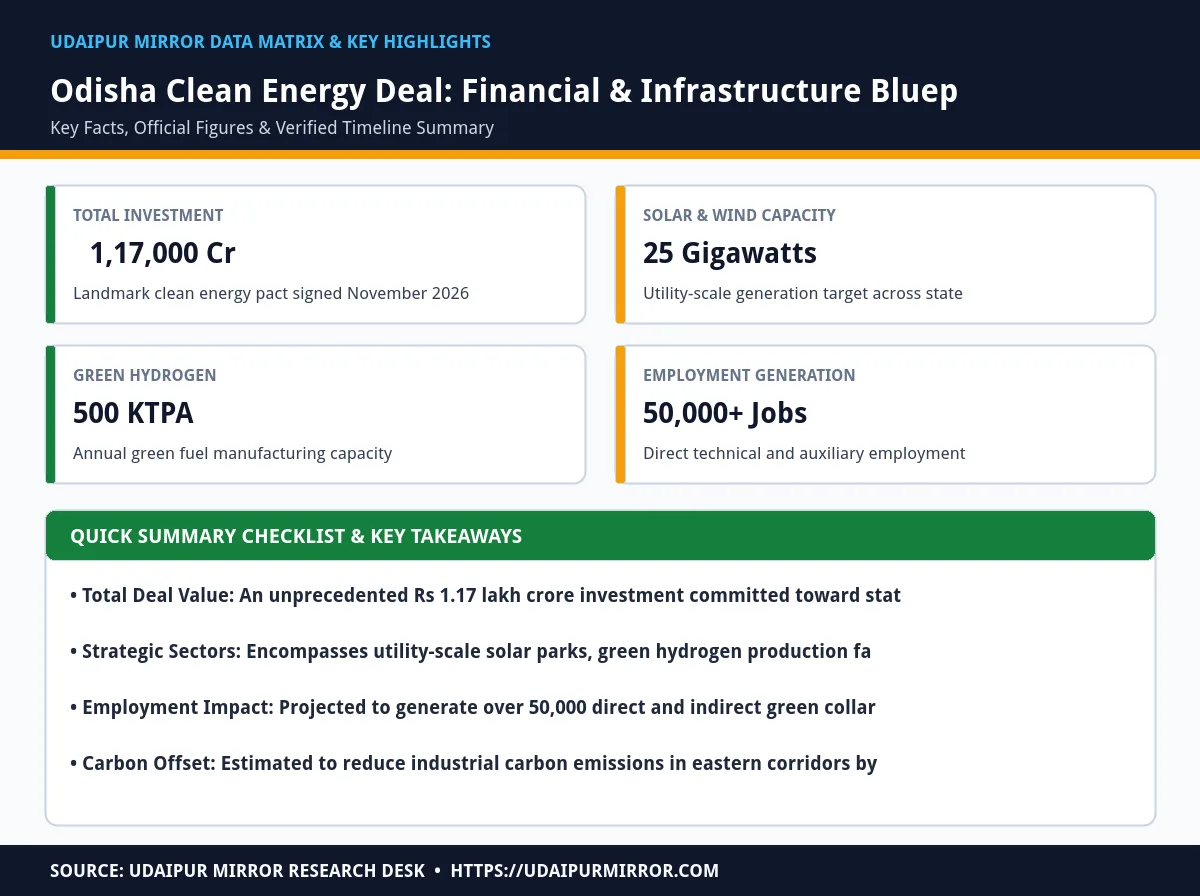
The monumental Rs 1.17 lakh crore green energy agreement spans multiple technological verticals to ensure balanced grid stability and sustainable industrial growth. Below is the detailed sector-wise breakdown of capacity targets and financial distribution under the state’s master plan.
| Technology Sector | Planned Capacity | Financial Outlay (₹ Cr) | Target Execution Horizon |
|---|---|---|---|
| Utility-Scale Solar Parks | 15,000 MW | ₹45,000 Crore | 2026 – 2028 |
| Pumped Storage Hydro | 8,000 MW | ₹32,000 Crore | 2027 – 2029 |
| Green Hydrogen & Ammonia | 500 KTPA | ₹25,000 Crore | 2027 – 2030 |
| Advanced Battery Storage (BESS) | 5,000 MWh | ₹10,000 Crore | 2026 – 2028 |
| Green Transmission Corridors | 12,000 Circuit KM | ₹5,000 Crore | 2026 – 2029 |
Beyond carbon emission reductions, the Rs 1.17 lakh crore package places heavy emphasis on socio-economic upliftment through localized skill development programs. Educational institutions across coastal and interior districts are rolling out specialized curricula in solar photovoltaic maintenance, green hydrogen safety protocols, and smart-grid administration. This directly aligns with broader national employment drives, mirroring initiatives seen in sectors like education recruitment where updates such as UP TGT Notification 2026 Out for 17,735 Vacancies, Apply Online highlight the immense focus on structured institutional growth across public domains.
Local panchayats and cooperative societies will also receive direct dividends from land lease agreements, ensuring that rural communities share the financial windfall of the clean energy revolution. Micro-entrepreneurs are expected to benefit from decentralized clean energy applications, fostering localized manufacturing clusters near major industrial corridors.
“Our goal is to ensure that every megawatt generated translates into sustainable livelihoods and empowering opportunities for our youth.” — Senior Industrial Development Commissioner
While mega-scale industrial pacts grab headlines, India’s green transformation is simultaneously bolstered by decentralized frameworks. Programs such as the PM Surya Ghar Muft Bijli Yojana Rajasthan: Online Apply, Subsidy Rates & Net Metering Rules demonstrate how household-level adoption complements macro-level utility projects. Odisha’s industrial roadmap draws inspiration from these citizen-centric models, aiming to integrate rooftop solar net-metering frameworks into urban municipal planning over the next phase.
By fusing utility-scale generation with distributed rooftop capacity, regional grids can mitigate transmission losses and maintain voltage stability during peak demand seasons. Experts predict that this dual-track approach will serve as a replicable template for other developing economies aiming for rapid decarbonization without compromising industrial output. (Also read: UP TGT Notification 2026 Out for 17,735 Vacancies, Apply Online).
“True energy independence requires a synchronized approach—from gigawatt-scale desert solar parks and coastal green hubs down to residential rooftop panels.” — Renewable Energy Research Analyst
The landmark clean energy agreement signed in Odisha is valued at an unprecedented Rs 1.17 lakh crore, aimed at transforming the state’s renewable energy infrastructure.
The pact covers utility-scale solar parks, pumped storage hydro plants, green hydrogen and ammonia production facilities, advanced battery energy storage systems (BESS), and green transmission corridors.
The clean energy transformation is projected to generate over 50,000 direct and indirect green collar jobs in engineering, construction, manufacturing, and maintenance.
The phased rollout is structured across the next five years, spanning from late 2026 through 2030, with initial infrastructural groundwork commencing immediately.
Add Udaipur Mirror as a preferred source on Google to see more of our travel guides in your AI overviews.