Office Address
14, Residency Road, Udaipur, Rajasthan 313001
Office Address
14, Residency Road, Udaipur, Rajasthan 313001


MUMBAI: MUMBAI — Navigating the complexities of current global macroeconomic developments requires a robust structural re-evaluation of hard assets, prompting top-tier fund houses to propose defensive yet growth-oriented frameworks. In the latest edition of ETMarkets Smart Talk, a senior fund manager from Tata Mutual Fund has put forward a distinctive tata mf commodity allocation model that splits exposure between precious metals and industrial commodities. This timely portfolio prescription arrives as global markets grapple with shifting Federal Reserve rate cut expectations, fluctuating Brent crude oil valuations, and dynamic geopolitical tensions across the Middle East and East Asia.
⚡ Quick Highlights: Tata MF Fund Manager Suggests 50:30:20 Commodity Mix
The financial markets have witnessed unprecedented fluctuations across bullion and base metals over the past quarters. While gold has faced resistance near the psychological $3,900 threshold amid fluctuating US election risks and shifting Middle East developments, investors are increasingly looking for sophisticated allocation blueprints. The recent ETMarkets Smart Talk interview sheds light on how traditional safe-haven strategies are evolving to incorporate industrial growth drivers. Investors tracking local bullion movements can examine historical trends by reviewing our detailed report on the Gold Rate Today in Udaipur 3rd November 2026 to understand retail pricing patterns.
Under the proposed 50:30:20 framework, the fund manager emphasizes that commodities should not merely act as an emergency hedge, but rather as an active asset class that responds to structural industrial shifts. By capping gold at 50 percent, the strategy frees up capital to capture the dual-engine momentum of silver and copper, which are heavily tied to the ongoing global transition toward renewable energy and electric mobility. (Also read: Anthropic’s New Consulting Venture: Why AI Model Companies Are Moving Into Services).
“A static allocation to gold is no longer sufficient in an era defined by rapid technological electrification and shifting trade corridors.” — Senior Fund Manager, Tata Mutual Fund
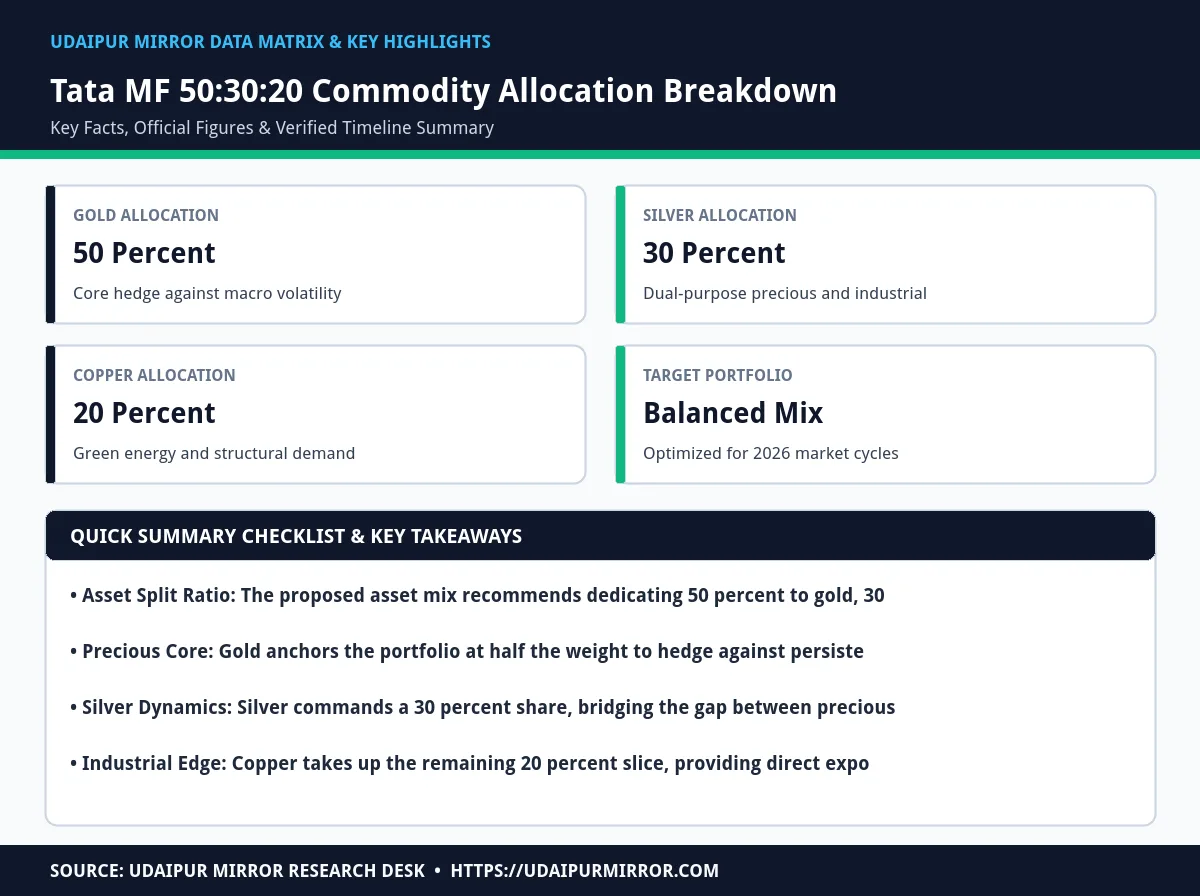
Review the comprehensive structural breakdown of the Tata Mutual Fund recommended commodity asset mix, detailing the exact percentage weight, primary market drivers, and specific risk-reward profiles for Indian and global investors navigating current economic headwinds.
| Asset Class | Allocation Weight | Primary Market Driver | Risk Profile |
|---|---|---|---|
| Gold | 50% | Safe-haven demand, central bank buying, currency hedge | Low to Moderate |
| Silver | 30% | Solar photovoltaic and EV manufacturing demand | Moderate to High |
| Copper | 20% | Global electrification, grid infrastructure expansion | Moderate to High |
| Total Portfolio | 100% | Balanced multi-commodity macro exposure | Optimized |
The inclusion of copper alongside gold and silver marks a significant shift in retail mutual fund advisory. While recent reports from the World Gold Council have highlighted moderated short-term forecasts for gold investments, base metals like copper continue to exhibit strong structural demand fundamentals driven by global decarbonization initiatives. This complementary dynamic ensures that when precious metals consolidate, industrial metals can potentially offset portfolio drag.
Furthermore, as domestic equity benchmarks like the Sensex, Nifty soar to a two-month high as FPIs ramp up buying activity, savvy investors are utilizing multi-asset allocation funds to rebalance their overall risk exposure. Integrating commodities via professional fund management helps mitigate localized stock market corrections.
“Copper is the new oil of the digital and green economy; ignoring it within a commodity basket leaves significant growth on the table.” — Commodity Strategy Desk
For Indian investors accustomed to heavy physical gold ownership, shifting toward a managed 50:30:20 commodity structure represents a modern evolution in wealth management. Physical gold comes with purity concerns, locker costs, and liquidity constraints, whereas mutual fund allocations provide transparent pricing and efficient tax structuring. As algorithmic trading and institutional capital flows dictate global commodity rates, structured fund allocations protect retail participants from sudden spot market volatility.
In addition to traditional financial instruments, institutional asset managers are increasingly adopting advanced technological tools and advisory frameworks to optimize portfolio construction, mirroring trends seen across sectors such as Anthropic’s New Consulting Venture: Why AI Model Companies Are Moving Into Services, where automation and expert consultation converge to redefine traditional service delivery models.
“Structuring commodity exposure through professional funds bridges the gap between complex global futures markets and retail household savings.” — Wealth Management Expert
The strategy proposes allocating 50 percent of a commodity portfolio to gold, 30 percent to silver, and 20 percent to copper to balance safe-haven hedging with industrial growth exposure.
Copper provides direct exposure to global green energy transition, electrification, and infrastructure development, offering growth potential that offsets precious metal consolidation phases.
It provides a diversified, liquid, and professionally managed alternative to physical gold buying, eliminating storage risks while optimizing risk-adjusted returns.
Macroeconomic factors like US Federal Reserve rate expectations and geopolitical tensions make gold a strong stabilizer, while silver and copper capture industrial demand cycles.
Add Udaipur Mirror as a preferred source on Google to see more of our travel guides in your AI overviews.