Office Address
14, Residency Road, Udaipur, Rajasthan 313001
Office Address
14, Residency Road, Udaipur, Rajasthan 313001

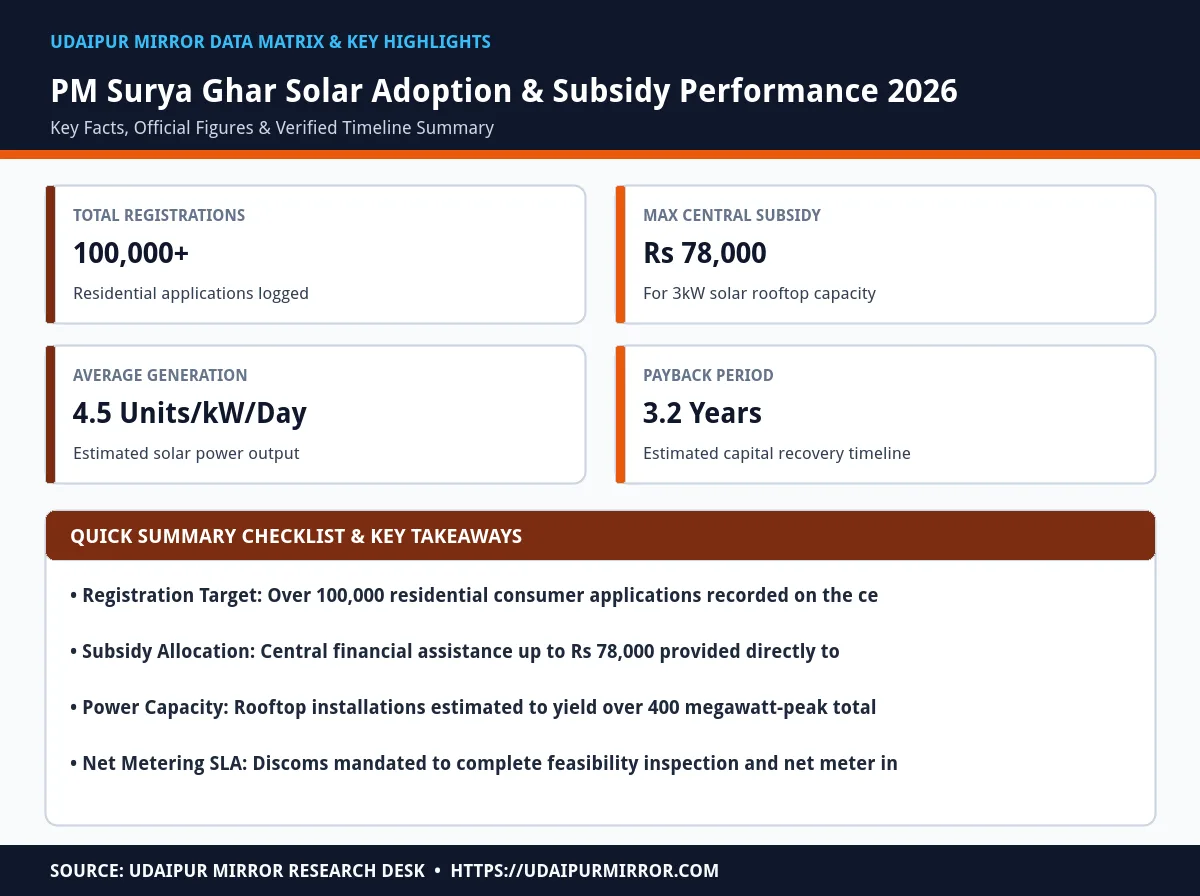
NEW DELHI / UDAIPUR: In the latest delhi rooftop solar registration milestone, achieve a historic operational benchmark as official registrations for residential installations crossed 100,000 applications. Announcing the figures on Wednesday evening, Chief Minister Rekha highlighted that the rapid adoption under the PM Surya Ghar Muft Bijli Yojana reflects growing consumer confidence in clean energy adoption, substantial grid tariff savings, and expedited net metering execution across distribution discoms.
⚡ Quick Highlights: Delhi Rooftop Solar Registration Milestone Exceeds 1 Lakh
Addressing press representatives on Wednesday night, Delhi Chief Minister Rekha emphasized that hitting the 100,000-application benchmark underscores a dramatic transformation in how citizens perceive residential green power. The initiative, executed in seamless coordination with central energy ministries under the PM Surya Ghar Muft Bijli Yojana framework, offers upfront direct subsidies alongside streamlined online portal workflows. Urban power distribution companies have reported an unprecedented influx of online submissions, signaling high consumer readiness to offset rising thermal power tariffs.
While state administrations streamline public civic drives similar to the recent Udaipur Food Safety Raid: 65 Kg Expired Goods Seized and Loose Ghee Sampled at Salgiya Establishment | खाद्य सुरक्षा दल की बड़ी कार्रवाई, clean energy welfare projects are witnessing unprecedented digital filing speeds across urban discoms. Officials noted that the convergence of simplified vendor selection, online net meter tracking, and automated feasibility checks has reduced approval bottlenecks from several months to under two weeks.
“Crossing one lakh rooftop solar registrations in record time demonstrates that when technology, transparent subsidies, and efficient discom coordination unite, citizens enthusiastically lead the transition toward clean power.” — CM Rekha, State Address on Solar Energy Progress
The table below provides a comprehensive breakdown of system capacities, estimated capital investments, central government financial assistance under PM Surya Ghar Muft Bijli Yojana, and the effective out-of-pocket costs for residential consumers in 2026.
| System Capacity | Estimated Cost | PM Surya Ghar Subsidy | Net Out-of-Pocket Investment |
|---|---|---|---|
| 1 kW Rooftop System | Rs 65,000 | Rs 30,000 | Rs 35,000 |
| 2 kW Rooftop System | Rs 1,20,000 | Rs 60,000 | Rs 60,000 |
| 3 kW Rooftop System | Rs 1,65,000 | Rs 78,000 | Rs 87,000 |
| 4 kW Rooftop System | Rs 2,15,000 | Rs 78,000 (Capped) | Rs 1,37,000 |
| 5 kW Rooftop System | Rs 2,60,000 | Rs 78,000 (Capped) | Rs 1,82,000 |
| 10 kW Residential/Group | Rs 5,00,000 | Rs 78,000 (Capped) | Rs 4,22,000 |
The success of the rooftop solar drive in Delhi provides an actionable template for neighboring states, including Rajasthan, where solar potential ranks among the highest in the country. In Rajasthan, citizens access clean energy subsidies through the state’s Single Sign-On (SSO) portal alongside the central PM Surya Ghar portal. By establishing direct sync between DISCOM utility databases and citizen Jan Aadhaar identity stacks, administrative processing times for rooftop solar subsidies have been drastically reduced.
Just as regional public institutions maintain operational transparency, as highlighted during the Udaipur Medical Induction 2026: 250 Students From 20 States Take Charak Shapath | चरक शपथ समारोह, state electricity boards are enforcing strict timelines for net meter commissioning within 15 days. Consumers across both regions benefit from uniform central financial assistance slabs, where residential systems up to 2 kW receive Rs 30,000 per kW, and systems up to 3 kW secure the full Rs 78,000 grant credited directly to verified bank accounts.
“Integrating central portal APIs with state citizen registries like Rajasthan SSO and Jan Aadhaar creates a seamless direct benefit ecosystem for renewable energy adopters.” — Senior Renewable Energy Policy Analyst
For domestic power consumers planning to install solar panels, navigating the application process requires specific prerequisites. Applicants must register on the PM Surya Ghar official portal or state-specific citizen portals using their active mobile number and electricity consumer account number (CA/K-Number). Once registered, the user submits technical details regarding roof area, sanctioned electrical load, and desired solar plant capacity.
Following initial submission, the local power distribution utility (DISCOM) conducts a technical feasibility assessment to verify local transformer capacity. Upon approval, the applicant selects an empanelled solar vendor to execute panel installation. After physical erection of the solar modules, the discom inspects the site, installs a bi-directional net meter, and issues a commissioning certificate. The central subsidy is subsequently disbursed directly into the consumer’s bank account within 30 days of commissioning. (Also read: Under The Sun Aquarium Udaipur Guide 2026: India's Largest Public Aquarium, Fish Species, Timings & Entry Ticket).
“The online workflow eliminates middleman intervention, ensuring that every applicant receives eligible subsidies directly into their Aadhaar-seeded bank account.” — Director of Consumer Energy Welfare
A standard 3 kW residential rooftop solar plant generates an average of 12 to 14 kilowatt-hours (units) of electricity per day under typical weather conditions. Over a full calendar year, such an installation yields approximately 4,300 to 4,500 units of clean electricity. For households consuming 300 to 400 units monthly, this output effectively reduces routine power bill payments to nominal fixed grid maintenance charges.
Under prevailing net metering regulations, excess power generated during daylight hours flows back into the city power grid, earning energy credits that offset grid electricity consumed during night hours. Given the current central subsidy of Rs 78,000 on a 3 kW system costing around Rs 1,65,000, the net out-of-pocket investment of Rs 87,000 is typically recovered through bill savings within 3 to 3.5 years, yielding free electricity for the remaining 20+ years of panel warranty life.
“Solar energy is no longer just an environmental decision; it is one of the highest-yielding personal capital investments available to urban families today.” — Clean Energy Investment Specialist
To qualify for the rooftop solar subsidy scheme, residential applicants must satisfy clear structural and administrative requirements. The applicant must hold legal property ownership or valid long-term lease rights to a concrete roof with unobstructed sun exposure. The electricity connection must be classified under the domestic non-commercial tariff category with a history of regular bill settlements.
Applicants must assemble a mandatory document packet prior to online registration. Key documents include a clear scanned copy of the latest electricity bill, property ownership proof, Aadhaar card of the primary account holder, and a cancelled bank cheque verifying the account holder’s name and IFSC code for direct benefit transfer processing.
“Ensuring document accuracy and rooftop shade feasibility beforehand speeds up DISCOM site approval within forty-eight hours of filing.” — Chief Project Manager, Solar Regulatory Cell
Under the PM Surya Ghar Muft Bijli Yojana, residential consumers receive central financial assistance directly transferred to their bank accounts. Systems up to 2 kW qualify for Rs 30,000 to Rs 60,000 subsidy, while 3 kW systems receive a maximum subsidy cap of Rs 78,000. Additionally, net metering allows households to offset monthly electricity bills against surplus solar generation.
Applicants require a recent electricity bill matching the installation address, active consumer account number (CA/K No.), identity proof (Aadhaar Card or PAN), property ownership proof, and a cancelled bank cheque/passbook copy for Direct Benefit Transfer (DBT) credit verification.
Under standardized grid connection guidelines, discoms must issue technical feasibility approval within 7 days of online submission. Following solar plant installation by an empanelled vendor, inspection and net meter commissioning must be finalized within 15 working days.
Yes, Rajasthan citizens can apply through the national PM Surya Ghar portal or state DISCOM portals via Rajasthan Single Sign-On (SSO). The application workflow, subsidy calculations, and net metering mandates remain aligned with national solar standards.
Add Udaipur Mirror as a preferred source on Google to see more of our travel guides in your AI overviews.


[…] 2026 स्पेशल स्ट्रे राउंड 12 minutes ago ⚡ Articles Delhi Crosses 1 Lakh Rooftop Solar Registrations Under PM Surya Ghar Scheme, Announces CM … News Udaipur Medical Induction 2026: 250 Students From 20 States Take Charak Shapath | चरक […]