Office Address
14, Residency Road, Udaipur, Rajasthan 313001
Office Address
14, Residency Road, Udaipur, Rajasthan 313001

UDAIPUR: UDAIPUR — In the heart of Rajasthan’s arid heritage plains, a nutritional revolution grounded in ancient Ayurvedic wisdom is taking center stage as modern science validates what ancestral kitchen traditions have known for millennia. Pure Jaisamand Lake surrounding pastoral regions and indigenous cattle breeding centers have long championed the preparation of desi a2 bilona cow ghee. Unlike mass-produced industrial fats, authentic A2 Bilona ghee derived from indigenous breeds like Rathi, Gir, and Tharparkar represents a masterclass in biochemical engineering, offering unparalleled therapeutic and culinary properties that continue to redefine dietary standards across India in November 2026.
⚡ Quick Highlights: Desi A2 Bilona Cow Ghee 2026: Benefits & Science
The production of authentic desi a2 bilona cow ghee is a labor-intensive art form deeply rooted in Ayurvedic texts. Unlike modern commercial dairies that extract cream directly from milk using high-speed mechanical separators, the traditional Bilona method begins by boiling pure, unadulterated A2 milk and setting it into nutrient-rich curd using a natural culture. This curd is then manually or bidirectionally churned using a specialized wooden churner known as a ‘bilona’ in both clockwise and counter-clockwise directions.
This ancient bidirectional churning process separates the butter (makkhan) from the buttermilk (mattha) gently, ensuring that the delicate molecular structures and amino acids are not destroyed by heat or friction. Once the makkhan is gathered, it is simmered slowly on a traditional earthen or low-flame cow-dung fire. As the moisture evaporates slowly, impurities are filtered out, leaving behind liquid gold—aromatic, golden ghee that carries the authentic essence of Rajasthani pastures. (Also read: Jaisamand Lake & Dhebar Dam Udaipur Guide 2026: Boating & Royal History).
“The Bilona process is not merely a method of extraction; it is a sacred transformation that preserves the living prana and medicinal intelligence of indigenous milk.” — Dr. Hemant Sharma, Ayurvedic Nutritionist
Understanding the fundamental differences in production methodology, nutrient retention, and physiological impact between traditional artisanal A2 Bilona ghee and industrial cream-separated variants is essential for making informed dietary choices in modern households.
| Parameter | Authentic A2 Bilona Ghee | Commercial Cream Ghee | Nutritional Impact |
|---|---|---|---|
| Raw Material Source | Whole curd from A2 milk (Rathi/Gir/Tharparkar) | Direct cream or malai from mixed breed milk | A2 milk contains easily digestible beta-casein proteins. |
| Churning Process | Bidirectional hand/wooden churn (Bilona) | High-speed industrial centrifuge separators | Bilona method retains vital live enzymes and micronutrients. |
| Fatty Acid Profile | High butyric acid, CLA, and short-chain fats | Predominantly saturated long-chain fats | Short-chain fats enhance gut lining and metabolism. |
| Vitamin Retention | High natural levels of Vitamins A, D, E, and K2 | Significantly depleted due to chemical processing | Supports immune function, skin health, and bone density. |
| Digestibility | Easily digestible, promotes agni (digestive fire) | Can feel heavy and sluggish on the digestive tract | Ideal for individuals with mild dairy sensitivities. |
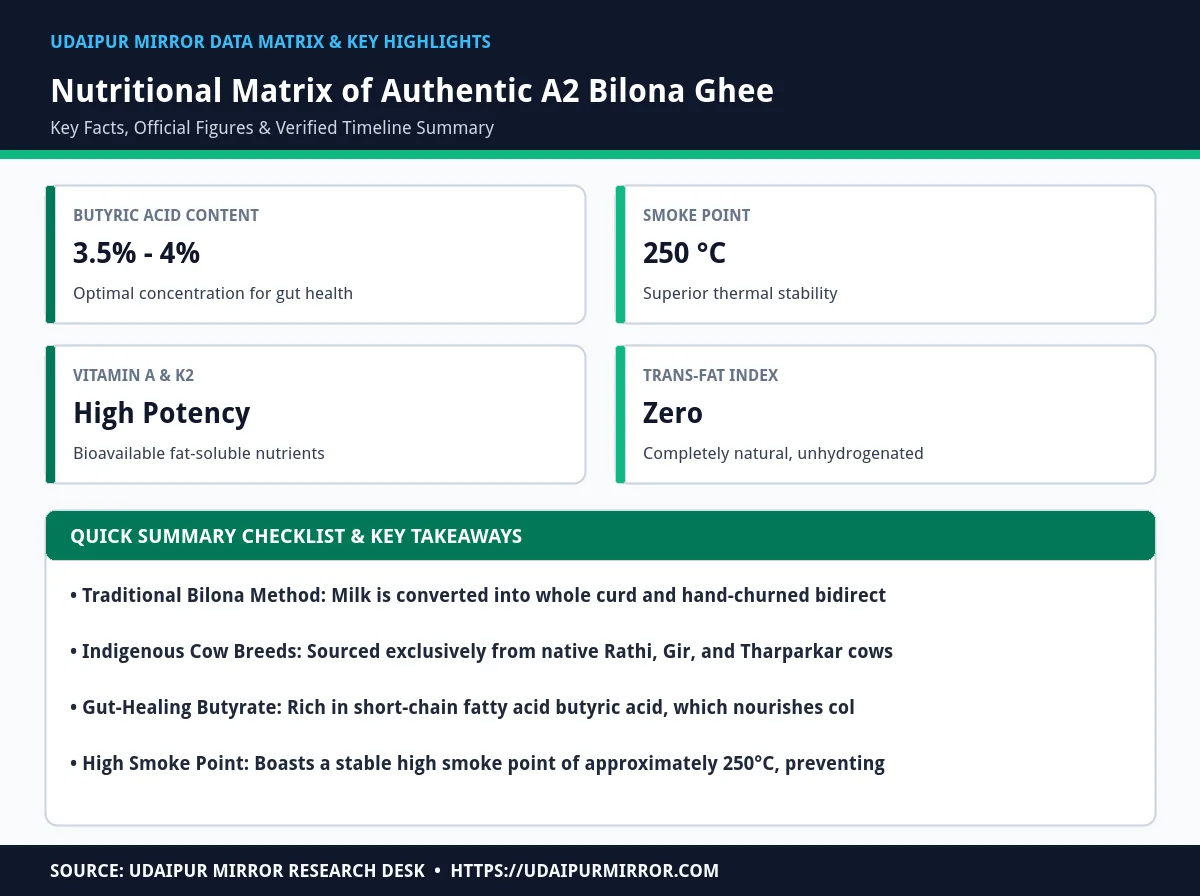
One of the most profound nutritional advantages of authentic A2 Bilona ghee is its remarkably high concentration of butyric acid, a short-chain fatty acid (SCFA) that plays a vital role in maintaining gastrointestinal integrity. The human gut microbiome relies heavily on butyrate as the primary energy source for colonocytes—the cells lining the colon. By incorporating genuine Bilona ghee into daily meals, individuals can actively strengthen their intestinal mucosal barrier, thereby preventing leaky gut syndrome and reducing systemic inflammation.
Furthermore, butyric acid has been extensively researched for its anti-inflammatory properties and its ability to regulate immune responses within the digestive tract. When heavy rainfall disrupts seasonal routines or festive overindulgence taxes the digestive system—much like the recent weather disruptions seen during local celebrations such as the Matabari Fair—a spoonful of warm A2 ghee acts as a soothing tonic, reigniting digestive fire (agni) and restoring microbial harmony without causing bloating or sluggishness.
“Butyrate found abundantly in pure Bilona ghee acts as cellular fuel for the gut lining, repairing damage and mitigating chronic inflammatory pathways.” — Dr. R. K. Vats, Gastroenterologist & Metabolic Researcher
For decades, saturated fats bore the brunt of misguided dietary guidelines that incorrectly linked all animal fats to arterial blockages and heart disease. However, modern cardiological and nutritional science in 2026 has thoroughly exonerated pure desi a2 bilona cow ghee. Unlike industrial trans-fats and highly refined vegetable oils laden with omega-6 fatty acids, authentic Bilona ghee consists of short and medium-chain fatty acids that are metabolized directly by the liver for instant energy rather than being stored as arterial plaque.
Additionally, A2 ghee is rich in Conjugated Linoleic Acid (CLA) and fat-soluble vitamins A, D, E, and K2. Vitamin K2, in particular, is a powerhouse nutrient that directs calcium away from arterial walls and deposits it into bones where it belongs, actively protecting against vascular calcification. Coupled with its exceptionally high smoke point of 250°C—which prevents the generation of carcinogenic free radicals during frying or sautéing—authentic ghee stands out as one of the safest and most heart-healthy cooking fats available. (Also read: Heavy Rain Wreaks Havoc on Udaipur Diwali Festival as Matabari Fair Devastated and Gate Collapses).
“The fear of pure desi ghee is a relic of outdated nutritional dogma. When consumed in moderation, traditional A2 ghee supports lipid profiles and protects cardiovascular tissue.” — Prof. Anjali Deshmukh, Clinical Cardiometabolic Specialist
A2 Bilona ghee is made from the milk of indigenous Indian cow breeds (such as Rathi, Gir, and Tharparkar) that contain A2 beta-casein protein. It uses the traditional Bilona method—where milk is turned into curd and hand-churned with a wooden churner—whereas commercial ghee is typically made by separating cream directly from high-yield crossbreed milk using industrial centrifuges.
No. Modern nutritional science confirms that pure A2 Bilona ghee does not cause heart blockages when consumed as part of a balanced diet. It contains beneficial short-chain fatty acids like butyric acid, CLA, and Vitamin K2, which protect arterial health, prevent calcification, and support healthy metabolism.
Butyric acid is a short-chain fatty acid that serves as the primary energy source for colon cells. It helps repair the gut lining, strengthens the intestinal mucosal barrier, reduces gut inflammation, and supports overall digestive wellness.
Authentic A2 Bilona ghee has a high smoke point of approximately 250°C (482°F). This high thermal stability ensures that the ghee does not break down into toxic free radicals or harmful compounds when used for high-heat Indian cooking, sautéing, or frying.
Add Udaipur Mirror as a preferred source on Google to see more of our travel guides in your AI overviews.






[…] Gatta of Mewar: Stuffed Mawa Dumplings, Rich Yogurt Gravy & Palace Origins 1 hour ago ⚡ Articles Desi A2 Bilona Cow Ghee 2026: Traditional Curd Churning, Butyric Acid & Cardiovascular… Articles Jaisamand Lake & Dhebar Dam Udaipur Guide 2026: Boating & Royal History 2 hours […]