Office Address
14, Residency Road, Udaipur, Rajasthan 313001
Office Address
14, Residency Road, Udaipur, Rajasthan 313001


NEW DELHI: NEW DELHI — Former India captain and seasoned national selector Dilip Vengsarkar urges BCCI to restore toss in Under-23 domestic cricket fixtures, calling the experimental removal of the time-honored tradition detrimental to the holistic development of young cricketers across the country. Speaking out on Sunday, the legendary batsman emphasized that the element of uncertainty and tactical adaptation brought by the toss is an irreplaceable component of competitive red-ball and white-ball cricket. While domestic tournament organizers had previously experimented with bypassing the coin flip to prioritize visiting team preferences or surface neutralisation, cricket purists and veteran administrators argue that such structural changes rob players of crucial tactical pressure-handling skills.
⚡ Quick Highlights: Dilip Vengsarkar Urges BCCI to Restore Toss in U-23 Matches
The debate surrounding the removal of the toss in age-group tournaments has gained massive traction among former players and coaches. Dilip Vengsarkar stressed that cricket is a game of uncertainties where adapting to the conditions dictated by a coin toss is a fundamental rite of passage for any aspiring professional. When administrators tinker with core elements like the toss in Under-23 matches, they inadvertently shield players from real-world match scenarios they will inevitably encounter at the international level.
Furthermore, assessing a pitch, reading overhead conditions, and making split-second captaincy decisions based on the fall of a coin are skills that cannot be replicated in a sanitized, toss-free environment. For instance, players navigating political shifts and administrative updates—much like administrative changes seen in contexts such as the TMC war of affidavits in the election commission—often find that stability in core rules is paramount for fair competition.
“The toss is an integral part of cricket's character. Eliminating it in Under-23 matches deprives youngsters of learning crucial tactical decisions.” — Dilip Vengsarkar, Former India Captain
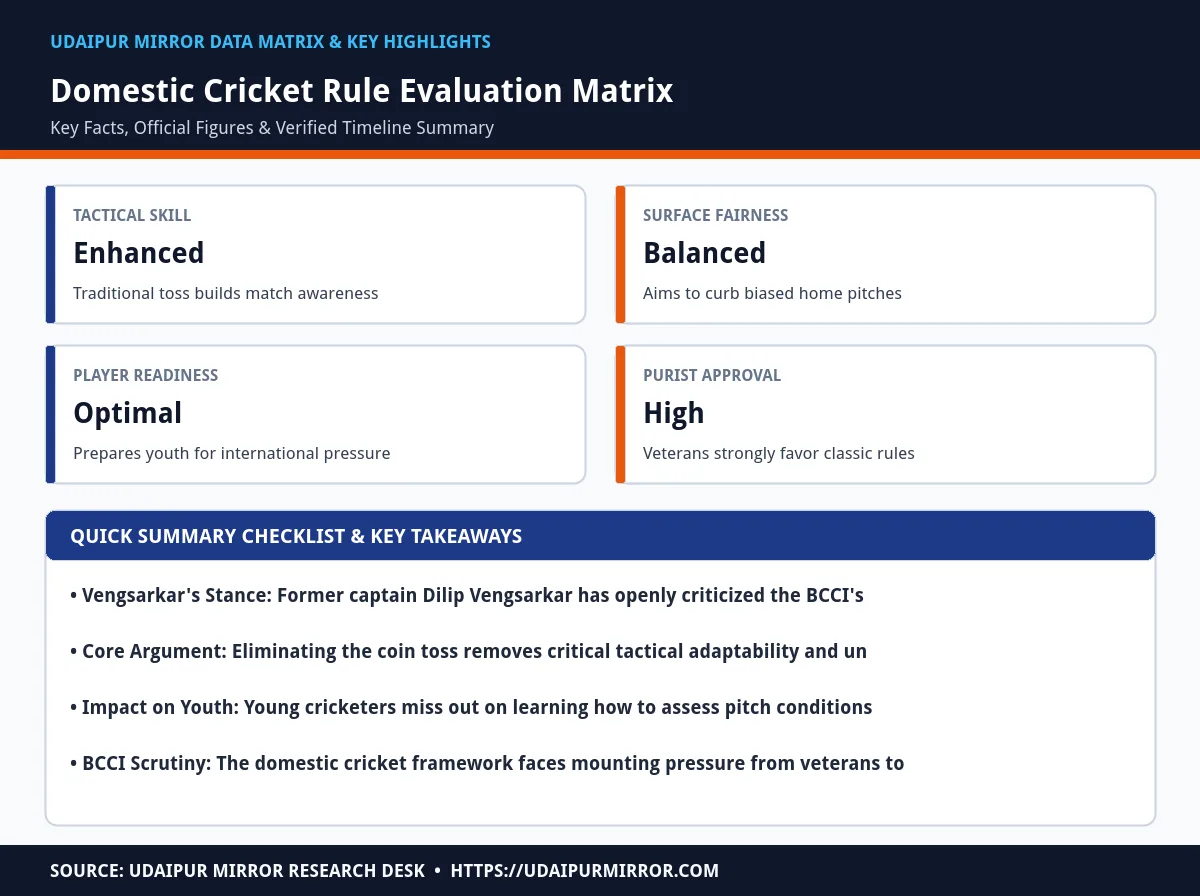
The Board of Control for Cricket in India has tested several experimental rules across its domestic tiers, including the CK Nayudu Trophy and Col C K Nayudu Under-23 tournaments, to address home advantage and pitch curation issues. Below is an overview of rule iterations over recent seasons.
| Tournament Tier | Rule Experiment | Objective | Current Status |
|---|---|---|---|
| CK Nayudu Trophy (U-23) | No Toss / Visitor Choice | Neutralize home advantage | Under review after veteran critique |
| Ranji Trophy Elite | Standard Coin Toss | Maintain traditional format | Active across all groups |
| Cooch Behar Trophy (U-19) | Standard Coin Toss | Encourage natural match play | Active nationwide |
| Syed Mushtaq Ali Trophy | Standard Coin Toss | Fast-paced T20 requirements | Active nationwide |
| Vijay Hazare Trophy | Standard Coin Toss | Fair 50-over conditions | Active nationwide |
The original rationale behind the BCCI’s trial to eliminate the toss in certain domestic age-group fixtures was to curb the rampant preparation of rank-turners or green-top minefields designed solely to benefit host associations. By allowing visiting teams uncontested choices, administrators hoped to level the playing field and promote sporting pitches across all venues.
However, critics argue that penalizing all venues through blanket rule changes is an ineffective substitute for rigorous pitch monitoring by neutral curators. Addressing sporting infrastructure requires comprehensive oversight, comparable to how regional authorities handle large-scale developments such as tracking Udaipur property registrations and market surges through transparent regulatory frameworks rather than blunt instruments.
As Indian cricket navigates transitions across formats—highlighted by recent discussions on veteran player workloads, fast-bowling reserves, and international schedules—the domestic structure remains the backbone of future success. Youngsters graduating from the Under-23 setup must step into first-class environments fully equipped with both technical proficiency and situational awareness.
When foundational elements like the toss are altered, it creates a disconnect between domestic tier practices and international standards. Vengsarkar’s appeal serves as a timely reminder to the BCCI leadership that developmental tournaments must mirror the challenges of the highest level as closely as possible. (Also read: Bengal Govt Clears 393 Private BEd Colleges for Admissions in 2026-28 Session).
Dilip Vengsarkar criticized the experimental removal of the toss in Under-23 domestic matches, arguing that it removes crucial tactical elements and leaves youngsters unprepared for international cricket.
The rule was initially tested to curb extreme home advantage and discourage host associations from preparing biased pitches.
The toss forces captains and players to assess pitch and weather conditions instantly, building critical decision-making skills under pressure.
While no official reversal has been formally announced yet, veteran feedback and ongoing technical committee reviews have placed the rule under heavy scrutiny.
Add Udaipur Mirror as a preferred source on Google to see more of our travel guides in your AI overviews.