No SIM in Your Phone? WhatsApp & Telegram Could Stop Working! New SIM-Binding Rules Explained
DoT mandates continuous SIM-binding for messaging apps including WhatsApp, Telegram, and Signal by December 31, 2026. Learn how this anti-fraud move impacts secondary devices, dual-SIMs, and international travel.
If you use WhatsApp, Telegram, or Signal on a secondary phone over Wi-Fi without a physical SIM card inside, your messaging routine is about to change drastically. Under new directives from the Department of Telecommunications (DoT), messaging platforms must implement continuous “SIM binding.”
By the compliance deadline of December 31, 2026—and taking full operational effect from January 1, 2027—these Over-The-Top (OTT) communication apps will verify that the registered mobile number’s SIM card is physically present and active in the device hosting the account.
⚡ Quick Highlights: No SIM? WhatsApp & Telegram to Stop Working Under New Rules
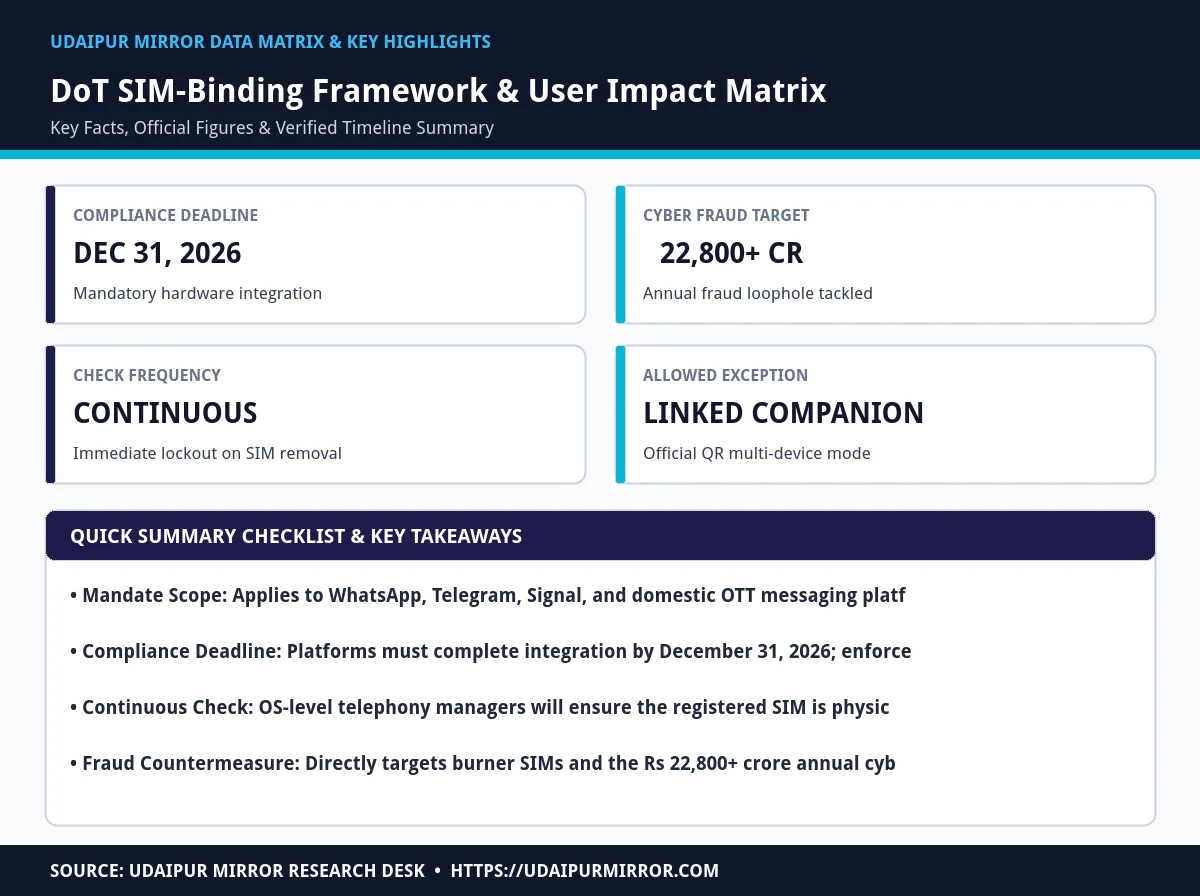
Mandate Scope: Applies to WhatsApp, Telegram, Signal, and domestic OTT messaging platforms.
Compliance Deadline: Platforms must complete integration by December 31, 2026; enforcement begins January 1, 2027.
Continuous Check: OS-level telephony managers will ensure the registered SIM is physically present in the device.
Fraud Countermeasure: Directly targets burner SIMs and the Rs 22,800+ crore annual cyber fraud and digital arrest racket.
Secondary Devices: Wi-Fi-only secondary phones will be blocked from running standalone accounts; multi-device mode required.
Travelers & Roaming: Switching to local travel SIMs will require dual-SIM or eSIM setups to keep Indian chat accounts operational.
1. What Is “SIM Binding” and How Does It Work?
Historically, messaging apps have relied on an initial one-time SMS verification code (OTP). Once entered:
The user could eject the SIM card, insert a different card, or use the phone purely over Wi-Fi.
The messaging account remained active indefinitely until manually uninstalled or re-registered elsewhere.
The Shift to Continuous Hardware Binding
SIM binding changes this handshake into an ongoing, persistent check—similar to how banking apps and UPI services like Google Pay or PhonePe operate:
Continuous SIM Presence: The app queries the operating system (Android or iOS) to ensure the physical SIM card or eSIM containing the registered IMSI/MSISDN is actively mounted in the device.
Immediate Lockout on Ejection: If the SIM card is removed, deactivated, or swapped with an unrecognized SIM, the messaging app terminates the session or restricts outgoing and incoming messages until the original SIM is detected.
The ₹22,800+ Crore Fraud Loophole: According to Ministry of Communications estimates, cyber fraud accounted for more than ₹22,800 crore in annual losses, heavily driven by digital arrest scams, impersonation of law enforcement, and investment schemes run over WhatsApp and Telegram.
Mule Numbers & Burner SIMs: Fraudsters routinely obtain Indian numbers using forged KYC, activate WhatsApp or Telegram via an SMS OTP, and immediately destroy or discard the physical SIM card. They then operate the accounts remotely over Wi-Fi or virtual private networks outside the jurisdiction of Indian telecom towers.
Traceability: By binding the app strictly to an active, KYC-verified SIM card, authorities ensure that if an account is operational, its mobile identifier is connected to a live telecom operator network.
Key compliance milestones, fraud countermeasures, and device requirements under India's new Telecom Cyber Security Rules.
3. Which Apps and Platforms Are Covered?
The directive covers major app-based communication services operating in India:
Platform
Current Status
WhatsApp
Active development underway; beta testing SIM-binding APIs on Android.
Telegram
Covered under the mandate; required to implement continuous SIM checks by the deadline.
Signal
Covered under the initial directive; expected to update client architectures to comply with local cyber regulations.
Domestic OTTs
JioChat, Arattai, ShareChat, Josh.
Snapchat
Granted exceptions based on functional architecture differences.
4. How Will This Impact Regular Users?
While designed to stop fraudsters, the transition will directly affect several common consumer setups:
A. Secondary Phones & Wi-Fi Tablets
Many users configure WhatsApp on an old Android handset or tablet connected solely to home Wi-Fi while their main SIM sits in their primary phone. This will no longer work unless the secondary device runs on WhatsApp’s official “Companion Mode” (Linked Devices) tied to a compliant primary phone.
B. Dual-SIM & Frequent SIM Swappers
Users who carry multiple SIM cards and rotate them in a single-slot phone will find their messaging apps suspended the moment the respective SIM is removed.
C. WhatsApp Web & Desktop Clients
The DoT’s original proposal required a forced logout of all web instances every 6 hours. Following industry consultation, this has evolved into risk-based authentication alongside periodic re-verification:
Linked desktop sessions will require recurring QR code re-authentication.
If the primary phone’s SIM goes inactive or missing, paired web instances will automatically decouple.
D. International Travelers & Roaming
Using International Roaming: If your Indian SIM card remains inserted and active in your phone while roaming abroad, your WhatsApp account will continue to function normally.
Switching to Local Foreign SIMs: If you remove your Indian SIM at your travel destination to insert a local foreign SIM card, your Indian WhatsApp account will trigger a SIM-mismatch flag. To retain access, users will need to rely on dual-SIM/eSIM setups where the Indian number remains digitally active alongside the travel data SIM.
5. OS-Level Infrastructure: Android & iOS Updates
To enable messaging apps to enforce this without violating platform security sandboxes, operating systems have added hardware-level detection:
Apple iOS: A dedicated patch enables developers to detect continuous SIM hardware presence and subscriber carrier identifiers.
Android: Google Play Services and telephony APIs expose hardware telephony managers allowing apps to run periodic background verification cycles.
Mobile Number Verification (MNV): The DoT is rolling out an integrated validation gateway enabling platforms to confirm legitimate ownership against telecom provider registries.
6. What Should You Do to Prepare?
Before the rules take full operational effect:
Verify Your Primary Device: Ensure the SIM card matching your WhatsApp/Telegram number is physically slotted into the phone you use every day.
Migrate Wi-Fi Setups to Linked Devices: If you use a tablet or secondary phone, do not register it as a standalone number. Instead, link it as a secondary device via the official multi-device companion feature while keeping the primary SIM phone active.
Switch to eSIM for Travel: If you travel frequently or maintain two numbers, convert your primary Indian number to an eSIM. This leaves your physical tray open for travel SIMs while keeping the Indian line active on the device.
Update Outdated Numbers: If you are running your chats on an old number that has since been disconnected or given to someone else by your telecom operator, migrate your chat account immediately to your current, KYC-active SIM using the in-app “Change Number” feature.
Frequently Asked Questions (FAQs)
1. What is the DoT SIM-binding rule for WhatsApp and Telegram?
The DoT mandate requires messaging apps like WhatsApp, Telegram, and Signal to continuously verify that the registered SIM card (physical or eSIM) is actively mounted in the phone hosting the account, preventing accounts from running on SIM-less Wi-Fi devices.
2. When is the final deadline for SIM-binding compliance in India?
Telecom and OTT messaging platforms must achieve full compliance by December 31, 2026, with strict operational enforcement commencing on January 1, 2027.
3. Can I still use WhatsApp Web or desktop applications?
Yes, linked desktop sessions will continue to work via companion mode, but will require periodic re-authentication and will automatically decouple if the primary SIM phone goes offline or loses its SIM.
4. What happens if I travel abroad and insert an international SIM?
Removing your Indian SIM to insert a local travel card will trigger a SIM-mismatch restriction. Travelers are advised to convert their Indian number to an eSIM so both lines remain active concurrently on dual-SIM devices.
Find this guide helpful?
Add Udaipur Mirror as a preferred source on Google to see more of our travel guides in your AI overviews.
HC Ajmera
The Udaipur Mirror Editorial Bureau is an independent newsroom comprising financial analysts, investigative reporters, and regional correspondents based in Udaipur, Rajasthan. The bureau provides data-driven coverage of Indian IPOs, Dalal Street market movements, Rajasthan infrastructure, and Mewar architectural heritage, adhering strictly to SEBI compliance norms and the Press Council of India code of ethics.