Office Address
14, Residency Road, Udaipur, Rajasthan 313001
Office Address
14, Residency Road, Udaipur, Rajasthan 313001


JAIPUR: JAIPUR — In a major administrative push to improve rural infrastructure and public utility networks, the state government has mandated that district mineral fund spending rajasthan be strictly channeled into core citizen services, healthcare clinics, educational facilities, and potable water access in mining-impacted regions.
⚡ Quick Highlights: Rajasthan District Mineral Fund Spending: ₹12,311 Cr Approved
The Rajasthan government has enacted stringent supervisory mechanisms to ensure that all financial allocations derived from mineral extractions directly benefit local communities. Historically, mining operations created environmental and infrastructural strain on surrounding habitations. By restructuring the District Mineral Foundation Trust (DMFT) protocols, the administration aims to rectify regional disparities.
In tandem with these fiscal measures, local civic authorities are tightening municipal compliance. For instance, while state infrastructure projects receive massive cash injections, urban centers like Udaipur grapple with local logistical challenges, prompting measures similar to the Udaipur heavy vehicle ban on 11 routes to protect city roads from heavy transport wear and tear.
“Our primary objective is to convert mineral wealth into permanent social assets that elevate the quality of life for every citizen residing near extraction zones.” — Senior State Planning Official, Government of Rajasthan
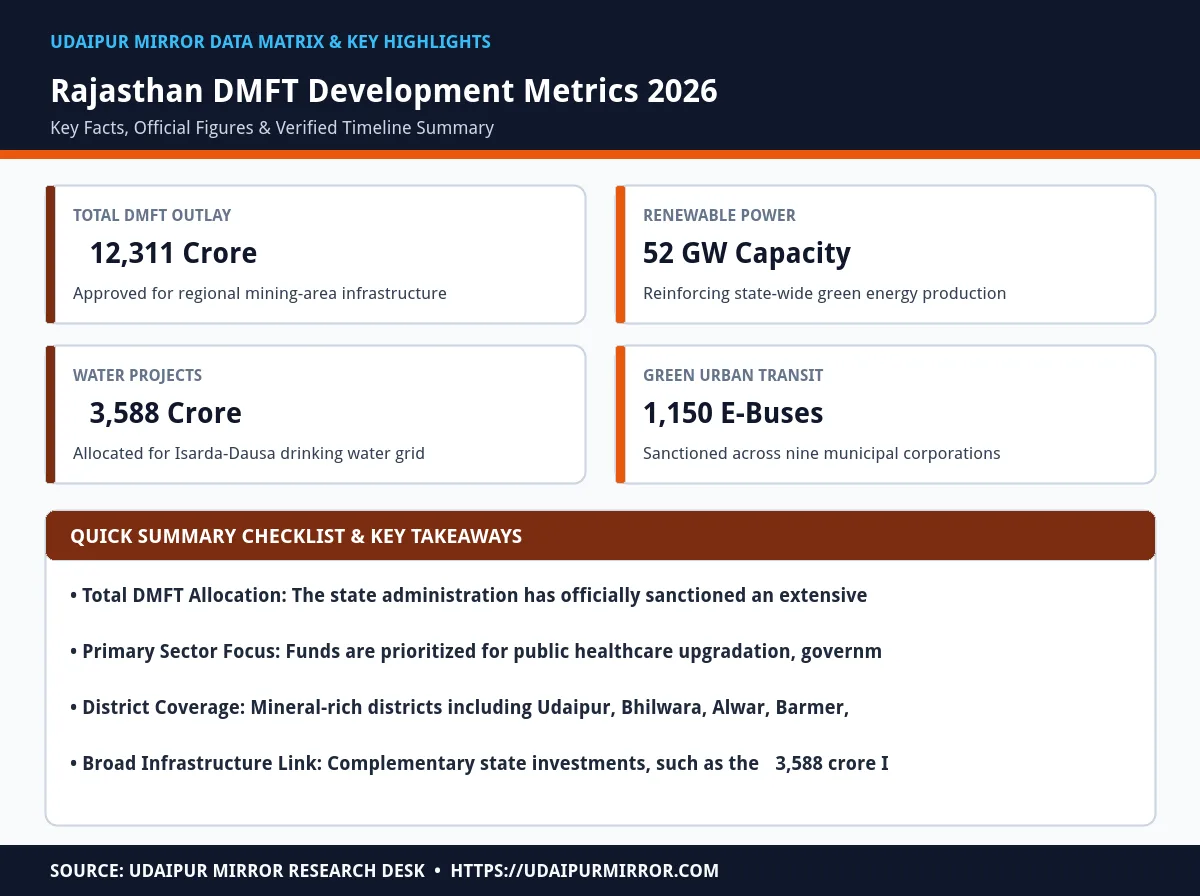
The revised budgetary distribution under the District Mineral Foundation Trust (DMFT) framework places heavy emphasis on transparent public utility delivery. Below is a comprehensive overview of how key mineral-rich districts in Rajasthan are directing these funds toward local community welfare.
| District | Primary Mineral Base | Key Focus Sector | Estimated Outlay Share |
|---|---|---|---|
| Udaipur | Lead, Zinc, Rock Phosphate | Rural Health & Drinking Water | High Priority |
| Bhilwara | Zinc, Lead, Iron Ore | School Upgradation & Roads | Moderate-High |
| Barmer | Lignite, Petroleum, Limestone | Community Health Centers | High Priority |
| Jodhpur | Sandstone, Limestone | Civic Sanitation & Infrastructure | Moderate Priority |
| Alwar | Marble, Quartz, Slate | Rural Connectivity & Utilities | Moderate Priority |
The state’s developmental blueprint extends far beyond basic mining welfare, creating an integrated matrix of public utility upgrades. Energy Minister recently highlighted that Rajasthan’s renewable energy capacity has touched an impressive 52 GW, while the Jaipur Discom reported a net profit of ₹931 crore, reflecting robust fiscal health across state-run utilities.
Concurrently, the state government is fast-tracking mega irrigation and drinking water initiatives. Chief Minister reviewed the progress of the ₹3,588 crore Isarda-Dausa drinking water project, ensuring that rural habitations in eastern Rajasthan secure uninterrupted water supplies. Similar grassroots administrative monitoring is visible when local communities raise issues through platforms akin to the Udaipur Bhaskar Samadhan reporting on Sajjangarh Road civic concerns, highlighting the administration’s responsiveness to civic grievances.
“Sustainable fiscal management in our power sector allows us to subsidize and support vital social infrastructure without accumulating unsustainable debt.” — State Energy Department Spokesperson
Complementing rural mineral fund expenditures, urban centers across Rajasthan are undergoing a green transportation overhaul. Under the centrally sponsored PM e-Bus Sewa scheme, Rajasthan has secured formal approval to deploy 1,150 electric buses across nine key cities. This initiative reduces carbon footprints while modernizing public transit fleets.
Public transport efficiency remains a cornerstone of state policy. Just as transport corporations enforce strict operational benchmarks—such as the recent mandate requiring Udaipur roadways conductors to meet 3,000 km targets on low-yield routes—urban electric bus deployments will be strictly monitored via GPS telemetry and passenger load factors to ensure maximum public utility.
“The integration of electric public transport in our secondary and tertiary cities marks a monumental leap toward sustainable urban mobility.” — Urban Development and Housing Department Official
The Rajasthan government has approved ₹12,311 crore in mining-area development works under the District Mineral Foundation Trust (DMFT) framework.
Primary focus sectors include public healthcare infrastructure, government school upgrades, clean drinking water supply, and rural road connectivity networks.
Districts like Udaipur, Bhilwara, Barmer, and Jodhpur receive dedicated allocations to address environmental and infrastructural strains caused by regional mining activities.
Key ongoing projects include the ₹3,588 crore Isarda-Dausa drinking water project and the deployment of 1,150 electric buses across nine cities under PM e-Bus Sewa.
Add Udaipur Mirror as a preferred source on Google to see more of our travel guides in your AI overviews.




[…] Mock Parliament Face-Off: Citizens' Group Plans Counter-Event to INDIA Bloc 3 seconds ago ⚡ Articles Rajasthan Pushes District Mineral Fund Spending Towards Basic Services and Local Developme… News Udaipur Traffic Restrictions: Collector Bans Heavy Vehicles on 11 City Routes from 7 AM to 10 […]