Office Address
14, Residency Road, Udaipur, Rajasthan 313001
Office Address
14, Residency Road, Udaipur, Rajasthan 313001


NEW DELHI: NEW DELHI — Intensifying the national debate over electoral transparency, senior parliamentarian shashi tharoor eci accountability discourse took center stage on Wednesday as he asserted that administrative course corrections behind closed doors fail to meet the standards required of a robust democracy. Speaking on the heels of major electoral roll updates, ongoing assembly election reviews, and judicial scrutiny regarding voter data handling, Tharoor emphasized that India’s constitutional bodies must embrace open scrutiny rather than arbitrary reversals to maintain public trust in the electoral process.
⚡ Quick Highlights: Shashi Tharoor Slams ECI Reversals & Demands Accountability
The debate surrounding the operational autonomy and decision-making transparency of India’s election machinery has gained renewed momentum. Critics and opposition lawmakers argue that institutional credibility hinges not just on conducting polls, but on explaining systemic shifts in real time. For fans tracking administrative updates alongside sports milestones like the IPL Teams and Players List, the need for transparent organizational structures is universally acknowledged across public and private domains.
Shashi Tharoor’s critique specifically targets the practice of altering electoral procedures or reversing significant administrative stances without public hearings or adequate parliamentary discourse. In a parliamentary democracy, statutory bodies must maintain absolute clarity to prevent speculations regarding electoral integrity. (Also read: IPL Teams and Players List: All 10 Franchises Full Squads, Captains & Complete Roster | आईपीएल टीमें और खिलाड़ी सूची).
“Closed-door policy adjustments and unannounced procedural reversals create unnecessary doubts among citizens. Democracy requires accountability in plain sight.” — Shashi Tharoor, Senior Parliamentarian
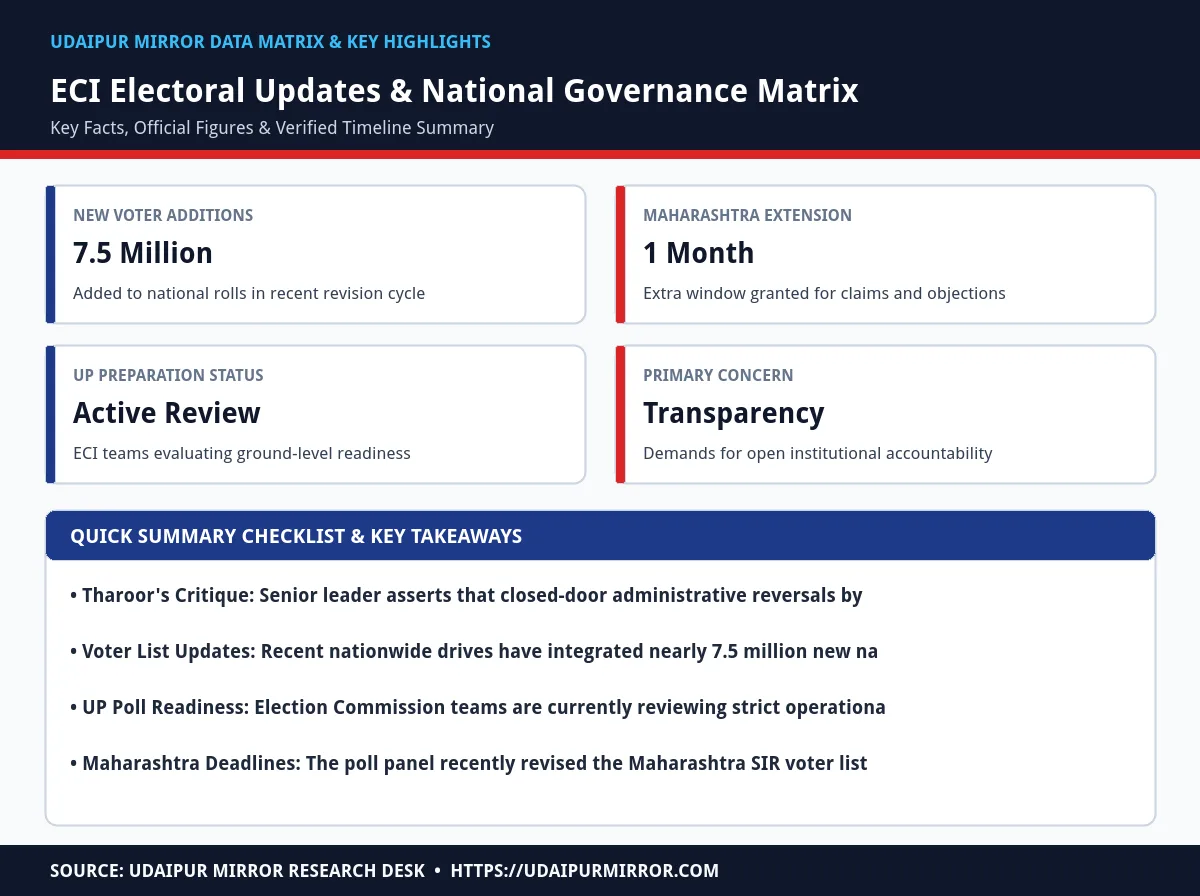
The following structured timeline outlines recent major administrative decisions, electoral roll revisions, and political accountability debates unfolding across national and state jurisdictions.
| Date / Period | Jurisdiction / Sector | ECI / Judicial Action | Key Political & Administrative Impact |
|---|---|---|---|
| November 18, 2026 | National Capital | Shashi Tharoor Statement | Demanded transparent public accountability over closed-door ECI reversals. |
| November 2026 | Uttar Pradesh | Assembly Poll Review | High-level ECI teams assessing grassroots election infrastructure and security. |
| November 2026 | Maharashtra | SIR Voter List Deadline | Extended timeline by nearly a month for filing claims and objections. |
| November 2026 | National Rolls | Voter Addition Drive | Nearly 7.5 million new citizens integrated into electoral registries. |
| November 2026 | Karnataka | High Court Stay Order | Proceedings paused on disputed Form 7 applications targeting specific voters. |
While national debates on institutional integrity continue in New Delhi, election machinery is operating at full throttle across critical states. In Uttar Pradesh, specialized Election Commission delegations are touring districts to evaluate ground-level preparedness, security logistics, and administrative readiness for the upcoming assembly elections. Similar rigorous planning is underway in Maharashtra, where the poll panel recently revised the Special Intensive Revision (SIR) voter list deadline.
By extending the timeline by nearly a month for citizens to file claims and objections, the ECI has attempted to address grassroots grievances. Travelers planning cross-country journeys during election seasons often monitor administrative advisories similarly to how they check a Udaipur to Spiti Valley Travel Guide for safe navigation through changing weather and terrain conditions.
“Rigorous ground evaluations and flexible timeline adjustments are vital to ensure that no legitimate voter is left disenfranchised during intensive revisions.” — Senior ECI Official
The intersection of judicial oversight and electoral administration has become increasingly prominent. Courts across various states are regularly called upon to adjudicate disputes regarding voter roll manipulation, targeted deletions, and data security. Most recently, the Karnataka High Court intervened by staying police investigations into alleged fraudulent Form 7 applications that reportedly targeted specific voter communities.
These legal interventions highlight the delicate balance required between swift administrative action and the fundamental right to fair representation. Legal analysts maintain that robust judicial review serves as a necessary check against administrative overreach, ensuring that technology and automated electoral databases are deployed with strict oversight. (Also read: Udaipur to Spiti Valley Travel Guide: How to Reach by Bus, Bike & Flight, Itinerary & Costs | उदयपुर से स्पीति वैली यात्रा).
“Judicial intervention in electoral administration underscores the necessity of foolproof digital verification and unbiased institutional processes.” — Constitutional Law Expert
As political parties gear up for intense electoral battles across multiple states, the discourse sparked by leaders like Shashi Tharoor transcends immediate partisan friction. It raises fundamental questions about how independent statutory institutions communicate with the electorate. In an era where digital verification and electoral roll management dictate democratic outcomes, absolute transparency is non-negotiable.
Governance experts emphasize that rebuilding trust requires proactive disclosures rather than reactive clarifications. Whether handling multi-phase state elections or managing national voter data upgrades, the Election Commission faces the ongoing challenge of proving its absolute impartiality to all stakeholders.
“The ultimate test of an electoral umpire is not just holding peaceful polls, but maintaining the unwavering faith of every political formation and citizen.” — Political Analyst
Shashi Tharoor criticized the ECI over closed-door policy reversals, arguing that administrative adjustments behind closed doors cannot replace genuine democratic accountability.
Recent national revision drives have successfully added nearly 7.5 million new names to voter lists across various states ahead of upcoming assembly elections.
The ECI revised the Maharashtra SIR voter list deadline, providing nearly an extra month for citizens and parties to file claims and objections.
The Karnataka High Court stayed an ongoing police probe into alleged fraudulent Form 7 applications that were reportedly targeting specific voter demographic groups.
Add Udaipur Mirror as a preferred source on Google to see more of our travel guides in your AI overviews.