Office Address
14, Residency Road, Udaipur, Rajasthan 313001
Office Address
14, Residency Road, Udaipur, Rajasthan 313001

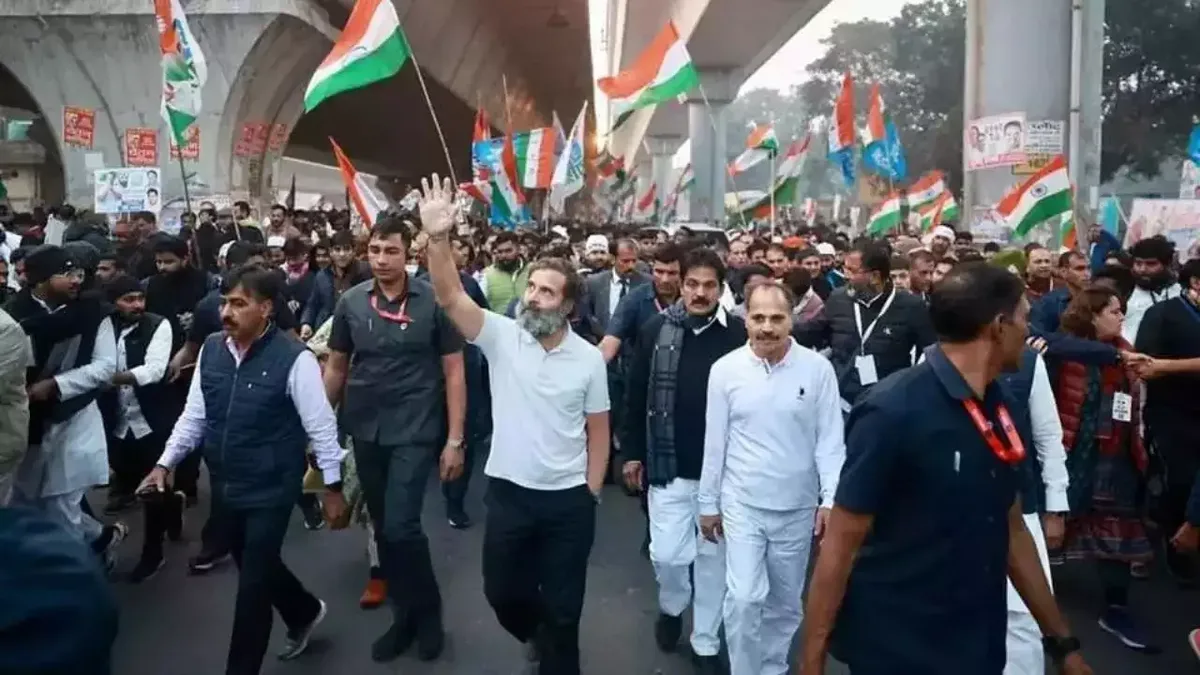
NEW DELHI: NEW DELHI — Political friction inside the national capital reached a fever pitch on Wednesday as Union Finance Minister Nirmala Sitharaman formally sitharaman challenges rahul gandhi to a transparent, structured parliamentary debate regarding Electronic Voting Machines (EVMs) and systemic institutional reforms (SIR). Speaking on the floor of the House, the senior Cabinet minister criticized the opposition’s ongoing narrative of casting doubts on autonomous democratic machinery, urging top leadership to substantiate claims with facts rather than staging continuous protests outside legislative chambers. The high-stakes political showdown follows weeks of verbal sparring between senior ruling alliance members and Congress leaders over electoral integrity and policy directions, creating intense legislative momentum.
⚡ Quick Highlights: Sitharaman Challenges Rahul Gandhi to Debate SIR, EVMs
The ongoing friction inside the national legislature escalated significantly when the Union Finance Minister took direct aim at the opposition’s persistent allegations surrounding voting transparency. By demanding an open floor debate, the ruling administration aims to counter what it characterizes as unfounded skepticism aimed at destabilizing constitutional faith. Cabinet ministers argued that repeated losses in state assembly polls have prompted opposition figures to target autonomous bodies unfairly, rather than engaging in constructive policy critique. Meanwhile, corporate sectors continue to monitor macroeconomic stability, with analysts noting that recent energy shifts such as Indus Towers Adds 300 MW Solar Power Across 50,000 Sites to Bolster Rajasthan Green Energy reflect robust infrastructural growth running parallel to these intense political battles.
Political commentators note that turning the tables on the opposition regarding procedural transparency shifts the legislative momentum. Rather than reacting defensively to outside protests, treasury benches have forced a direct parliamentary contest where assertions must be backed by verifiable data. This strategy is expected to dominate legislative proceedings throughout the current session. (Also read: Indus Towers Adds 300 MW Solar Power Across 50,000 Sites to Bolster Rajasthan Green Energy).
“If there are genuine concerns regarding our electoral machinery, the floor of Parliament is the rightful place to debate them with facts, not through street agitation.” — Senior Cabinet Source
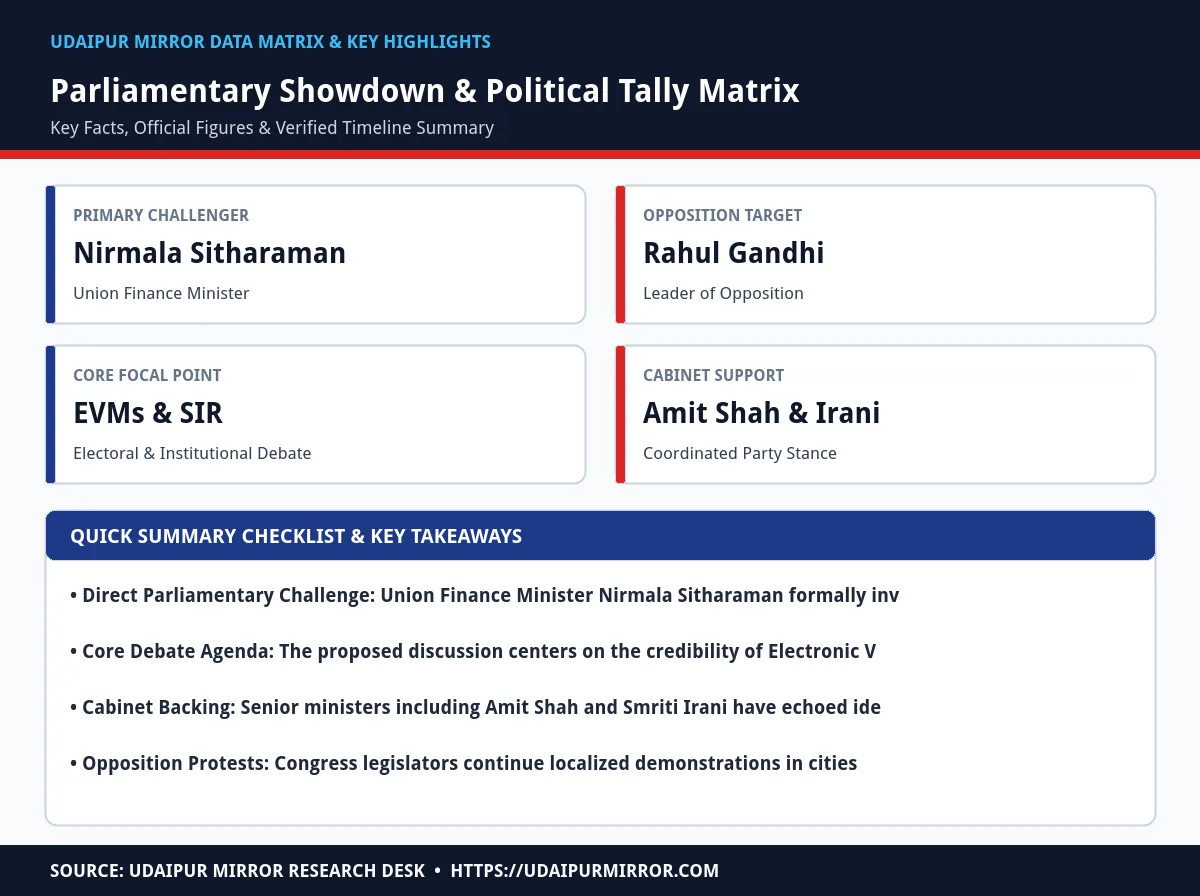
The following chronological matrix outlines the key political statements, ministerial challenges, and opposition counter-protests that have shaped the national political narrative over the past forty-eight hours.
| Date | Leader / Minister | Key Statement / Action | Core Focus Area |
|---|---|---|---|
| Nov 3, 2026 | Smriti Irani | Called opposition leadership ‘prince in perpetual waiting’ and urged acceptance of poll verdicts. | Electoral Defeats & Institutions |
| Nov 3, 2026 | Amit Shah | Challenged Rahul Gandhi to open debate on SIR amidst continuing Bengaluru protests. | Systemic Institutional Reform |
| Nov 4, 2026 | Nirmala Sitharaman | Formally challenged opposition bench to debate EVMs and SIR directly in Parliament. | Parliamentary Debate |
| Nov 4, 2026 | Congress Party | Maintained agitation stance and organized targeted demonstrations across regional hubs. | Grassroots Protests |
In tandem with Sitharaman’s challenge, senior ministers including Amit Shah and Smriti Irani launched a synchronized counter-offensive, pointing out that electoral verdicts must be respected across all tiers of governance. Irani particularly criticized the leadership style of the opposition, claiming that repeated electoral setbacks have failed to inspire introspection within the party rank and file. While political strategists debate the long-term electoral implications of these exchanges, citizens across states are simultaneously managing personal financial planning, drawing parallels to how young professionals evaluate long-term financial security much like Average 401(k) Balance by Age: What You Need to Save From 20s to Retirement discusses prudent monetary habits for future stability.
The coordinated response from the executive branch underscores a unified party strategy to preempt opposition narratives ahead of upcoming legislative milestones. By anchoring their arguments in historical poll metrics and constitutional safeguards, senior ministers seek to project an image of unwavering administrative confidence.
“Stop attacking independent institutions every time the electorate delivers a decisive mandate against your policies.” — Smriti Irani, Union Minister
Responding to the central government’s challenge, regional and national opposition units have vowed to maintain pressure both inside and outside legislative complexes. Protests organized in major metropolitan hubs like Bengaluru highlight the grassroots mobilization strategy adopted by party workers. Congress leaders maintain that their protests are a legitimate expression of public anxiety over the protection of democratic rights and transparency in voting systems. As the political tussle unfolds, observers expect both sides to leverage upcoming public forums to amplify their respective messages.
The friction inside Parliament is unlikely to subside quickly, as both coalitions view public perception on institutional integrity as a decisive factor for upcoming political milestones. While administrative business continues alongside committee reviews, the central debate over EVMs and SIR remains the dominant talking point across national news desks. (Also read: Udaipur Team Lifts Overall Championship Trophy With 101 Medals at State Kickboxing Tournament | उदयपुर की टीम बनी ओवरऑल चैंपियन).
“Our protests are a democratic defense of people's rights to demand total transparency in every election process.” — Congress Party Spokesperson
Union Finance Minister Nirmala Sitharaman challenged Rahul Gandhi following persistent opposition claims and protests questioning the credibility of Electronic Voting Machines and institutional frameworks.
SIR refers to systemic institutional reforms, a key subject of discussion regarding the oversight and mechanics of Indian democratic elections.
Senior ministers including Amit Shah and Smriti Irani have strongly criticized the opposition for attacking autonomous institutions and urged them to accept democratic poll verdicts.
Alongside parliamentary protests in New Delhi, opposition workers have staged demonstrations in key urban centers such as Bengaluru.
Add Udaipur Mirror as a preferred source on Google to see more of our travel guides in your AI overviews.