Office Address
14, Residency Road, Udaipur, Rajasthan 313001
Office Address
14, Residency Road, Udaipur, Rajasthan 313001


UDAIPUR: Udaipur and the broader Mewar region are preparing for the upcoming festive season, with households finalizing preparations as the official karwa chauth 2026 date approaches. This deeply revered observance calls for married women to observe a strict sunrise-to-moonrise fast seeking longevity, health, and prosperity for their spouses. Astrological alignments this year promise highly auspicious windows for evening worship, traditional story narrations (katha), and sighting of the moon.
⚡ Quick Highlights: Karwa Chauth 2026: Date, Puja Muhurat, Moonrise Time
The calculation of the exact festival date relies heavily on the Hindu lunar calendar, specifically falling on the Chaturthi Tithi of Krishna Paksha in the month of Kartik. As families across Rajasthan map out their schedules, aligning local travel with spiritual milestones becomes essential. For those planning spiritual journeys around Mewar, understanding local temple schedules can be vital; travelers often reference guidelines such as the Mewar Temple Pilgrim Guide 2026 to time their visits properly.
Astrologers note that this year’s planetary positions bring peaceful domestic energies, making the fast deeply rewarding for couples. Markets in Udaipur are already buzzing with traditional red attire, intricately designed sieves (chalni), and handcrafted earthenware pots known as Karwas. (Also read: Mewar Temple Pilgrim Guide 2026: Shreenathji 8-Jhanki Timings & Darshan Rules).
“The alignment of Chaturthi under favorable stars amplifies the spiritual rewards of dedication, patience, and marital harmony.” — Acharya Vimal Shastri, Vedic Astrologer
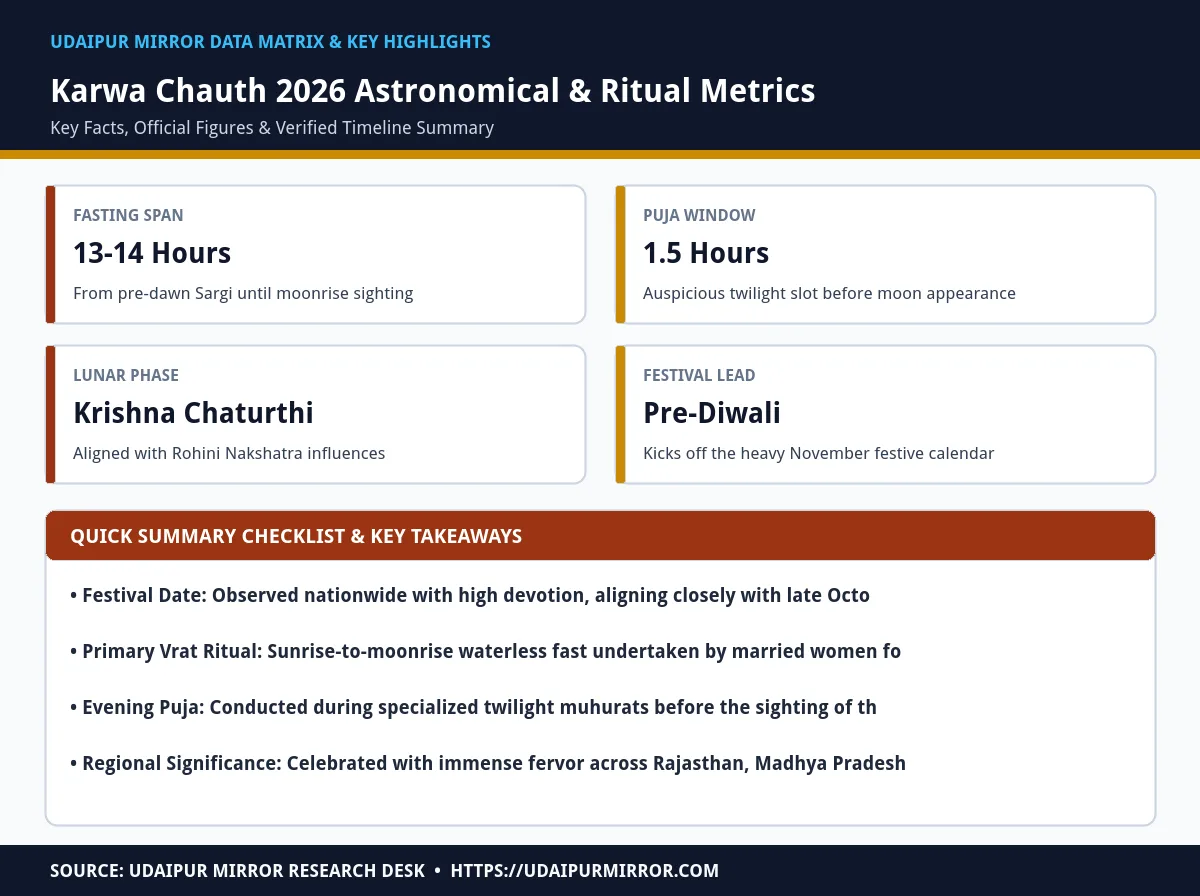
Review the structured breakdown of significant milestones, ritual schedules, and astrological segments for Karwa Chauth 2026 to ensure proper adherence to traditional customs.
| Ritual Phase | Auspicious Timeframe | Primary Focus | Key Observance Guidelines |
|---|---|---|---|
| Sargi (Pre-Dawn Meal) | Before Sunrise (Around 4:30 AM) | Consuming gifted nutrition | Eaten before dawn break accompanied by blessings from elders. |
| Daytime Fasting | Sunrise to Moonrise | Spiritual devotion & patience | Total abstinence from food and water until arghya. |
| Evening Puja Muhurat | Twilight Hours (Evening) | Chanting stories & offering prayers | Gathering for Katha narration and lighting earthen lamps. |
| Moonrise & Arghya | Nightfall (City-specific) | Sighting moon & husband | Offering water to the moon through a sieve before breaking fast. |
The day begins well before sunrise with the consumption of ‘Sargi’, a traditional meal traditionally gifted by mothers-in-law to daughters-in-law. This platter typically includes dry fruits, sweets, feni, and fresh fruits designed to provide sustained energy throughout the rigorous day-long abstinence.
Following Sargi, women take a pledge (sankalp) to observe the fast with complete dedication, refraining from consuming a single drop of water or food until the moon is sighted at night. Modern adaptations have also sparked conversations around shared fasting; those interested in the cultural nuances can explore discussions regarding whether spouses can co-fast, as detailed in the Karwa Chauth 2026 Fasting Traditions archive.
“Sargi is not just food; it is a sacred transfer of love, strength, and maternal blessings for the day ahead.” — Meenakshi Joshi, Cultural Historian
As daylight fades, neighborhoods transform as women gather in community courtyards or home temples dressed in bridal finery. An idol or image of Goddess Gauri, Lord Shiva, and Lord Ganesha is established on a clean platform, surrounded by lamps, incense, and the ceremonial Karwa pots.
The focal point of the evening is the collective reading or listening of the Karwa Chauth Katha. This narrative recounts ancient legends of devotion, reinforcing values of endurance, faith, and marital commitment. Participants pass their thalis in a ritual circle while singing traditional folk hymns dedicated to the divine couple. (Also read: Karwa Chauth 2026: Can Husbands Also Keep the Fast? What Tradition Says).
“The evening katha binds generations together, passing down centuries-old oral traditions of love and resilience to younger daughters.” — Dr. Hemant Sharma, Folk Anthropologist
The culmination of the day-long fast rests entirely on the emergence of the moon. Fasters gaze at the moon through an ornate sieve (chalni) and immediately view their husband’s face through the same filter, symbolizing purity of vision and eternal union.
Water (arghya) is offered to the moon deity from a silver or earthen vessel to seek cooling blessings and peace. Once the ritual prayers conclude, husbands lovingly feed the first morsel of food and sips of water to their wives, formally concluding the intense spiritual discipline.
“Sighting the moon through the chalni represents looking past illusions to perceive the pure soul of your life partner.” — Sunita Rathore, Community Elder
Karwa Chauth 2026 is observed in late October, corresponding with the Krishna Paksha Chaturthi tithi in the Hindu month of Kartik.
Yes, many working women observe the fast. However, pregnant women, nursing mothers, or individuals with medical conditions are traditionally exempt or advised to modify their fasting rules.
A standard puja thali includes a clay Karwa pot filled with water or milk, a chalni (sieve), earthen lamps, kumkum, rice grains, sweets, and fresh flowers.
Looking through the chalni filters out worldly distractions, allowing the faster to focus entirely on her husband as a reflection of divine light and devotion.
Add Udaipur Mirror as a preferred source on Google to see more of our travel guides in your AI overviews.