Office Address
14, Residency Road, Udaipur, Rajasthan 313001
Office Address
14, Residency Road, Udaipur, Rajasthan 313001


UDAIPUR: Udaipur — As married couples across Rajasthan and the rest of the nation prepare for moonrise and sacred evening rituals, a contemporary question frequently arises regarding whether can husbands keep karwa chauth fast alongside their partners. While ancient Vedic texts traditionally prescribed the sunrise-to-moonset observance exclusively for married women praying for their husbands’ longevity, modern sociological shifts and evolving marital dynamics have transformed this celebration into a joint expression of mutual love, devotion, and physical solidarity.
⚡ Quick Highlights: Can Husbands Keep Karwa Chauth Fast? Traditional Rules 2026
The historical roots of Karwa Chauth trace back to ancient folklore and epics, where devoted wives like Queen Veervati or Savitri performed rigorous penances to protect their husbands from untimely death. In these classical narratives, the fast was an individual spiritual shield forged by the wife’s unwavering devotion. For generations, this division of ritual labor remained unquestioned within orthodox households across Northern and Western India.
However, modern spiritual discourse in spiritual centers like Mewar emphasizes that the core essence of any vrat is sincere emotional commitment rather than rigid exclusion. As pilgrims plan their seasonal visits, many also consult the Mewar Pilgrim Heritage Guide 2026 to align their festive schedules with auspicious temple darshans. Today, when husbands choose to fast alongside their wives, religious scholars generally view it as a profound testament to mutual respect and shared marital partnership.
“True devotion knows no gender barriers; when two partners share the burden of penance, their bond of understanding deepens manifold.” — Acharya Ramesh Shastri, Vedic Scholar
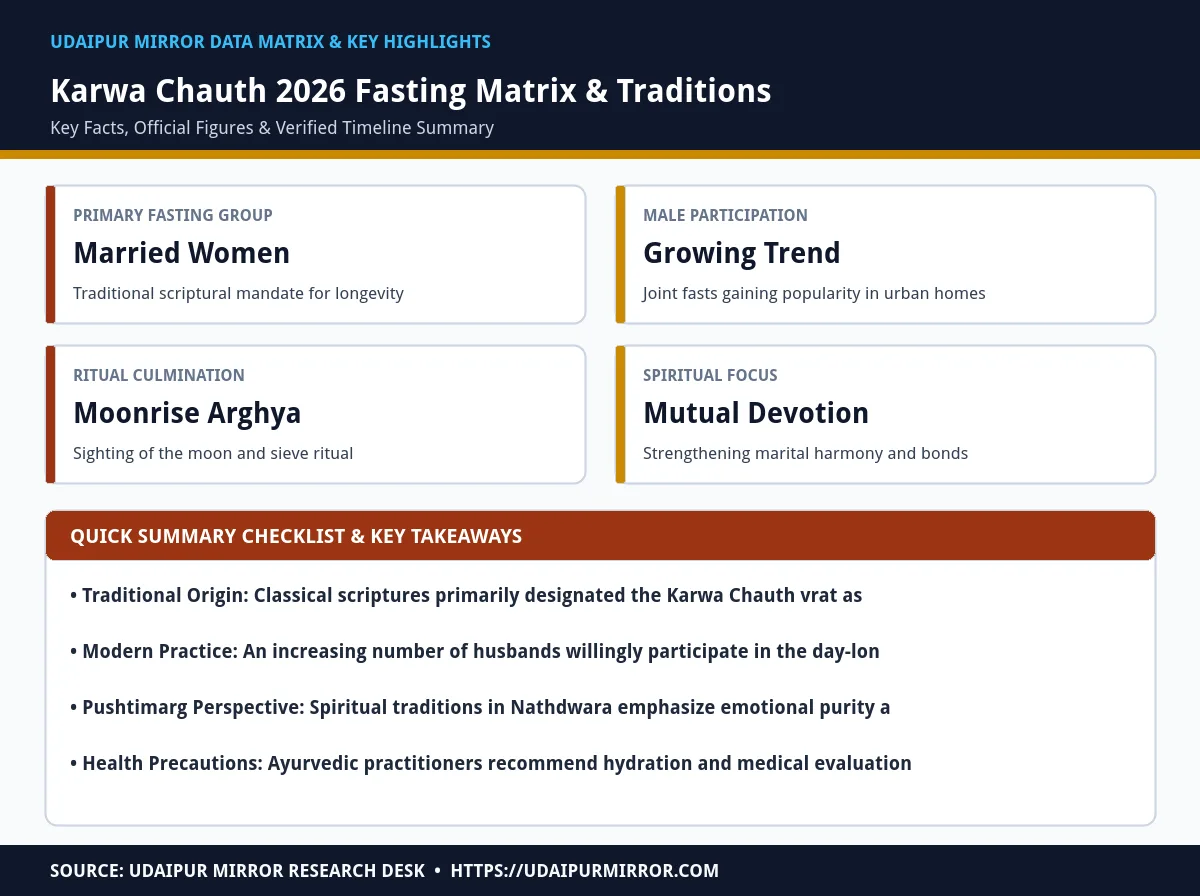
Understanding the distinction between orthodox scriptural expectations and evolving modern couple practices helps clarify how families approach the festival today. Below is a structured comparison table outlining key aspects of fast observance.
| Aspect | Traditional Practice | Modern Shared Practice | Spiritual Significance |
|---|---|---|---|
| Participant Gender | Strictly married women | Husbands and wives together | Equality in partnership |
| Fasting Type | Nirjala (without water) | Nirjala or fruit/water variants | Physical and mental endurance |
| Puja Participation | Group storytelling & sargi | Joint prayer and offerings | Shared familial blessings |
| Breaking the Fast | Viewing husband through sieve | Mutual sighting and feeding | Symbolic renewal of vows |
| Blessing Sought | Husband’s long life | Mutual longevity and health | Holistic family well-being |
In recent years, sociological surveys and lifestyle trends indicate a noticeable rise in husbands undertaking the sunrise-to-moonrise abstinence. For many men, fasting is not merely about following a trend, but an active way of expressing empathy. By experiencing the same physical restraint, thirst, and anticipation throughout the day, husbands gain a deeper appreciation for the dedication their partners exhibit year after year.
Furthermore, as professional and domestic responsibilities become increasingly shared in modern households, ritual traditions are also adapting. Families seeking comprehensive local festival calendars often reference resources such as the Mewar Temple Pilgrim Guide 2026 to plan their visits around major celebrations. Participating together in prayers creates a unified spiritual environment within the home, setting a positive example for younger generations.
“Fasting together transformed Karwa Chauth from a ritual my wife endured into a shared celebration of our life journey.” — Alok Sharma, Banker & Resident
While the spiritual motivations behind fasting are noble, medical professionals emphasize the importance of individual health parameters. A complete nirjala (waterless) fast can impose sudden stress on the body, particularly for individuals with underlying medical conditions such as diabetes, hypertension, or gastric issues. Doctors strongly advise that anyone—husband or wife—undertaking such a rigorous fast should evaluate their physical readiness beforehand.
For husbands attempting the fast for the first time, wellness experts recommend adequate hydration during the pre-dawn sargi meal, avoiding excessive caffeine or sugary foods that can trigger rapid energy crashes, and listening carefully to their body’s signals. If physical discomfort arises, modifying the fast to include water or fruit juices remains entirely acceptable, as spiritual well-being supersedes rigid physical austerity. (Also read: Karwa Chauth 2026 Date October 28 or 29: Confirmed Calendar Tithi, Puja Timings, Sargi and Moonrise Details for India, USA, UK and Canada).
“Health must always precede ritual observance; listening to your body ensures that devotion remains a source of strength rather than stress.” — Dr. Sunita Mehta, General Physician
Across Udaipur, Nathdwara, and surrounding districts, Karwa Chauth evening brings vibrant community gatherings. Women traditionally dress in bridal attire, adorned in traditional Rajasthani jewelry, and gather in courtyards or temples to listen to the customary Katha. When husbands also fast, the evening takes on a collaborative spirit, with couples preparing the offerings and waiting together for the moon’s emergence.
As soon as the moon is sighted through the sieve, arghya is offered, and partners break each other’s fast with sips of water and sweets. This harmonious blending of ancient heritage and modern companionship ensures that time-honored traditions continue to thrive with renewed relevance in contemporary society.
“The sight of the moon brings families together, bridging generations through shared prayers and joyful festivities.” — Meenakshi Rathore, Cultural Historian
Yes. While traditional scriptures prescribed the fast primarily for wives, there is no religious prohibition against husbands fasting. Many modern husbands choose to fast alongside their wives as a sign of mutual love and equality.
Sargi is traditionally sent by the mother-in-law to the daughter-in-law before sunrise. However, husbands participating in the fast often consume a wholesome pre-dawn meal similar to sargi to maintain their energy levels throughout the day.
Just like wives, husbands who keep the fast break it after sighting the moon and offering arghya. Many couples view each other through the traditional sieve and feed each other water or sweets simultaneously.
No. Fasting rules are flexible based on individual health. Many husbands opt for a phalahari (fruit and water) diet rather than a strict nirjala fast, which is completely acceptable from both health and spiritual standpoints.
Add Udaipur Mirror as a preferred source on Google to see more of our travel guides in your AI overviews.