Office Address
14, Residency Road, Udaipur, Rajasthan 313001
Office Address
14, Residency Road, Udaipur, Rajasthan 313001

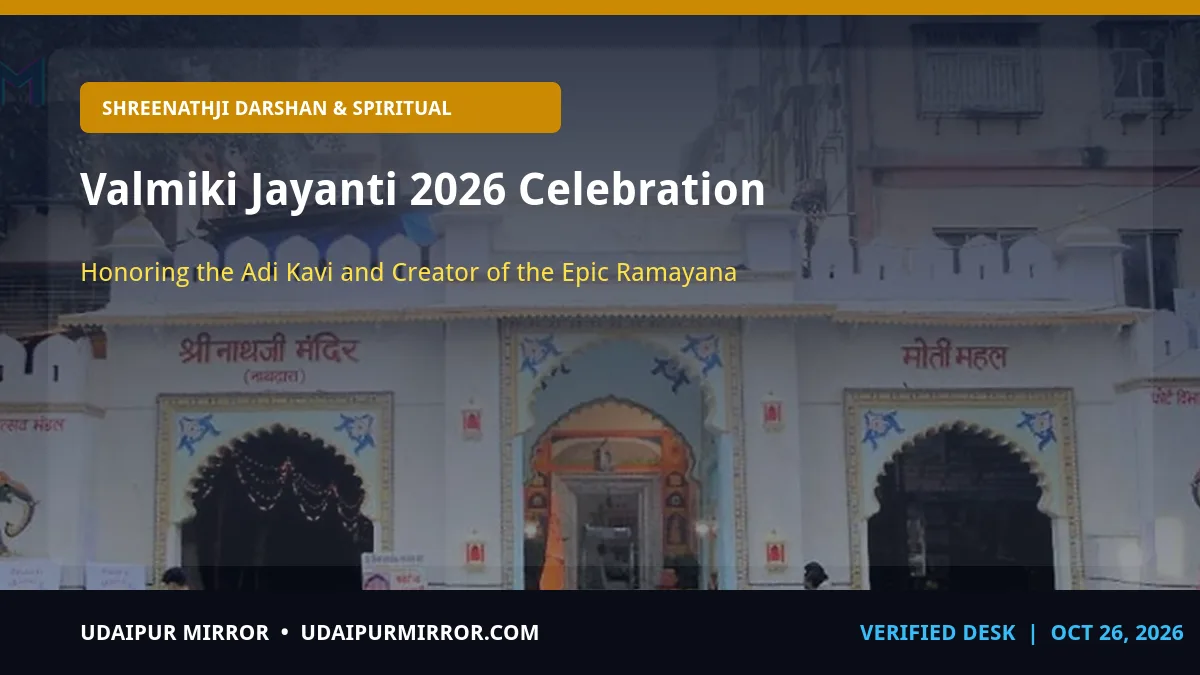
UDAIPUR: UDAIPUR — Devotees across the country observe valmiki jayanti 2026 with immense spiritual fervor, commemorating the birth anniversary of Maharishi Valmiki, revered universally as the Adi Kavi (first poet) of Sanskrit literature. As millions gather at temples and community centers to recite verses from the epic Ramayana, scholars and spiritual seekers reflect on the profound moral and philosophical framework established by the sage. For pilgrims planning spiritual journeys, aligning local temple visits with auspicious holy days remains a core tradition, much like following the Mewar Pilgrim Guide 2026 during festive seasons.
⚡ Quick Highlights: Valmiki Jayanti 2026: Date, Significance & Life History
The legendary account of Maharishi Valmiki stands as one of the most inspiring narratives of redemption in ancient Hindu lore. According to sacred texts, he was initially known as Ratnakar, a dacoit who roamed the forests. However, an encounter with the divine sage Narada Muni altered the course of his existence forever. When asked if his family would share the karmic burden of his sins, Ratnakar realized the harsh truth of his actions.
Overcome with profound remorse, Ratnakar immersed himself in deep meditation, chanting the holy name of Lord Rama with such intense devotion that anthills (valmika) formed around his motionless body. When the divine clearance manifested, he was reborn spiritually as Maharishi Valmiki. Spiritual seekers looking for historical alignment often study calendars that also reference the Panchang Today, October 25, 2026 to understand auspicious lunar phases.
“Penance purifies the mind, and true devotion to righteousness dissolves the heaviest of karmic bonds.” — Ancient Vedic Proverb
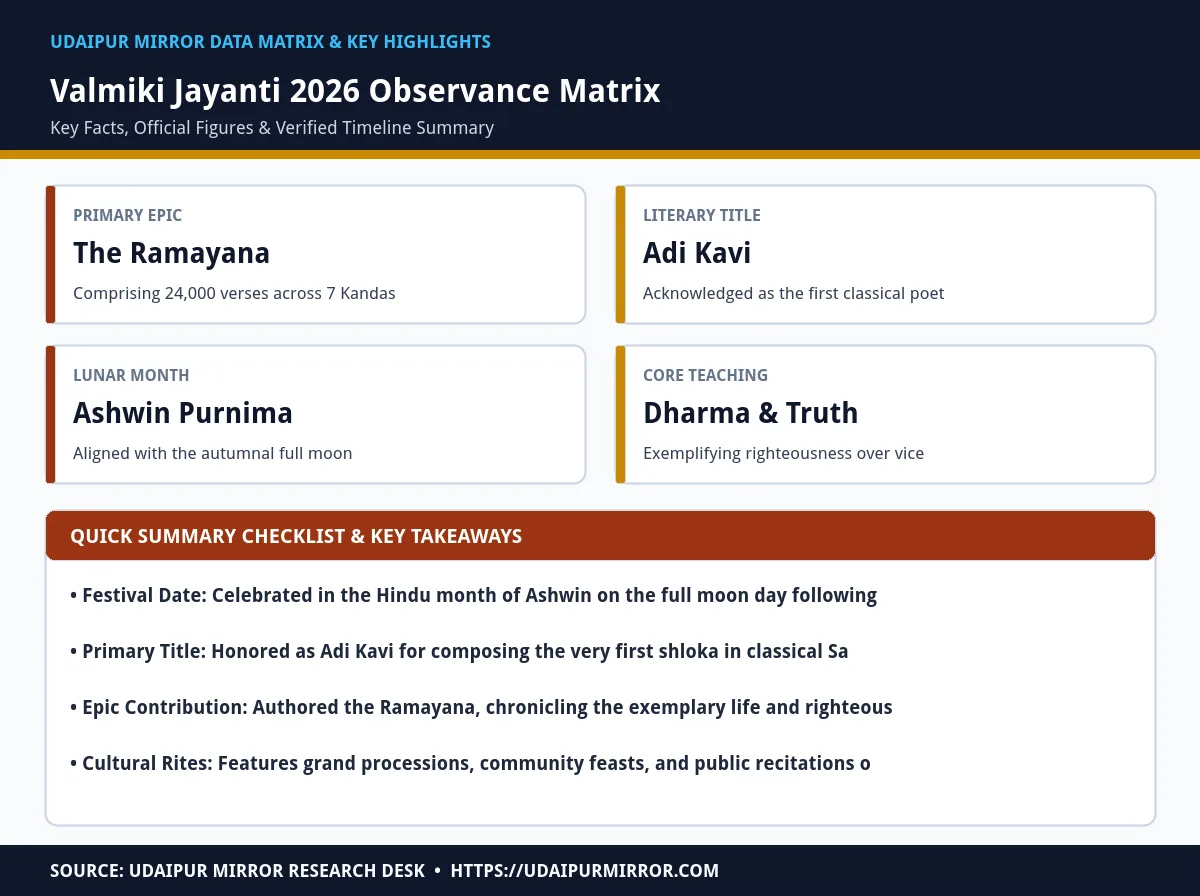
The following structured guide outlines the key elements, traditional rituals, and calendar context associated with the observance of Valmiki Jayanti in 2026.
| Event Aspect | Traditional Detail | Spiritual Significance | Observance Form |
|---|---|---|---|
| Festival Name | Valmiki Jayanti | Honoring the Adi Kavi | Public Processions & Prayers |
| Timing | Ashwin Shukla Purnima | Auspicious Lunar Alignment | Early Morning Temple Visits |
| Core Text | Valmiki Ramayana | Blueprint of Righteous Living | Akhand Path & Recitation |
| Social Impact | Community Harmony | Equality and Brotherhood | Bhandaras & Cultural Seminars |
| Historical Root | Ratnakar’s Transformation | Power of Repentance | Spiritual Discourses |
Maharishi Valmiki’s contribution to world literature is anchored in the composition of the Ramayana, an epic that has shaped Indian culture and ethics for millennia. The genesis of the epic itself is tied to a poignant moment of empathy. Disturbed by the sight of a hunter shooting a male bird from a mating pair, the sage’s grief spontaneously birthed a rhythmic couplet in Sanskrit.
This spontaneous verse, recognized as the very first shloka in classical Sanskrit poetry, caught the attention of Lord Brahma, who appeared before Valmiki and commissioned him to write the entire life story of Lord Rama. Comprising 24,000 verses distributed across seven kandas, the Ramayana remains an unmatched literary masterpiece.
“Out of sorrow arose the first verse of poetry, setting a divine standard for human expression.” — Scriptural Tradition
On the auspicious day of Valmiki Jayanti, towns and cities witness grand celebrations characterized by vibrant processions known as Shobha Yatras. Devotees carry decorated portraits and idols of Maharishi Valmiki through major thoroughfares, chanting Vedic hymns and devotional bhajans. Temples dedicated to the sage organize special prayer services, scripture readings, and community kitchens (bhandaras).
Educational institutions and cultural organizations also host seminars and essay competitions to educate the younger generation about the sage’s literary contributions and the moral lessons embedded in the Ramayana. These gatherings foster a spirit of unity, social equality, and communal harmony among all participants. (Also read: Panchang Today, October 25, 2026: Shukla Chaturdashi under Revati Nakshatra | Astrology).
“Celebrating the Adi Kavi is a reaffirmation of our collective commitment to truth, duty, and literary heritage.” — Cultural Scholar
The teachings of Maharishi Valmiki extend far beyond storytelling; they offer a timeless manual for ethical governance, personal integrity, and emotional resilience. The characters in the Ramayana—whether it is Rama’s unwavering adherence to truth, Sita’s grace under adversity, or Lakshmana’s selfless service—serve as eternal archetypes for human conduct.
In contemporary times, revisiting Valmiki’s work provides essential solace against the stresses of modern life. By emphasizing that background does not limit one’s spiritual potential, Valmiki’s own life journey champions the universal truth that redemption and greatness are attainable through sincere repentance and righteous living.
“The Ramayana is not merely a tale of the past, but a living guide for the future of humanity.” — Philosophical Treatise
Valmiki Jayanti celebrates the birth anniversary of Maharishi Valmiki, the author of the Ramayana and revered as the Adi Kavi (first poet) of Sanskrit literature.
It is observed on the full moon day (Purnima) in the Hindu lunar month of Ashwin, typically falling shortly after Sharad Purnima.
He is called Adi Kavi because he composed the very first shloka in classical Sanskrit meter, which later inspired the composition of the entire Ramayana.
Celebrations include grand Shobha Yatras (processions), community prayers, reading sessions of the Ramayana, and charitable food distributions.
Add Udaipur Mirror as a preferred source on Google to see more of our travel guides in your AI overviews.