Office Address
14, Residency Road, Udaipur, Rajasthan 313001
Office Address
14, Residency Road, Udaipur, Rajasthan 313001


NEW DELHI / UDAIPUR: Artificial intelligence is no longer merely an experimental tool for software enhancement; it has become a structural force that is actively altering international business models. As enterprises worldwide accelerate their deployment of advanced generative models, the global outsourcing bargain is experiencing an unprecedented paradigm shift, moving traditional IT services away from classical labor-heavy cost arbitrage toward high-efficiency automated execution.
⚡ Quick Highlights: AI Is Rewriting The Global Outsourcing Bargain: 2026 Analysis
For decades, the foundation of cross-border technology services rested heavily on labor arbitrage—leveraging skilled engineering pools in emerging markets to deliver software development and maintenance at a fraction of Western costs. However, as generative algorithms and autonomous coding systems achieve remarkable proficiency, the core economic equation is faltering. When software code can be synthesized, tested, and deployed in fractions of traditional timeframes, the sheer volume of billable hours ceases to be a primary metric of value.
This transformation is prompting corporate boards to rethink vendor contracts. Instead of paying for headcount expansion, clients now demand guaranteed performance metrics, faster time-to-market, and continuous innovation cycles. While executing these portfolio adjustments, enterprises are also monitoring broader financial ecosystems, much like investors analyzing opportunities in markets such as the EAAA India Alternatives IPO to optimize their capital deployment strategies.
“The era of trading raw human hours for digital output is drawing to a close. Intelligence is becoming the new baseline utility.” — Global Technology Strategy Analyst
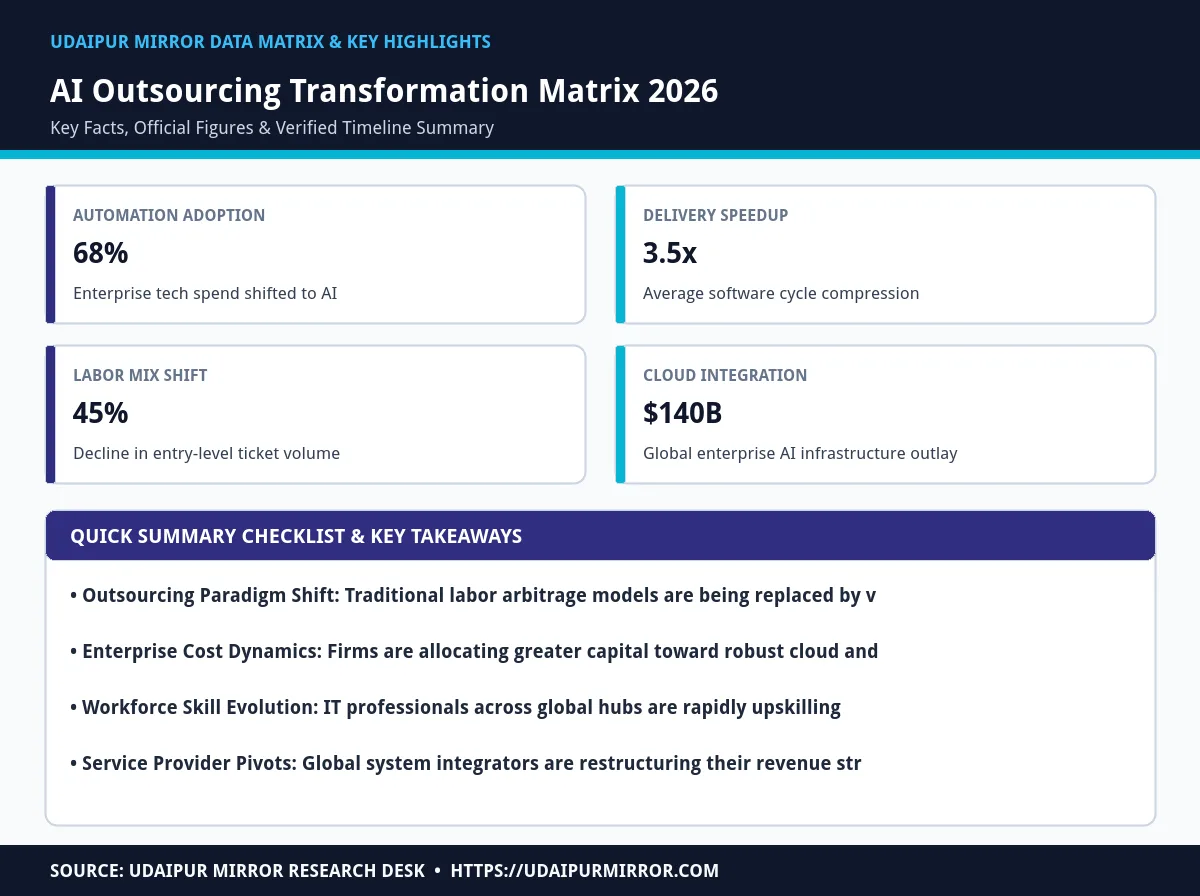
The economic foundations of international technology contracts are undergoing a structural overhaul. The comparison below outlines how key service dimensions differ between conventional labor-based outsourcing and modern AI-centric models.
| Service Dimension | Traditional Outsourcing Model | Modern AI Outsourcing Model | Primary Impact on Value |
|---|---|---|---|
| Pricing Structure | Time and Material (Billable Hours) | Value-Based Outcomes & Efficiency | Shifts risk from client to vendor |
| Code Generation | Manual developer coding and testing | Autonomous AI agents and co-pilots | Accelerates delivery timelines |
| Support Services | Tiered human helpdesk operations | Conversational AI and predictive ticketing | Lowers operational overheads |
| Skill Requirements | High volume of junior developers | Advanced architecture and AI oversight | Elevates baseline technical requirements |
| Contract Duration | Multi-year fixed capacity agreements | Agile, milestone-linked modular deals | Increases vendor accountability |
As enterprise adoption scales, the entire technology value chain experiences profound reorganization. System integrators and boutique software firms alike are racing to embed proprietary machine learning frameworks into their service offerings. Clients no longer seek basic offshore support units; they demand sophisticated integration partners capable of orchestrating complex multi-cloud environments, ensuring data sovereignty, and mitigating algorithmic drift across production systems.
This operational evolution mirrors infrastructure developments happening across diverse sectors, whether urban administrative bodies revamping regional planning frameworks similar to the Udaipur Development Authority plot schemes or rural communities adopting green energy transformations like Chhattisgarh’s Khaira solar village initiative. In every domain, systemic efficiency and future-proof digital infrastructure are replacing older, manual modalities.
“Enterprises that fail to bake intelligence into their foundational workflows will find themselves priced out of competitive global markets.” — Enterprise Architecture Lead
The displacement of routine coding and transactional IT tasks by automation has sparked intense debate regarding employment stability. While early career roles involving basic syntax generation or manual ticket sorting face contraction, demand for high-level system architects, prompt engineers, and AI ethics compliance officers is surging. Technology education providers and corporate training divisions are aggressively restructuring their curricula to bridge this widening talent gap.
Ultimately, the global outsourcing bargain is evolving into a collaborative ecosystem where human oversight guides autonomous digital labor. Providers that successfully navigate this transition will redefine international tech partnerships for the next decade, ensuring resilience against rapid technological disruptions. (Also read: UDAipur Development Authority Unveils New Residential Plot Schemes and Revised DLC Rates for FY 2026-27).
“AI will not replace humans, but humans using AI will quickly replace those who do not.” — Future of Work Researcher
AI is shifting enterprise tech contracts away from traditional labor arbitrage (billable hours) toward value-driven outcomes, speed, and automated execution frameworks.
Traditional service providers must pivot from manual staffing models to offering proprietary AI platforms, consulting, and automated software delivery systems to stay competitive.
Routine coding and entry-level support tasks are experiencing automation-driven contraction, while demand for advanced architectural, governance, and AI oversight roles is increasing.
Key priorities include cloud infrastructure security, cross-border data compliance, algorithmic transparency, and measurable performance outcomes over headcount volume.
Add Udaipur Mirror as a preferred source on Google to see more of our travel guides in your AI overviews.






[…] Setup for Today: GIFT Nifty Steady Amid Wall Street Sell-Off and Crude Oil Dip 4 seconds ago ⚡ Apps AI Is Rewriting The Global Outsourcing Bargain – Analysis 36 minutes ago ⚡ Elections Rahul Gandhi Can Only Be PM in Mock Parliament, Says Union Minister Amit Shah 1 hour ago […]