Office Address
14, Residency Road, Udaipur, Rajasthan 313001
Office Address
14, Residency Road, Udaipur, Rajasthan 313001


NEW DELHI: NEW DELHI — Union Minister for Electronics and Information Technology
⚡ Quick Highlights: Vaishnaw at NDTV World Summit: India Smartphone Milestone 2028
The statements made by Union Minister Ashwini Vaishnaw at the NDTV World Summit have fundamentally altered the narrative surrounding India’s consumer electronics sector. Instead of celebrating incremental milestones in smartphone assembly by global brands, the government has thrown down the gauntlet for domestic enterprises to engineer and market a truly Indian flagship smartphone ecosystem. This vision parallels recent structural advancements seen in other technology sectors, where advancements like IT Stocks Q2 Results Analysis highlight India’s growing dominance in software engineering and artificial intelligence integration.
Industry analysts note that while India has successfully attracted top-tier manufacturers like Apple and Samsung to set up massive production lines across Tamil Nadu and Uttar Pradesh, owning the entire value chain—from silicon design to software interface—remains the ultimate litmus test for technological sovereignty. (Also read: Tech, Innovation Could Boost Indo-UAE Trade to 0b by 2032: Indian Diplomat).
“We are no longer content with being the world's assembly line. October 2028 will mark India's arrival as a creator of elite, world-class mobile technology.” — Ashwini Vaishnaw, Union Minister for Electronics & IT
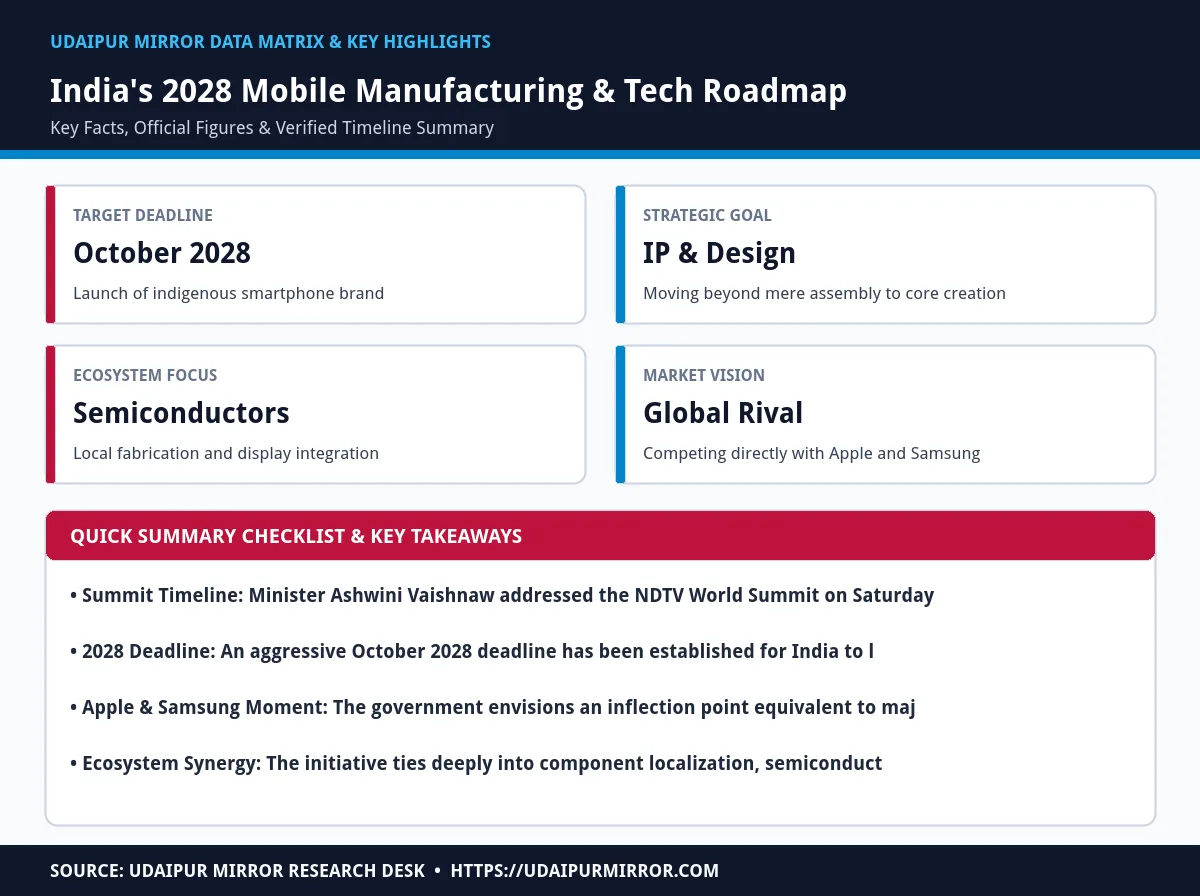
A detailed breakdown of how India’s mobile manufacturing sector has progressed from basic assembly towards complete domestic product conceptualization and semiconductor integration.
| Strategic Phase | Primary Focus Area | Key Policy Drivers | Target Milestone |
|---|---|---|---|
| Phase 1 (2024) | Smartphone Assembly & Export | PLI Schemes for Large-Scale Electronics | USD 15 Billion Annual Exports |
| Phase 2 (2025) | Component Localization | Sub-assembly incentives, PCB manufacturing | 35% Domestic Value Addition |
| Phase 3 (2026) | Semiconductor & Display Fabs | India Semiconductor Mission (ISM) backing | Initial Silicon Wafer Production |
| Phase 4 (2028) | Homegrown Brand Launch | Complete R&D, Chipset Design, IP Ownership | October 2028 Flagship Debut |
Setting an explicit deadline of October 2028 demonstrates extreme confidence in the ongoing semiconductor fabrication units and design incentives currently rolling out across the nation. The minister emphasized that India’s domestic market, driven by massive data consumption and rapid 5G deployment, provides the perfect sandbox for a homegrown brand to scale rapidly before going global.
Furthermore, hardware ecosystems are expanding rapidly to support heavy-duty devices, with innovations reminiscent of robust battery engineering seen in upcoming heavy-duty releases such as the Vivo Y600 Set for India Launch With Monumental 10,000mAh Battery, proving that consumer demands for heavy-duty endurance are being met by advanced supply chains.
“India will have its own Apple and Samsung moment. Our engineers have the talent, our startups have the hunger, and our policies now provide the backing.” — Ashwini Vaishnaw
While the 2028 goal is inspiring, industry stakeholders acknowledge the immense challenges involved in breaking into a mature global smartphone market dominated by established behemoths. Developing proprietary mobile operating systems, custom silicon chipsets, and high-end camera sensors requires multi-billion dollar capital expenditure and years of rigorous R&D.
However, the government’s phased incentive structure aims to mitigate these risks by partnering with academic institutions and global research centers. By fostering collaborative innovation, India intends to bridge the gap between academic research and commercial manufacturing swiftly. (Also read: IT Stocks Q2 Results Analysis: Infosys vs TCS vs Wipro vs HCL vs TechM in AI Race).
“The path is challenging, but our policy framework ensures that risk is shared and innovation is generously rewarded.” — Senior Ministry Official
The broader economic implications of an indigenous smartphone brand extend far beyond consumer gadgets. Millions of high-paying engineering, design, supply chain management, and quality assurance jobs are expected to be created across technology hubs like Bengaluru, Pune, Noida, and Hyderabad.
As India marches toward its 2028 target, local suppliers and ancillary industries will experience unprecedented growth, cementing the nation’s status as an indispensable pillar of the global digital economy.
“Technology self-reliance is economic security. Every smartphone designed in India adds immense value to our GDP.” — Ashwini Vaishnaw
Union Minister Ashwini Vaishnaw announced an aggressive October 2028 deadline for India to launch its very own indigenous smartphone brand, aiming to create an ‘Apple and Samsung moment’ for the country.
The target deadline set by the government is October 2028, marking a shift from contract manufacturing to core intellectual property and design creation.
It represents a transition from being a global assembly hub to an independent technology creator, ensuring supply chain security and boosting high-value domestic engineering jobs.
Support includes semiconductor fabrication incentives, R&D funding, strengthened patent laws, and collaborative frameworks between academic institutions and tech enterprises.
Add Udaipur Mirror as a preferred source on Google to see more of our travel guides in your AI overviews.