Office Address
14, Residency Road, Udaipur, Rajasthan 313001
Office Address
14, Residency Road, Udaipur, Rajasthan 313001

BENGALURU: BENGALURU — As Indian technology firms wrap up their earnings announcements for the second quarter of fiscal 2027, the latest it stocks q2 results analysis reveals a complex narrative of macroeconomic stabilization, shifting discretionary spending, and a relentless scramble to monetize generative enterprise AI platforms. Tier-1 Indian IT corporations including Tata Consultancy Services (TCS), Infosys, Wipro, HCLTech, and Tech Mahindra have all reported their financial health, highlighting varying degrees of success in navigating global enterprise tech budget contractions while attempting to secure high-value digital transformation contracts.
⚡ Quick Highlights: IT Stocks Q2 Results Analysis: Infosys vs TCS vs Wipro vs HCL
The Q2 earnings season has painted a nuanced picture of demand recovery across key western markets. While discretionary spending by banking, financial services, and insurance (BFSI) clients remains cautious, cost-optimization and vendor consolidation deals continue to flow into Indian headquarters. TCS posted a steady constant currency revenue expansion, anchored by robust deal wins in North American retail and European manufacturing. Meanwhile, Infosys capitalized on its digital transformation expertise to capture market share, allowing management to revise their full-year growth outlook upward.
Operating margins across the board faced persistent headwinds from annual wage increments, subcontracting costs, and investments in generative AI talent upskilling. However, automation initiatives and improved employee utilization rates helped cushion the blow. Beyond corporate earnings, broader economic indicators such as those discussed in economic analyses like our detailed report on regional per capita income metrics highlight how shifting macroeconomic factors influence consumer and enterprise sentiment globally.
“Demand patterns are stabilizing across our core verticals. Clients are prioritizing efficiency, operational resilience, and scalable AI adoption over experimental proofs-of-concept.” — Senior IT Industry Analyst
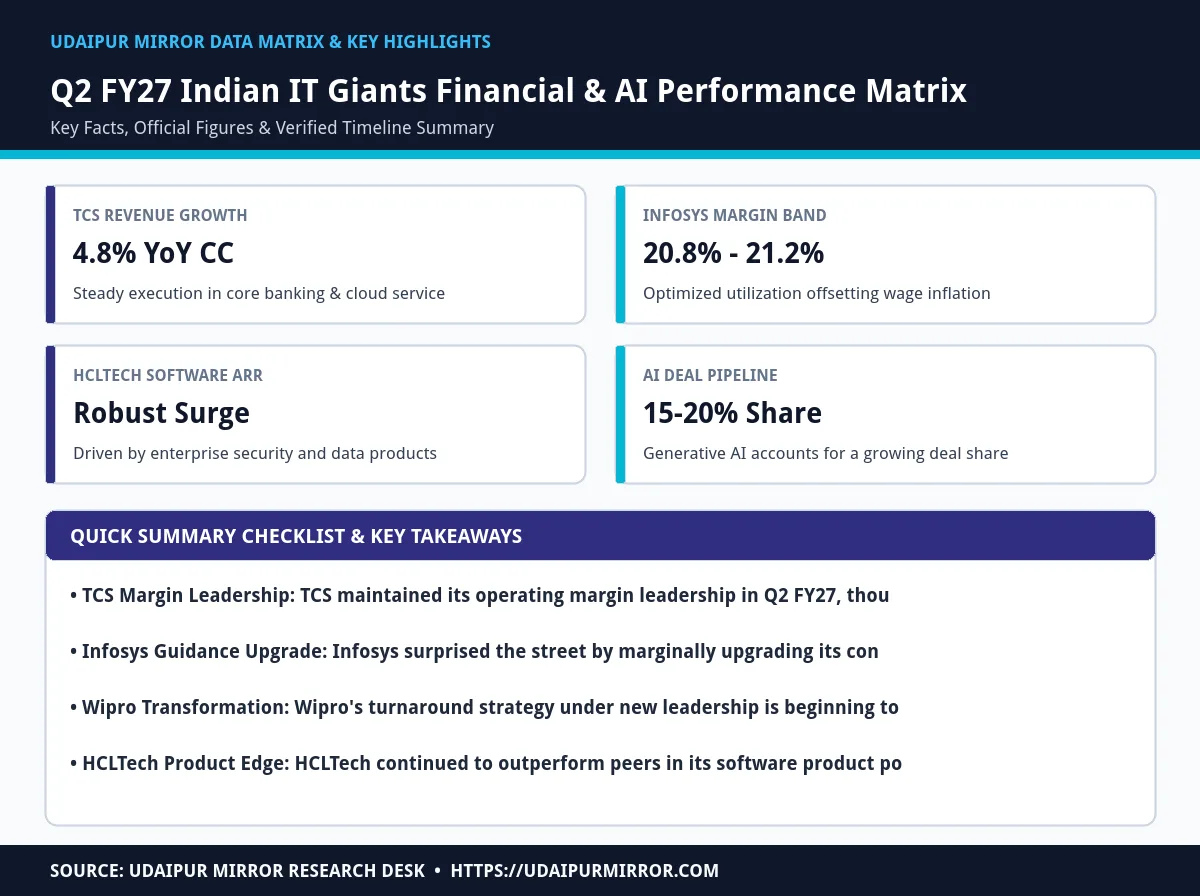
The following structured data table outlines the core financial performance indicators, constant currency growth rates, operating margins, and AI integration metrics for the top five Indian IT service providers during the second quarter of fiscal year 2027.
| Company Name | Constant Currency Growth | Operating Margin | Interim Dividend | AI Strategy Focus |
|---|---|---|---|---|
| Tata Consultancy Services (TCS) | 4.8% YoY | 24.5% | Rs 10 per share | Enterprise Cognitive Core & Cloud AI |
| Infosys | 5.2% YoY | 21.0% | Rs 18 per share | Topaz GenAI Suite & Automation |
| HCLTech | 6.1% YoY | 18.4% | Rs 12 per share | AI Force Software & Engineering |
| Wipro | 2.9% YoY | 16.7% | Rs 6 per share | AI360 Framework & Data Hubs |
| Tech Mahindra | 3.4% YoY | 14.2% | Rs 15 per share | Project Indus LLM & Telecom AI |
A central theme dominating analyst earnings calls this quarter is the monetization of artificial intelligence. While all major Indian IT service providers report massive pipelines filled with generative AI projects, translating these proofs-of-concept into sustained top-line revenue growth remains an industry-wide challenge. Companies are heavily promoting proprietary suites—such as Infosys Topaz, TCS Cognix, and Wipro AI360—to help global enterprises transition from experimental trials to production-grade deployment.
Industry executives emphasize that while AI deals currently represent a fraction of total contract values, their strategic importance is disproportionately high. Clients demand guaranteed productivity gains, forcing IT firms to adopt outcome-based pricing models rather than traditional billable-hour structures. In parallel, capital markets are closely monitoring how Indian tech firms allocate resources toward cloud infrastructure and advanced computing nodes, drawing parallel interest with monumental capital events such as the historic public market listings and funding rounds seen across the wider Indian digital ecosystem.
“Artificial intelligence is no longer a peripheral pilot project; it is deeply embedded in every enterprise RFQ we receive today.” — Chief Technology Officer at Leading IT Firm
Amid moderate top-line growth, Indian IT corporations have consistently reinforced their reputation as reliable dividend payers. Strong free cash flow generation and conservative balance sheets allowed firms to announce generous interim dividends for shareholders during their board meetings this October. TCS and Infosys led the pack with substantial per-share payouts, while HCLTech and Tech Mahindra maintained attractive dividend yields to reward long-term investors.
This consistent return of capital highlights the financial resilience of the sector, even as management teams navigate global geopolitical uncertainties and currency fluctuations. Institutional investors have responded favorably to these capital allocation strategies, viewing stable dividend yields as a vital cushion against broader equity market volatility. (Also read: Jio Platforms IPO Final Day Closes with Record Rs 4.90 Lakh Crore Bids and Listing Date Announcement).
Looking ahead into the second half of fiscal year 2027, the Indian IT sector faces a mix of structural opportunities and macro risks. While anticipated interest rate cuts in western economies could thaw discretionary tech spending, global supply chain complexities and currency volatility remain wildcards. Companies that successfully scale their generative AI capabilities while maintaining strict cost discipline are expected to capture disproportionate market share in the upcoming quarters.
Ultimately, the Q2 results demonstrate that Indian IT giants have successfully weathered the post-pandemic correction phase. By pivoting aggressively toward cloud infrastructure modernization, enterprise AI integration, and disciplined operational execution, firms like TCS, Infosys, Wipro, HCLTech, and Tech Mahindra are well-positioned for sustainable, profitable growth as the digital economy evolves.
HCLTech and Infosys registered robust constant currency revenue growth in Q2 FY27, driven by strong software product performance and large deal momentum.
IT firms are monetizing AI through proprietary platforms like Infosys Topaz and TCS Cognix, shifting toward outcome-based pricing models tied to client productivity gains.
Operating margins remained largely stable despite wage hikes and sub-contractor expenses, supported by automation, operational efficiencies, and higher employee utilization.
Infosys marginally upgraded its constant currency revenue growth guidance for the fiscal year, reflecting strong large-deal wins and healthy enterprise pipeline conversion.
Add Udaipur Mirror as a preferred source on Google to see more of our travel guides in your AI overviews.