Office Address
14, Residency Road, Udaipur, Rajasthan 313001
Office Address
14, Residency Road, Udaipur, Rajasthan 313001

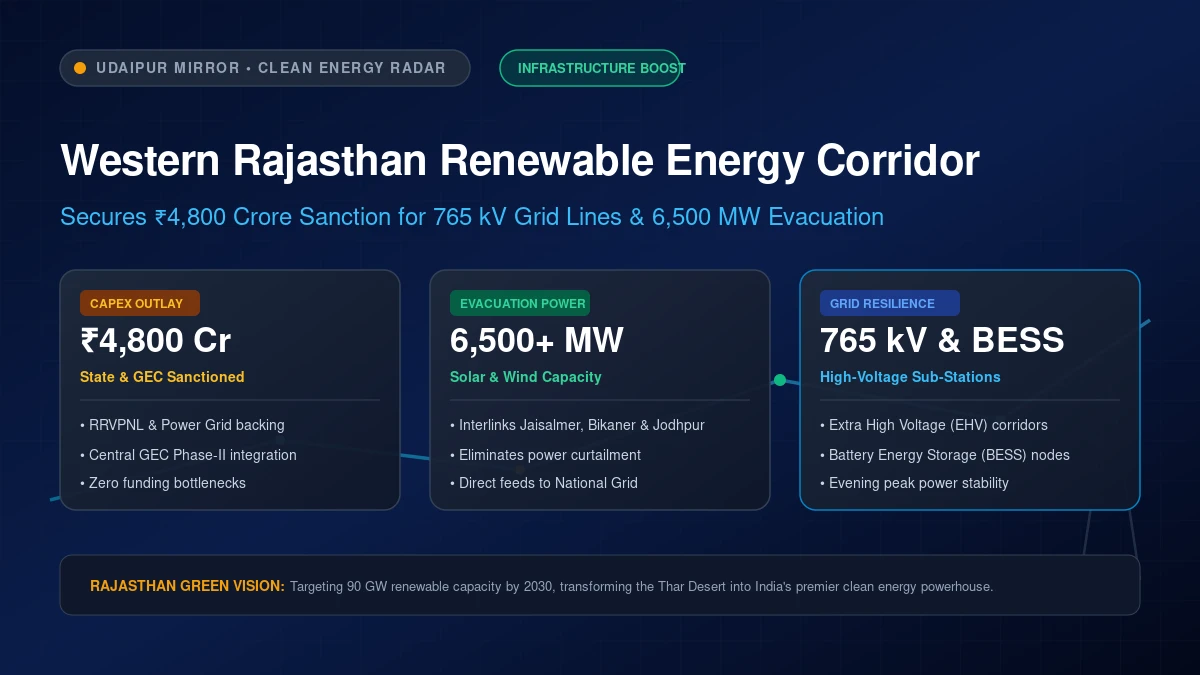
In a monumental milestone for India’s clean energy ambitions, the western rajasthan renewable energy corridor has secured a massive ₹4,800 crore investment sanction. Approved by the Rajasthan Energy Department alongside central support under the Green Energy Corridor (GEC) initiative, this substantial capital infusion is dedicated to building extra-high-voltage (EHV) transmission networks, modern gas-insulated substations (GIS), and cutting-edge battery storage systems across the Thar desert. The strategic expansion will enable the seamless evacuation of over 6,500 megawatts (MW) of solar and wind energy directly into the National Power Grid.
Western Rajasthan—encompassing the sun-drenched expanses of Jodhpur, Jaisalmer, Bikaner, and Barmer—commands India’s highest solar irradiance, with over 325 clear sunny days annually. However, rapid commissioning of mega solar parks has historically outpaced transmission evacuation infrastructure, creating periodic bottlenecks for power developers. As detailed in our comprehensive coverage of Rajasthan’s green energy policy and mega solar corridors, this fresh ₹4,800 crore allocation establishes the technical superhighway required to eliminate green power curtailment and fulfill India’s commitment of achieving 500 gigawatts (GW) of non-fossil capacity by 2030.
Executed collaboratively by Rajasthan Rajya Vidyut Prasaran Nigam Limited (RRVPNL) and Power Grid Corporation of India Limited (PowerGrid), the ₹4,800 crore package focuses on upgrading transmission voltage ratings to reduce line transmission losses over long distances.
Key technical specifications of the project package include:
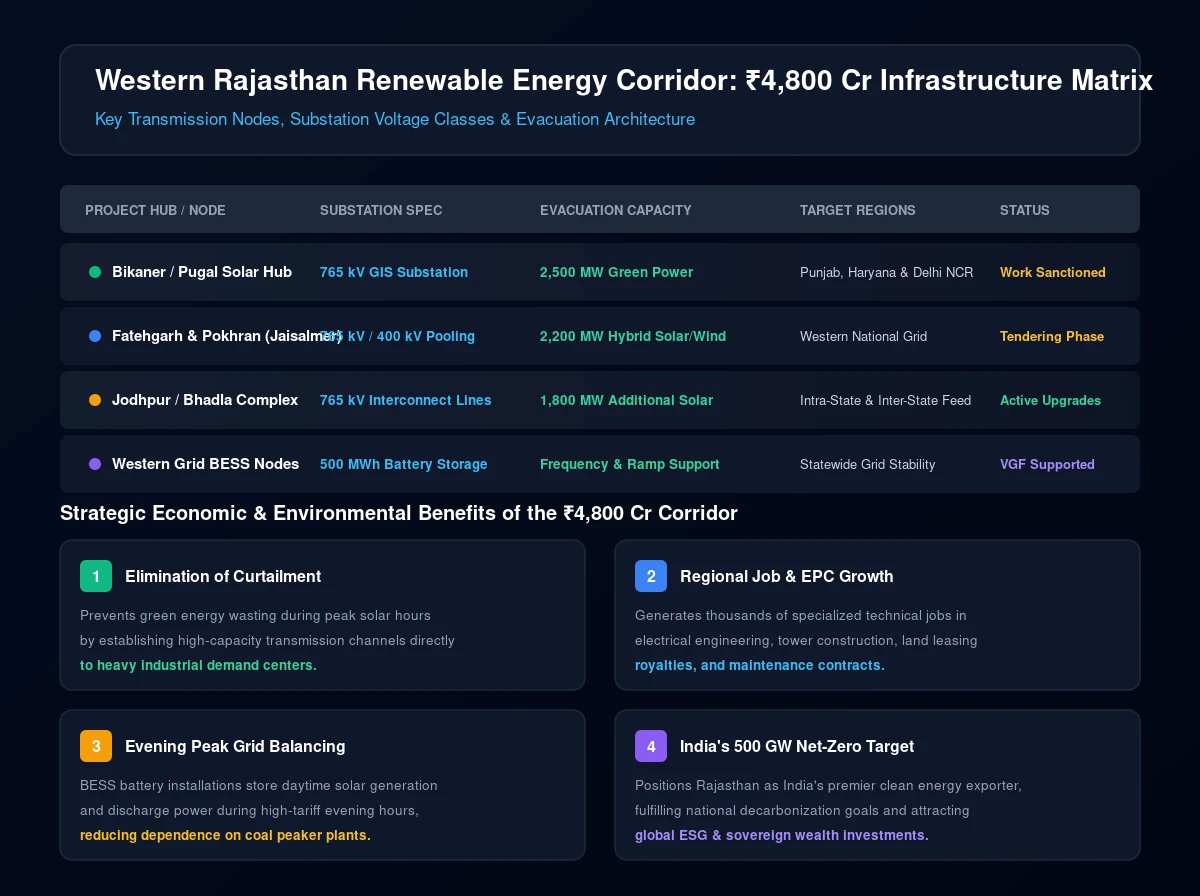
The western rajasthan renewable energy corridor acts as a unified aggregation network for multiple mega-scale renewable generation clusters across the state:
Bikaner has rapidly emerged as the newest ground zero for public and private solar installations, hosting mega-scale projects developed by NTPC, SJVN, and private power producers. The newly sanctioned 765 kV corridor will evacuate approximately 2,500 MW of power toward northern industrial corridors including Punjab, Haryana, and Delhi-NCR.
Jaisalmer hosts some of the world’s most concentrated wind-solar hybrid projects, taking advantage of strong seasonal monsoon winds alongside high solar radiation. Upgrading the Fatehgarh pooling substation ensures seamless power transmission to western load centers without straining regional intra-state grids.
Home to the renowned Bhadla Solar Park—one of the largest operational single-location solar complexes on earth—the Jodhpur segment of the corridor will receive upgraded transmission links to enhance export capability and integrate next-generation commercial rooftop and distributed solar systems.
Beyond technical decarbonization, the ₹4,800 crore infrastructure blitz delivers substantial socio-economic dividends across Western Rajasthan:
As highlighted in our daily review of top Rajasthan news and civic developments, the state government has instituted ambitious policy frameworks under the Rajasthan Renewable Energy Policy, aiming for 90,000 MW of installed green power capacity by 2030. The sanction of ₹4,800 crore for Western Rajasthan’s transmission grid provides the structural foundation needed to turn this vision into reality, cementing the Thar desert’s position as the powerhouse of India’s green industrial future.
Add Udaipur Mirror as a preferred source on Google to see more of our travel guides in your AI overviews.





[…] border frontiers—an area undergoing vast infrastructure shifts as detailed in our analysis of the Western Rajasthan Renewable Energy Corridor—the Meteorological Centre Jaipur (IMD) has issued a formal Yellow Alert forecasting continued […]