Office Address
14, Residency Road, Udaipur, Rajasthan 313001
Office Address
14, Residency Road, Udaipur, Rajasthan 313001


UDAIPUR: UDAIPUR — In a major breakthrough for solar physics and space weather research, Indian space scientists based in Udaipur have successfully decoded the complex mechanics behind an intense X 2.0 category solar flare that erupted on October 31, 2024. The detailed investigative study, which highlights how udaipur scientists solar plasma explosion dynamics reached unprecedented thermal peaks, was published in the prestigious Astrophysical Journal in October 2026. Led by Dr. Bhuwan Joshi alongside researchers Vishwa Vijay Singh and Dr. N.P.S. Mithun, the study sheds vital light on coronal magnetic structures and potential threats to global satellite communication networks.
⚡ Quick Highlights: Udaipur Scientists Decode Massive Solar Plasma Explosion Analysis
The sun’s outermost atmospheric layer, known as the corona, frequently exhibits complex magnetic phenomena that challenge modern astrophysics. When the X 2.0 class flare occurred on October 31, 2024, it presented a rare window into extreme plasma dynamics. The research team in Udaipur undertook a rigorous investigation into how magnetic structures within the corona evolve, interact, and occasionally trigger catastrophic energy releases. Previous local scientific assessments have occasionally intersected with civic alerts, such as managing infrastructural strains similar to those seen when Udaipur Deepotsav fire incidents surge 2026 due to dry atmospheric conditions, emphasizing the need for robust monitoring systems.
According to the published findings, a massive magnetic structure situated in the sun’s corona rose rapidly, driven by intense subsurface forces. However, an overlying magnetic ceiling or layer successfully trapped the structure, preventing it from fully erupting into open space. This containment resulted in a localized compression and superheating of plasma, pushing temperatures to an astonishing 2.2 crore Kelvin. The visual signatures of this containment and subsequent energy flare were captured as intense brightness and intricate magnetic loops along the solar limb. (Also read: Udaipur Police Seize 780-Kg Illegal Cannabis Crop Worth Rs 4 Crore in Mandwa; 4 States Supply Network Busted | मांडवा में 4 करोड़ का गांजा जब्त).
“The energy released during this solar event was colossal, comparable to millions of hydrogen bombs detonating simultaneously. Our analysis reveals critical insights into how coronal magnetic ceilings contain and redirect immense solar energy.” — Dr. Bhuwan Joshi, Lead Solar Physicist
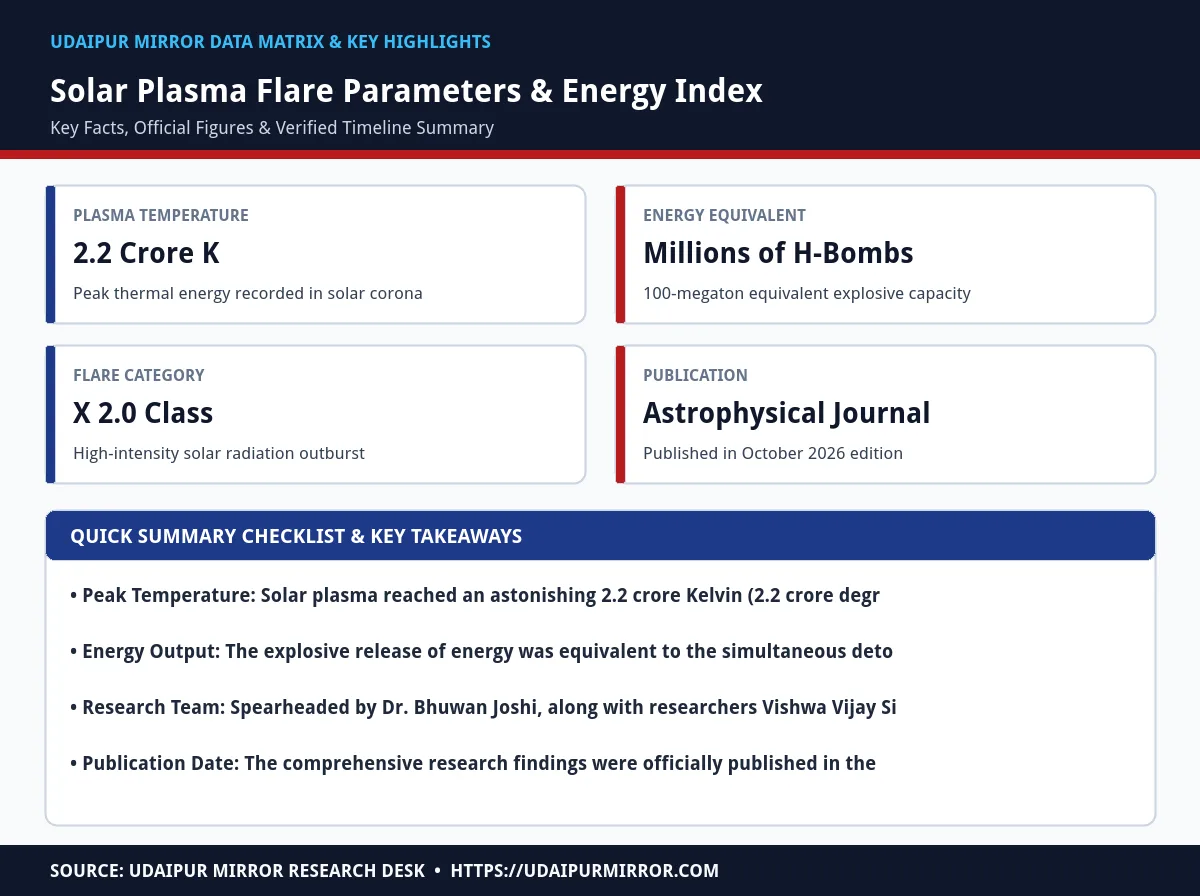
The following data table outlines the core parameters, research milestones, and potential systemic implications of the X 2.0 solar flare analyzed by the Udaipur research team.
| Parameter | Observed Metric | Scientific Implication | Status / Reference |
|---|---|---|---|
| Event Date | 31 October 2024 | Initial X 2.0 category solar flare eruption recorded | Confirmed Observation |
| Plasma Temp | 2.2 Crore Kelvin | Extreme heating of coronal plasma loops | Verified by Udaipur Team |
| Energy Release | 100 Megaton Scale | Equivalent to millions of hydrogen bombs exploding | Calculated Yield |
| Publication | October 2026 | Featured in The Astrophysical Journal (USA) | Peer-Reviewed |
| Primary Risk | Tech Disruption | Potential threat to satellites, power grids, and communication | Space Weather Alert |
While solar flares of this magnitude occur regularly across different solar cycles, their potential impact on Earth remains a paramount concern for space agencies and telecommunication operators worldwide. If a coronal mass ejection of this scale were directed straight toward Earth, the incoming stream of high-energy particles could severely disrupt global satellite networks, radio communications, and regional electrical grids. Modern society’s heavy reliance on satellite navigation and digital infrastructure makes understanding these solar mechanisms more crucial than ever.
In addition to space weather monitoring, regional scientific institutions across India have also been active in addressing terrestrial challenges, ranging from environmental surveillance to cracking down on illicit syndicates, echoing past major operations like when Udaipur Mandwa illegal cannabis crop seized operations dismantled multi-state smuggling rings. The Udaipur solar study provides critical baseline data that helps astrophysicists model space weather more accurately, offering early warning frameworks to safeguard vulnerable orbital assets.
“Understanding these extreme solar eruptions is essential for protecting modern technological infrastructure on Earth, from communication satellites to power distribution grids.” — Dr. N.P.S. Mithun, Co-Researcher

उदयपुर के वैज्ञानिकों ने अंतरिक्ष विज्ञान के क्षेत्र में एक और बड़ी उपलब्धि हासिल करते हुए सूर्य पर अक्टूबर 2024 को हुए एक भीषण विस्फोट का गहराई से अध्ययन किया है। यह शोध अक्टूबर 2026 में अमेरिका की प्रतिष्ठित पत्रिका ‘द एस्ट्रोफिजिकल जर्नल’ में प्रकाशित हुआ है। डॉ. भुवन जोशी के निर्देशन में विश्व विजय सिंह और डॉ. एनपीएस मिथुन द्वारा किए गए इस विश्लेषण में सामने आया कि सूर्य के कोरोना (बाहरी वायुमंडल) में एक विशाल चुंबकीय ढांचा तेजी से ऊपर उठा था।
अध्ययन के अनुसार, इस विस्फोट के दौरान प्लाज्मा का तापमान 2.2 करोड़ केल्विन यानी करीब 2.2 करोड़ डिग्री सेल्सियस तक पहुंच गया था। वैज्ञानिकों ने बताया कि इस प्रक्रिया में उत्पन्न होने वाली ऊर्जा लगभग 100 मेगा टन क्षमता वाले लाखों खतरनाक हाइड्रोजन बमों के एक साथ फटने के बराबर थी। यदि इस प्रकार के सौर विस्फोटों का सीधा प्रभाव पृथ्वी पर पड़े, तो हमारे उपग्रह (सैटेलाइट्स), वैश्विक संचार माध्यम और बिजली वितरण व्यवस्था पूरी तरह से ठप हो सकती है।
सूर्य की इस अध्ययनित तस्वीर में बाईं ओर दिखाई देने वाली तेज चमक और चुंबकीय लूप इस बात का प्रमाण हैं कि सौर वायुमंडल में किस प्रकार अत्यधिक ऊर्जा का संचय और विमोचन होता है। उदयपुर के वैज्ञानिकों का यह शोध अंतरराष्ट्रीय स्तर पर अंतरिक्ष अनुसंधान और अंतरिक्ष मौसम (स्पेस वेदर) की भविष्यवाणी करने में अत्यंत महत्वपूर्ण साबित होगा। (Also read: Awaiting Report on Waris Punjab De’s Separatist Link Claims: Election Commission of India).
“सूर्य के कोरोना में हुआ यह एक्स 2.0 श्रेणी का विस्फोट बेहद शक्तिशाली था। इसमें प्लाज्मा का तापमान 2.2 करोड़ डिग्री सेल्सियस तक पहुंच गया था, जो कि अंतरिक्ष अनुसंधान में एक महत्वपूर्ण मील का पत्थर है।” — विश्व विजय सिंह, शोधकर्ता
The plasma temperature reached an astonishing 2.2 crore Kelvin (approximately 2.2 crore degrees Celsius) during the X 2.0 category solar flare.
The research was led by Dr. Bhuwan Joshi along with Vishwa Vijay Singh and Dr. N.P.S. Mithun, and was published in the American journal ‘The Astrophysical Journal’ in October 2026.
अध्ययन के अनुसार, सौर विस्फोट के दौरान प्लाज्मा का तापमान 2.2 करोड़ केल्विन यानी करीब 2.2 करोड़ डिग्री सेल्सियस तक पहुंच गया था।
यदि ऐसे तीव्र सौर विस्फोटों का प्रभाव पृथ्वी तक पहुंचता है, तो अंतरिक्ष में स्थापित सैटेलाइट्स, संचार व्यवस्था और बिजली वितरण प्रणालियों को भारी नुकसान पहुंच सकता है।
Add Udaipur Mirror as a preferred source on Google to see more of our travel guides in your AI overviews.