Office Address
14, Residency Road, Udaipur, Rajasthan 313001
Office Address
14, Residency Road, Udaipur, Rajasthan 313001


NEW DELHI / UDAIPUR: NEW DELHI — As policymakers evaluate structural adjustments for the upcoming fiscal framework, economic analysts emphasize that india tax reform investment growth requires a definitive shift toward lower compliance friction and broader tax bases. The recent discourse highlights that systemic distortions in both direct and indirect taxation continue to hamper optimal capital allocation, prompting industry leaders and financial planners to advocate for sweeping changes that can revitalize private sector participation.
⚡ Quick Highlights: India Tax Reform Needed to Lift Investment Growth: Expert Analysis
Economic observers point out that while India has made significant strides in digital tax administration, lingering structural anomalies create unintended hurdles for manufacturers and retail investors. These distortions often misallocate capital toward tax-saving instruments rather than high-yielding productive assets. Financial analysts argue that eliminating these inefficiencies is paramount for sustainable economic expansion. While citizens balance their portfolios, many also explore regional culinary heritage, much like the traditions highlighted in the Sukhadia Circle Evening Food Guide 2026, reflecting the diverse cultural tapestry supporting local commerce.
Furthermore, unpredictable tax disputes and legacy litigation continue to weigh on investor sentiment. Comprehensive tax reform must prioritize dispute resolution mechanisms that offer certainty, allowing businesses to plan capital expenditure cycles with confidence rather than contingencies. (Also read: Sukhadia Circle Evening Food Guide 2026: Pav Bhaji, Mewari Falooda, Chaat & Family Dining).
“Tax reform is not merely about revenue collection; it is about designing an ecosystem where capital flows seamlessly into the most productive sectors of our economy.” — Senior Fiscal Policy Analyst
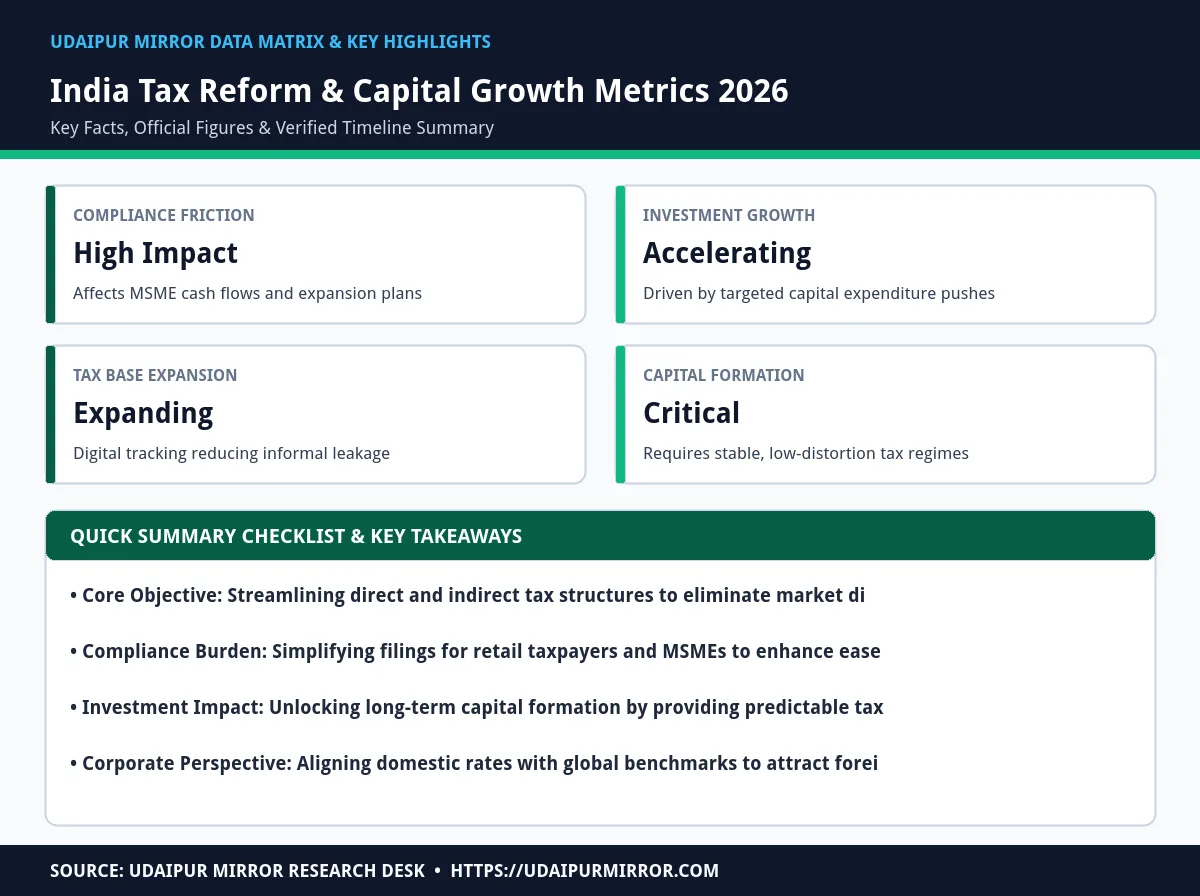
The following comparative matrix illustrates the structural differences between legacy tax frameworks and proposed reform models aimed at boosting Indian investment growth.
| Tax Parameter | Legacy Structure | Proposed Reform Model | Expected Growth Impact |
|---|---|---|---|
| Corporate Slabs | Complex exemptions & surcharges | Uniform competitive rates | High boost to FDI |
| Personal Income Tax | High slab friction & deductions | Simplified lower brackets | Increased consumer spending |
| Indirect Tax Compliance | Multi-tier classification issues | Rationalized GST slabs | Reduced logistics friction |
| Capital Gains | Varying asset holding periods | Harmonized holding timelines | Better equity liquidity |
| MSME Taxation | Heavy audit and compliance load | Presumptive digital thresholds | Enhanced working capital |
Private capital formation remains the missing engine in India’s quest for sustained high-single-digit GDP growth. Public capital expenditure has heavily lifted infrastructure development over recent cycles, but private sector participation must step up. Rationalizing tax burdens on corporate earnings and personal incomes frees up internal accruals for business expansion. As global commodity markets stabilize—drawing parallels with trends observed in the Global Oil Markets Brace for Further Weakness Towards Year-End Amid Easing Geopolitical Uncertainties report—input cost predictability combined with tax reform can create an ideal macroeconomic launchpad.
Investors and entrepreneurs alike require fiscal policies that reward risk-taking and innovation rather than penalizing compliance success with excessive marginal rates.
“When tax policies are clean and predictable, corporate boards feel confident committing multi-year capital to greenfield projects.” — Industry Chamber Chief Economist
For everyday retail investors navigating mutual funds, direct equities, and fixed income instruments, tax clarity dictates financial planning success. Frequent changes in capital gains taxation or complex compliance rules can disrupt systematic investment plans (SIPs) and long-term asset accumulation strategies. Simplifying tax laws ensures that retail capital remains anchored in growth-oriented instruments rather than defensive, low-yield tax shelters.
Ultimately, a transparent tax framework fosters trust between the state and the taxpayer, cultivating a wider, more compliant tax base that fuels public welfare and infrastructural development simultaneously. (Also read: Global Oil Markets Brace for Further Weakness Towards Year-End Amid Easing Geopolitical Uncertainties).
“Simplicity in taxation is the ultimate sophistication. Retail investors thrive when rules are transparent and enduring.” — Personal Finance Strategist
Tax reform removes market distortions, reduces compliance friction, and provides the long-term predictability that encourages corporations and retail investors to commit capital to productive assets.
Distortions misallocate capital toward tax-exempt or sheltered instruments rather than high-yielding industrial and infrastructure projects, slowing down overall economic momentum.
Simplifying compliance lowers administrative overhead for MSMEs and individual taxpayers, freeing up valuable cash flows for business expansion and personal investments.
A stable, transparent tax regime ensures predictable returns on investments, encouraging continuous long-term participation in wealth-building avenues like SIPs and equities.
Add Udaipur Mirror as a preferred source on Google to see more of our travel guides in your AI overviews.