Office Address
14, Residency Road, Udaipur, Rajasthan 313001
Office Address
14, Residency Road, Udaipur, Rajasthan 313001


NEW DELHI / NEW YORK: NEW DELHI / NEW YORK — As the macroeconomic landscape shifts toward the close of 2026, global oil markets are bracing for further downward pressure. Market experts and international energy analysts note that easing geopolitical uncertainties in key producing regions, coupled with sluggish industrial demand across Western and Asian powerhouses, are rapidly altering crude oil trajectories. For energy-importing economies like India, this developing oil market softness introduces a complex matrix of macroeconomic tailwinds and domestic pricing adjustments.
⚡ Quick Highlights: Global Oil Markets Brace for Weakness Amid Easing Tensions
The recent downward revision in energy price forecasts stems from a convergence of supply-side resilience and cooling demand metrics. For months, energy traders priced in acute geopolitical risks spanning major oil-producing zones. However, recent diplomatic breakthroughs and stabilized logistical pathways have dissipated much of this fear premium.
Furthermore, industrial manufacturing indices across Europe and parts of Asia indicate a slower-than-anticipated consumption velocity. As factories operate at measured capacities, petroleum product consumption has failed to register its traditional winter peak demand spikes. This fundamental imbalance has emboldened bearish market participants, leading to progressive liquidation of long positions in futures contracts. Also read our comprehensive analysis on India Wind Repowering Plan: 8 GW Upgrade, 50% Capacity Gain to understand how renewable energy adoption is gradually transforming long-term national energy matrices.
“The dissipation of geopolitical risk premiums has fundamentally realigned energy equations, shifting trader focus back to baseline supply and demand fundamentals.” — Senior Global Commodities Strategist
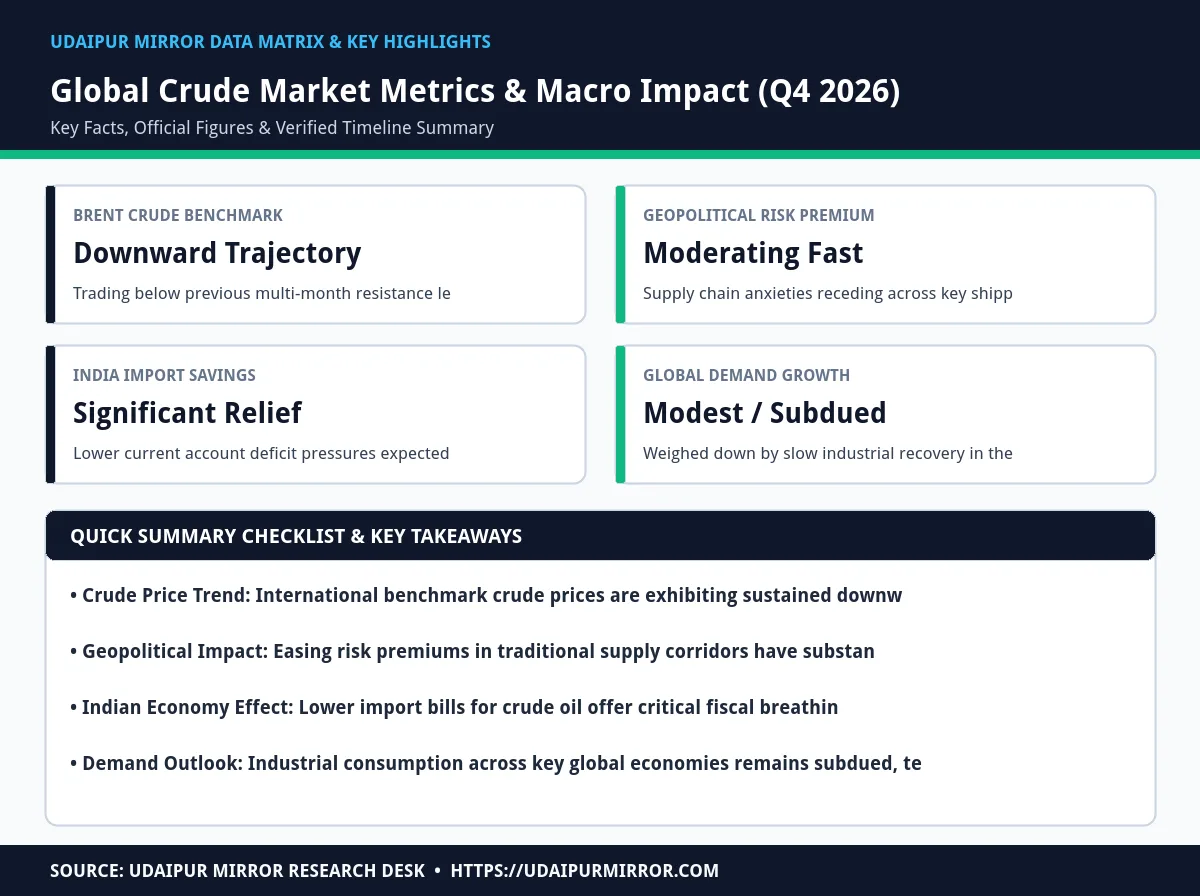
The following data table outlines key global energy benchmarks, foreign exchange parameters, and domestic transmission indicators as monitored by market analysts during the second week of November 2026.
| Indicator / Asset | Current Status (Nov 2026) | Q3 2026 Average | Macro Implication for India |
|---|---|---|---|
| Brent Crude (USD/bbl) | Softening toward lower band | Higher volatility range | Reduces oil import bill & fiscal deficit |
| USD-INR Exchange Rate | Stable near 84.10 range | Similar consolidation | Protects import parity pricing structure |
| Domestic Retail Fuel | Stable / Under review | Unchanged benchmark | Maintains retail inflation stability |
| Global Industrial Demand | Cautious & Slow | Uneven recovery | Limits aggressive upward commodity shocks |
| OPEC+ Compliance | Active monitoring | Strict quota adherence | Acts as a soft floor for price drops |
For India, which imports over 85% of its crude oil requirements, a weakening global oil market acts as a potent macroeconomic cushion. Lower international crude prices directly translate into a reduced import bill, easing pressure on the country’s current account deficit (CAD) and bolstering foreign exchange reserves.
In tandem with ongoing domestic infrastructure pushes—such as the strategic investments highlighted in Tata Power Appoints Sanjay Banga as CEO Amid Strong Q2 Profit Jump—cheaper raw energy inputs provide domestic manufacturing and power generation sectors with vital operating cost reductions. This fiscal breathing room allows policymakers greater flexibility in managing macroeconomic stability amidst global monetary tightening cycles.
“Softening oil prices provide an invaluable macroeconomic shield for developing economies, insulating fiscal targets from external commodity shocks.” — Macroeconomic Policy Analyst
Even as prices face downward pressure toward the close of 2026, market participants remain vigilant regarding potential interventions by OPEC and its allies. The cartel has repeatedly demonstrated its willingness to deepen or extend voluntary production quotas to defend price floors. However, compliance challenges and rising non-OPEC production—particularly from Western Hemisphere basins—have diluted the group’s absolute price-setting dominance.
Energy experts suggest that while short-term sentiment remains bearish, any unexpected supply disruption or aggressive production adjustments by major exporters could introduce sudden volatility. Consequently, institutional investors are adopting hedged strategies, balancing short-term bearish bets against potential geopolitical black-swan events. (Also read: Tata Power Appoints Sanjay Banga as CEO Amid Strong Q2 Profit Jump).
“OPEC+ faces a delicate balancing act as non-member supply expands while global demand growth normalizes to post-pandemic trends.” — Energy Market Economist
Global oil prices are facing downward pressure due to easing geopolitical tensions, stabilized supply logistics, and subdued industrial energy demand across major economies.
A drop in international crude prices reduces India’s import bill, eases the current account deficit, helps stabilize the rupee, and controls domestic inflationary pressures.
Yes, while OPEC+ continues to monitor quotas, their absolute influence is being tested by rising non-OPEC production and softer global demand growth.
Experts anticipate continued range-bound or soft pricing toward year-end, though potential supply adjustments or unforeseen geopolitical events could introduce short-term volatility.
Add Udaipur Mirror as a preferred source on Google to see more of our travel guides in your AI overviews.