Office Address
14, Residency Road, Udaipur, Rajasthan 313001
Office Address
14, Residency Road, Udaipur, Rajasthan 313001


NEW DELHI: NEW DELHI — As global markets navigate complex economic shifts, artificial intelligence adoption in traditional industries has transitioned from a futuristic concept into an urgent operational necessity. Legacy sectors—spanning manufacturing, supply chain logistics, energy, and agriculture—are no longer viewing advanced machine learning models as experimental tools. Instead, enterprises worldwide are embedding automated intelligence directly into core operational workflows to reduce overhead, eliminate human error, and unlock unprecedented productivity gains in an increasingly competitive digital economy.
⚡ Quick Highlights: Artificial Intelligence: Why Traditional Industries Adopt AI
For decades, artificial intelligence remained confined to tech-native startups and digital giants. Traditional industries viewed complex algorithms as high-risk investments with uncertain returns. However, recent economic pressures, volatile supply chains, and rising operational costs have altered boardroom priorities entirely. Enterprises now recognize that legacy infrastructure cannot sustain modern market demands without intelligent automation. As financial markets closely monitor broader economic indicators—similar to how analysts evaluate stability during periods when Will Sensex, Nifty Continue Their Bull Run or Consolidate? 4 Factors to Watch—corporate leaders are steering capital into resilient, tech-driven architectures.
This structural migration is further accelerated by the maturation of plug-and-play enterprise software. Companies no longer need to build foundational models from scratch; instead, they can deploy specialized AI agents that integrate seamlessly with legacy enterprise resource planning (ERP) systems. This democratization of technology has lowered entry barriers, enabling even mid-sized industrial firms to harness predictive analytics. (Also read: Will Sensex, Nifty Continue Their Bull Run or Consolidate? 4 Factors to Watch).
“Artificial intelligence is no longer a luxury for tech titans; it is the fundamental operating system keeping traditional industries competitive in a volatile global market.” — Dr. Arindam Roy, Senior Enterprise Technology Analyst
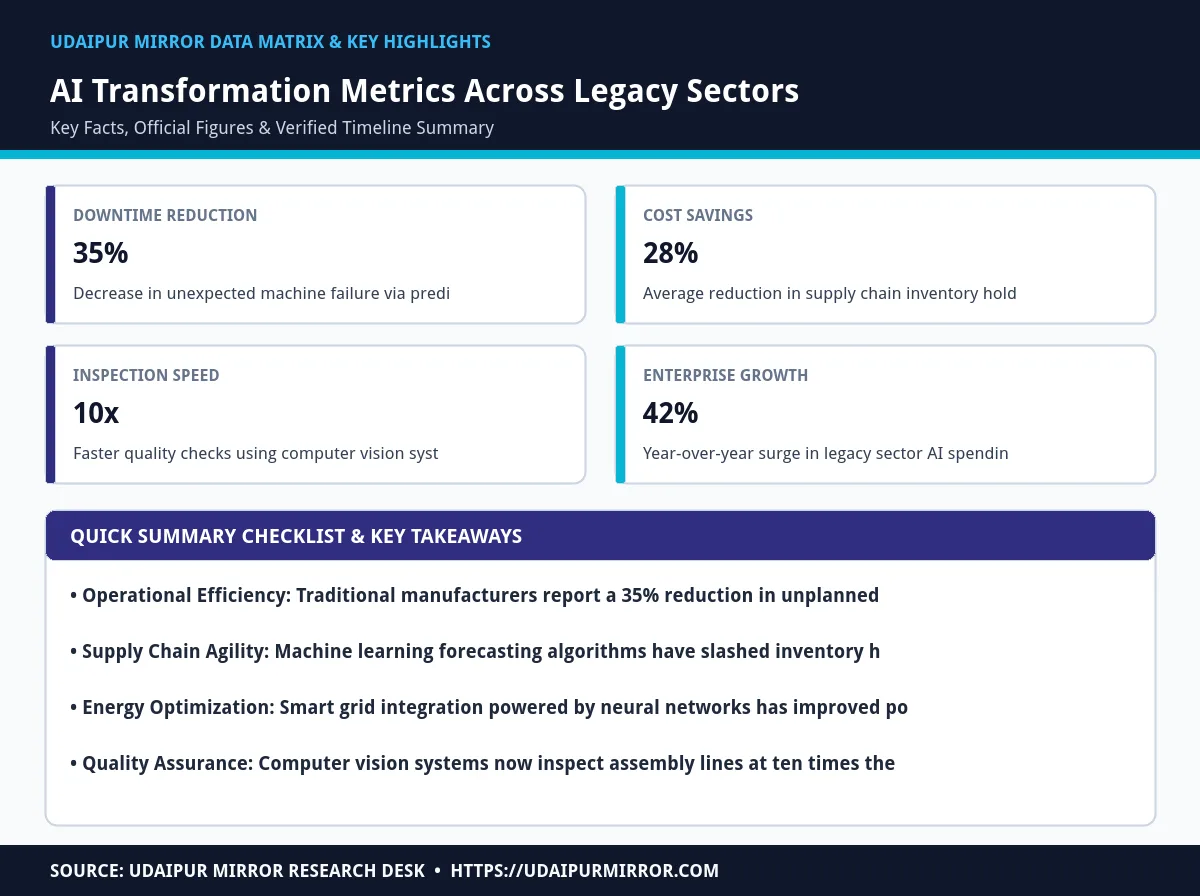
The integration of advanced machine learning models manifests differently across various legacy pillars. The matrix below outlines primary AI use cases, key technological drivers, and quantified operational benefits observed across global enterprises.
| Industry Sector | Primary AI Application | Key Technology Driver | Quantified Benefit |
|---|---|---|---|
| Manufacturing | Predictive Maintenance | IoT Sensors & Neural Networks | 35% less equipment downtime |
| Supply Chain & Logistics | Demand Forecasting | Generative AI & Big Data Analytics | 28% lower inventory holding costs |
| Energy & Utilities | Smart Grid Balancing | Automated Reinforcement Learning | 22% improved energy distribution |
| Agriculture | Precision Crop Monitoring | Computer Vision & Drones | 30% reduction in chemical waste |
| Construction | Structural Stress Analysis | Deep Learning Simulation Models | 20% faster project completion |
One of the most immediate catalysts for AI adoption in traditional sectors is the persistent fragility of global supply chains. Geopolitical shifts, extreme weather events, and unpredictable consumer demand fluctuations have exposed the vulnerabilities of traditional logistics models. By implementing machine learning forecasting tools, enterprises can now anticipate disruptions weeks in advance rather than reacting after a bottleneck occurs.
Furthermore, as industrial ecosystems aggressively transition toward sustainable frameworks—aligning with broader national targets such as those seen when India Seeks to Triple Clean Energy Capacity to 900 Gigawatts by 2035 Amid Hurdles—AI algorithms play a critical role in managing intermittent power loads and optimizing green supply chain footprints. Automated routing and smart warehousing have transformed static godowns into dynamic, responsive fulfillment hubs.
“Predictive logistics powered by AI turns a reactive supply chain into an anticipatory powerhouse, saving millions in potential demurrage and waste.” — Meenakshi Sundaram, Global Supply Chain Director
Despite clear financial and operational advantages, the journey toward total AI integration is not without friction. Traditional industries face unique hurdles, including workforce skepticism, data silos, and cybersecurity vulnerabilities. Many legacy organizations store critical operational data in fragmented, non-standardized formats that modern machine learning models cannot easily ingest.
To overcome these barriers, forward-thinking enterprises are investing heavily in comprehensive digital literacy programs. Upskilling veteran floor workers to collaborate effectively with automated machinery has proven essential for successful change management. Cultivating a culture of continuous technological adaptation ensures that human expertise and artificial intelligence work in symbiotic harmony rather than competing for dominance. (Also read: India Seeks to Triple Clean Energy Capacity to 900 Gigawatts by 2035 Amid Hurdles).
“Technology implementation fails without cultural alignment. The true challenge of AI adoption is not writing the algorithm; it is bringing your workforce along on the journey.” — Vikramaditya Sen, Chief Transformation Officer
Traditional industries are adopting AI to combat rising operational costs, mitigate supply chain fragilities, eliminate human error, and achieve significant productivity gains through predictive maintenance and automated workflows.
Sectors such as manufacturing, supply chain logistics, heavy engineering, energy utilities, and agriculture are seeing the highest return on investment through optimized resource allocation and predictive analytics.
Modern enterprise AI solutions feature flexible APIs and middleware that connect directly with legacy ERP and database frameworks, allowing businesses to leverage advanced analytics without undergoing costly total system overhauls.
The primary challenges include fragmented data silos, cybersecurity risks associated with connected IoT devices, and workforce resistance requiring extensive digital upskilling and change management.
Add Udaipur Mirror as a preferred source on Google to see more of our travel guides in your AI overviews.






[…] SCSS Investment Rules: 5 Mistakes Retirees Must Avoid Before Investing ₹30 Lakh 3 hours ago ⚡ Apps Artificial Intelligence: Why Traditional Industries Are Rapidly Adopting AI Technologies 4 hou… Business Will Sensex, Nifty Continue Their Bull Run or Consolidate? 4 Factors to Watch 6 hours ago […]