Office Address
14, Residency Road, Udaipur, Rajasthan 313001
Office Address
14, Residency Road, Udaipur, Rajasthan 313001


NEW DELHI: NEW DELHI — As international delegates converge to evaluate renewable infrastructure milestones, the International Solar Alliance (ISA) has officially unveiled its comprehensive 5-year strategic roadmap. Designed to cement global solar leadership, the policy blueprint places India at the heart of cross-border energy grids, green technology diffusion, and rigorous climate diplomacy. This master plan arrives as nations worldwide accelerate their transition away from fossil-fueled power grids, seeking resilient alternatives to safeguard domestic economies from geopolitical supply shocks.
⚡ Quick Highlights: ISA 5-Year Strategy: India's Vision for Global Solar Leadership
The International Solar Alliance’s newly minted 5-year strategy is much more than a technical blueprint; it is a masterclass in modern climate diplomacy. By positioning itself as the primary convener for sunshine-rich nations across the tropics, India is effectively reshaping international energy alliances. As traditional industrial sectors modernize, many manufacturing hubs are also exploring how artificial intelligence and smart automation can optimize power consumption, making green transitions even more efficient.
Through coordinated diplomatic engagements, the ISA aims to remove trade bottlenecks that currently hinder the smooth flow of photovoltaic modules, inverters, and battery storage systems. Nations that previously depended entirely on imported fossil hydrocarbons are now finding diplomatic leverage through indigenous solar capacity building. (Also read: Artificial Intelligence: Why Traditional Industries Are Rapidly Adopting AI Technologies).
“Solar energy is no longer just an environmental imperative; it is the cornerstone of sovereign energy security and diplomatic resilience in the 21st century.” — Senior ISA Policy Strategist
Understanding the financial structure of rooftop and commercial solar installations is critical for homeowners and enterprises alike. Below is a detailed breakdown comparing standard system sizes, applicable government subsidies, estimated installation costs, and monthly savings under current regulatory frameworks.
| System Capacity | Average Setup Cost | Govt. Subsidy | Monthly Savings | Estimated Payback |
|---|---|---|---|---|
| 1 kW System | ₹60,000 | ₹30,000 | ₹1,200 – ₹1,500 | 3.5 – 4 Years |
| 2 kW System | ₹1,20,000 | ₹60,000 | ₹2,500 – ₹3,000 | 3.8 – 4.2 Years |
| 3 kW System | ₹1,80,000 | ₹78,000 | ₹3,800 – ₹4,500 | 4.0 – 4.5 Years |
| 5 kW System | ₹3,00,000 | ₹78,000 (Max Cap) | ₹6,500 – ₹7,500 | 4.2 – 4.8 Years |
| 10 kW Commercial | ₹5,50,000 | Nil (Commercial) | ₹14,000 – ₹16,000 | 3.2 – 3.8 Years |
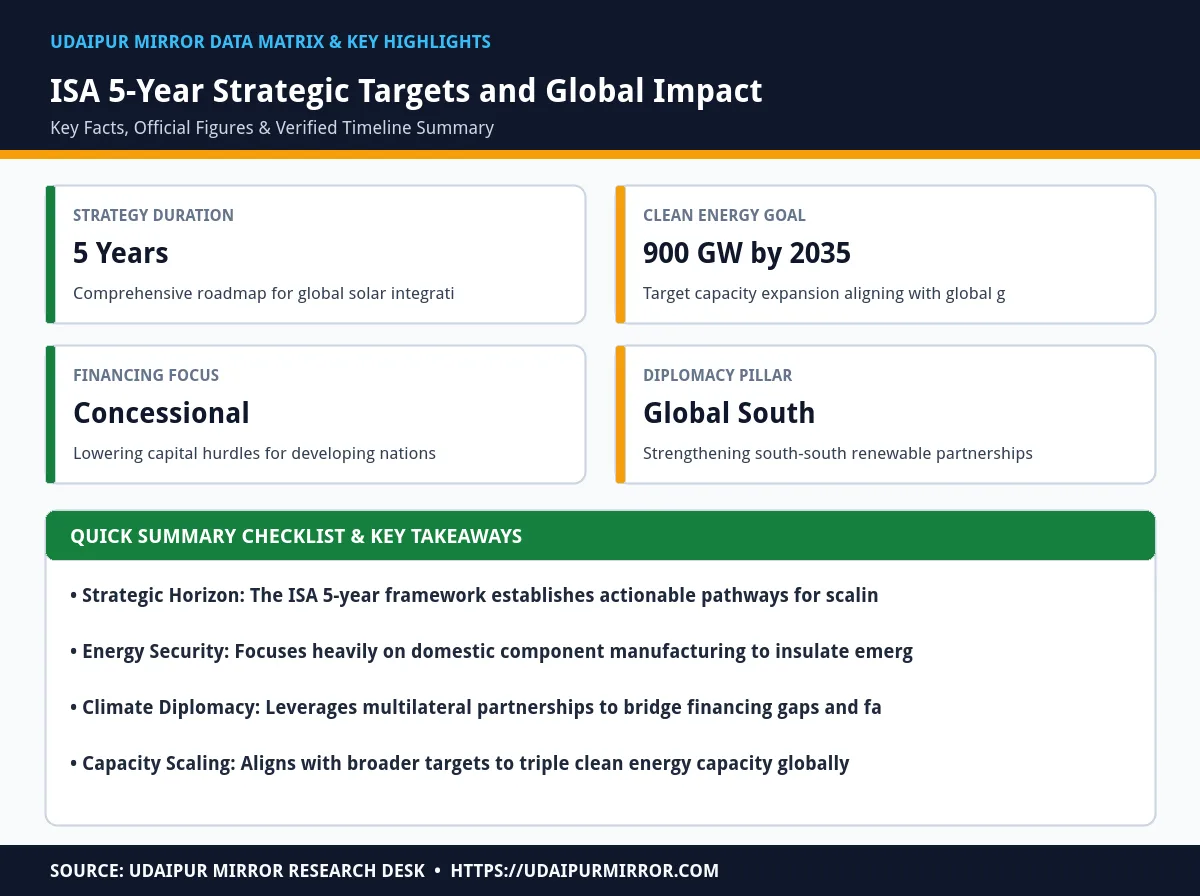
A central pillar of the ISA’s strategy involves scaling up manufacturing ecosystems within developing economies to prevent future supply chain vulnerabilities. By reducing reliance on single-source suppliers, member nations can foster robust domestic industries. This expansive vision ties directly into national targets, mirroring how India seeks to triple clean energy capacity to 900 gigawatts by 2035 despite prevailing financial and logistical hurdles.
Financial derisking remains critical to this agenda. The alliance is working closely with multilateral development banks to establish specialized guarantee funds. These funds will absorb initial project risks, thereby encouraging private institutional investors to deploy capital into utility-scale solar parks and decentralized rooftop grids alike.
“Derisking green investments in the Global South is the single most important hurdle we must clear to unlock trillions of dollars in private climate finance.” — Multilateral Finance Taskforce Chair
While utility-scale mega solar parks generate the bulk of grid power, decentralized solar applications remain vital for rural electrification and community-level resilience. The ISA strategy emphasizes microgrids and agricultural solar pumps that directly benefit agrarian communities, insulating them from erratic grid supplies and diesel price fluctuations.
By empowering local technicians and micro-entrepreneurs to maintain these decentralized units, the strategy creates sustainable local employment. This grassroots approach ensures that the clean energy transition is inclusive, equitable, and resilient against local disruptions. (Also read: India Seeks to Triple Clean Energy Capacity to 900 Gigawatts by 2035 Amid Hurdles).
“True energy security is achieved only when the remotest village has reliable, independent access to clean power.” — Rural Renewable Energy Director
Integrating massive volumes of intermittent solar power into legacy national grids presents severe engineering challenges. Voltage fluctuations, frequency stability, and storage deficits require immediate modernization of transmission infrastructure. The ISA’s strategy outlines dedicated technical working groups tasked with sharing best practices in smart grid management and battery energy storage systems (BESS).
Furthermore, cross-border grid interconnectivity is being actively pursued to balance generation peaks across different time zones. By linking regional power pools, nations can absorb excess solar generation and dispatch it seamlessly where demand is highest, maximizing overall system efficiency.
“Grid flexibility must evolve in lockstep with generation capacity if we are to prevent curtailment and ensure absolute system stability.” — Chief Grid Architect
The primary objective is to cement global solar leadership, enhance energy security for member nations, and leverage climate diplomacy to accelerate worldwide renewable adoption.
It provides frameworks for concessional financing, technical assistance, supply chain diversification, and risk-mitigation guarantees to unlock private capital.
India acts as the foundational leader and driving force behind the ISA, sharing its domestic expertise in massive solar park deployment and decentralized rooftop schemes.
It emphasizes smart grid modernization, battery energy storage systems (BESS), and cross-border grid interconnectivity to manage intermittency and power balancing.
Add Udaipur Mirror as a preferred source on Google to see more of our travel guides in your AI overviews.