Office Address
14, Residency Road, Udaipur, Rajasthan 313001
Office Address
14, Residency Road, Udaipur, Rajasthan 313001


MUMBAI: MUMBAI — In a high-profile index rejig that has drawn intense interest from institutional investors and retail traders alike, shriram finance replaces trent in bse sensex, marking a significant milestone for the non-banking financial company. The announcement follows the latest semi-annual index reconstitution by Asia Index Private Limited, which assesses free-float market capitalisation, liquidity, and trading volumes over preceding quarters. AsDalal Street continues its robust upward trajectory, scaling new nine-month closing highs, this structural index shift underscores the evolving sectoral weightings within India’s premier equity gauges.
⚡ Quick Highlights: Shriram Finance Replaces Trent in BSE Sensex: Index Changes
The inclusion of Shriram Finance in the 30-share BSE Sensex reflects its dominant position in India’s retail and commercial vehicle financing sector. Over the past several quarters, the company has demonstrated robust asset growth, improved asset quality metrics, and consistent profitability, catching the attention of index committees. As digital infrastructure and secure financial networks support large institutions, Shriram Finance’s scaled operations have justified its elevation to India’s most tracked benchmark index.
Conversely, Trent Limited’s exit from the Sensex comes after a phenomenal multi-year bull run that saw its valuation multiply significantly. Index rebalancing rules are strictly quantitative, relying on average free-float market capitalisation and liquidity. Even when high-flying stocks exit due to relative ranking shifts or capitalization thresholds, it highlights the dynamic and competitive nature of India’s capital markets. (Also read: KPTCL Launches Comprehensive Cybersecurity Program to Safeguard Power Transmission Network).
“Index reconstitution ensures that our benchmark indices accurately mirror the evolving structure of corporate India, rewarding sustained liquidity and market depth.” — Senior Index Strategist, Mumbai
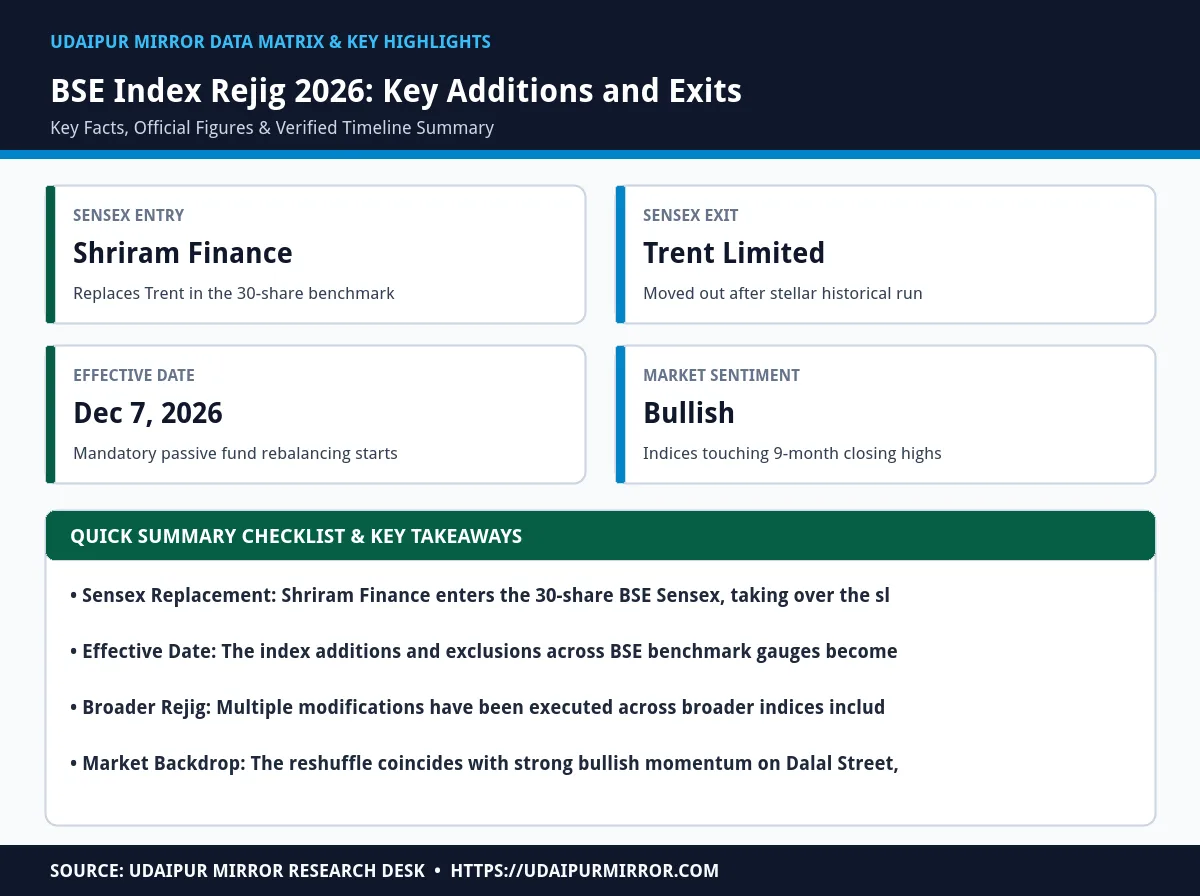
The table below outlines the prominent stock movements, index classifications, and structural adjustments implemented during the latest BSE index reconstitution cycle affecting premier benchmarks.
| Index Name | Action Type | Incoming Security | Outgoing Security | Effective Timeline |
|---|---|---|---|---|
| BSE Sensex | Replacement | Shriram Finance Ltd | Trent Limited | December 7, 2026 |
| Sensex 50 | Rebalance | Selected NBFC Leader | Mid-Cap Equities | December 7, 2026 |
| BSE 100 | Addition/Exit | High-Liquidity Large-Cap | Underperforming Counter | December 7, 2026 |
| BSE MidCap | Migration | Promoted Small-Caps | Demoted Large-Caps | December 7, 2026 |
| BSE SmallCap | Expansion | Emerging Growth Stocks | Exit to MidCap | December 7, 2026 |
Beyond the headline-grabbing change in the flagship 30-stock Sensex, the semi-annual review has triggered a cascade of adjustments across the BSE 100, Sensex 50, and various sectoral indices. These movements dictate how institutional funds, including mutual funds and foreign portfolio investors (FPIs), allocate billions of rupees across Indian equities. While index upgrades frequently attract sustained buying pressure, downgrades can lead to temporary selling as benchmark-tracking funds adjust holdings.
At the same time, market regulators remain vigilant. While monitoring corporate governance and market integrity, regulatory bodies such as SEBI are exploring advanced technological frameworks, including India-made artificial intelligence models, to detect market anomalies and ensure transparent price discovery across all listed counters.
“Institutional rebalancing creates predictable short-term volume spikes, but fundamentally strong businesses ultimately follow their long-term earnings trajectory.” — Dalal Street Institutional Desk Chief
The timing of the index announcement coincides with an exceptionally resilient phase for Indian stock markets. Sustained domestic institutional buying, robust retail participation via systematic investment plans (SIPs), and favorable macroeconomic indicators have propelled the Sensex and Nifty to scale nine-month closing highs. Bulls have maintained firm control over Dalal Street despite occasional global headwinds and profit-booking phases.
Market analysts advise investors to focus on fundamental business health rather than short-term price volatility triggered by index inclusions or exclusions. As companies adapt to advanced data analytics—much like how modern technological integrations are transforming traditional industries—listed entities continue to showcase robust operational efficiency and earnings growth.
“The underlying strength of domestic retail capital is providing an effective cushion against global market uncertainties.” — Senior Equity Research Analyst
Shriram Finance Limited officially replaced Trent Limited in the 30-share BSE Sensex benchmark index during the semi-annual index reconstitution.
The announced additions and exits across the BSE Sensex, Sensex 50, and BSE 100 indices become effective on Monday, December 7, 2026.
Stocks are added or removed based on quantitative criteria evaluated semi-annually, primarily focusing on free-float market capitalisation, trading liquidity, and overall market ranking.
Inclusion in headline indices like the Sensex typically triggers passive fund inflows from ETFs and index funds, often causing positive price momentum, while exits can lead to selling pressure during portfolio rebalancing.
Add Udaipur Mirror as a preferred source on Google to see more of our travel guides in your AI overviews.