Office Address
14, Residency Road, Udaipur, Rajasthan 313001
Office Address
14, Residency Road, Udaipur, Rajasthan 313001


NAGDA, UDAIPUR: NAGDA, UDAIPUR — Nestled quietly along the tranquil banks of the Bagela Lake just 22 kilometers north of Udaipur, the magnificent saas bahu temples nagda stand as enduring testaments to the architectural brilliance of 10th-century Mewar. Originally dedicated to Lord Vishnu and constructed during the reign of King Kartripala of the late Guhila dynasty, these twin structures officially known as the Sahasra Bahu temples draw global heritage enthusiasts, epigraphists, and spiritual travelers alike. As visitors navigate the winding countryside roads—with convenient options such as Two New Udaipur-Neemuch Roadways Buses from Nov 21 facilitating regional transit—they encounter a breathtaking synthesis of myth, stone mastery, and sacred geography that has captivated historians for centuries.
⚡ Quick Highlights: Saas Bahu Temples Nagda 2026: Timings, History & Architecture
The popular modern moniker of the twin shrines often evokes curiosity, but local nomenclature has a fascinating etymological root. Originally consecrated as the Sahasra-Bahu temples—translating directly from Sanskrit as ‘One with a thousand arms,’ an epithet for Lord Vishnu—the name underwent a gradual phonetic transformation over centuries among rural dialects. Common folk vernacular shortened the complex Sanskrit term to ‘Saas-Bahu’ (Mother-in-law and Daughter-in-law), giving birth to the playful local folklore of two separate shrines built by a mother-in-law and daughter-in-law with contrasting architectural tastes.
Despite the charming folktales told by village elders, epigraphical inscriptions found within the temple complex clearly establish its theological dedication to Vaishnavism. The larger temple represents the principal shrine of the deity, while the slightly smaller companion structure, positioned closely alongside, shares identical architectural reverence. For spiritual seekers wishing to explore other ancient cave shrines in the region, studying historical legends akin to the Gupteshwar Mahadev Udaipur Guide 2026 offers profound insights into Mewar’s deep-rooted mythological landscape.
“The linguistic shift from Sahasra-Bahu to Saas-Bahu illustrates how ancient Sanskrit divine epithets naturally adapted into folk idioms across Mewar.” — Dr. K. L. Sharma, Architectural Historian
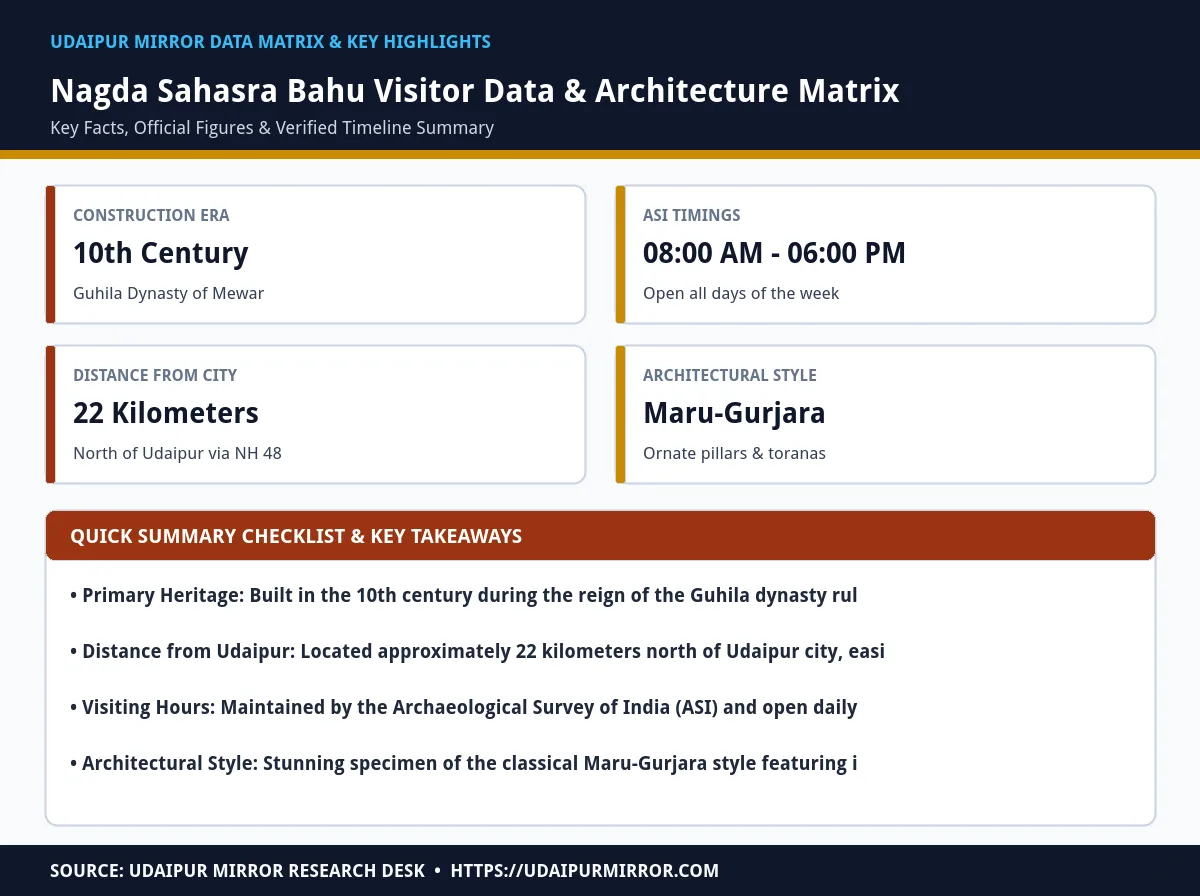
Planning your heritage excursion to the historic Nagda temple complex requires precise information regarding operating hours, ticketing guidelines, travel distances, and recommended photography permissions. The following structured reference matrix outlines all essential details for visitors in 2026.
| Parameter Category | Official Details & Specifications | Visitor Guidelines | Applicable Season / Status |
|---|---|---|---|
| Site Name | Sahasra Bahu (Saas-Bahu) Temples | Twin temple complex dedicated to Lord Vishnu | Protected Monument |
| Operating Hours | 08:00 AM to 06:00 PM | Arrive before sunset for optimal natural lighting | Open Daily |
| Entry Fee Structure | Nominal ASI Ticket Rates | Free entry for archaeological students and minors | Standardized Tariff |
| Distance from Udaipur | 22 Kilometers via NH-8 | Accessible via cabs, auto-rickshaws, and buses | All-Weather Road |
| Best Time to Visit | October to March | Pleasant morning weather for extensive photography | Peak Tourism Season |
Architecturally, the saas bahu temples nagda represent a pristine zenith of the Maru-Gurjara architectural style (often referred to as Solanki style), which flourished across western India during the early medieval era. The complex consists of two principal temples surrounded by smaller subsidiary shrines, all elevated on a high, intricately molded jagati (platform). The exterior walls are adorned with multi-tiered horizontal bands featuring divine sculptures, celestial nymphs (apsaras), geometric patterns, and floral scrolls that demonstrate exquisite chisel work.
Engineering brilliance is particularly evident in the structural load distribution of the open mandapa (hall). Instead of solid masonry walls, the open pavilions utilize slender, intricately carved pillars that support massive architraves and corbelled ceilings. This open-air design allows natural sunlight and cool breeze from the adjacent Bagela Lake to permeate the inner sanctums, creating an ethereal ambiance that changes dramatically throughout daylight hours.
“The Maru-Gurjara mastery at Nagda is visible in how stone is treated like wax, yielding breathtaking lace-like toranas and celestial panels.” — Heritage Conservation Committee, Udaipur
Stepping beneath the porticos reveals some of the most spectacular stone artistry in northern India. The interior ceiling panels of the temples are masterclasses in corbelled dome construction, featuring concentric rings of stone adorned with celestial dancers, musicians, and floral rosettes. Prominent central panels meticulously depict Hindu trinity deities including Brahma, Shiva, and Vishnu, surrounded by mythological narratives drawn directly from the great epics.
Of particular note are the friezes depicting episodes from the Ramayana. Artisans carved intricate narrative panels showing Sita’s abduction, Hanuman’s journey across the ocean, and scenes from the epic battle of Lanka with startling spatial depth and emotional expressiveness. These narrative reliefs serve as a visual scripture for medieval pilgrims who visited the sacred complex centuries ago. (Also read: Two New Udaipur-Neemuch Roadways Buses from Nov 21: Timings, Routes & Fare Details).
“Every square inch of stone ceiling at Nagda narrates ancient cosmic geometry and epic tales from the Ramayana.” — Epigraphical Survey Directorate
Managed under the rigorous conservation protocols of the Archaeological Survey of India (ASI), the Sahasra Bahu temple complex is open to the public daily from 08:00 AM to 06:00 PM. Visitors are advised to allocate at least one to two hours to thoroughly explore the intricate carvings and enjoy the serene lakeside surroundings. Nominal ticketing fees apply at the entrance counter, with free admission extended to school groups and archaeological researchers upon formal request.
To maximize your itinerary, experienced travel planners recommend combining a morning visit to Nagda with darshan at the world-renowned Eklingji temple located just a short distance away in Kailashpuri. Wear comfortable walking shoes with good grip, as uneven stone flooring and elevated platforms require cautious navigation. Early morning hours offer the best natural illumination for architectural photography without the midday glare.
“Proper time management allows travelers to seamlessly pair Nagda's architectural splendor with the spiritual aura of Eklingji.” — Mewar Tourism Advisory Board
The temples are managed by the Archaeological Survey of India (ASI) and remain open daily from 08:00 AM to 06:00 PM.
The local name is a corrupted phonetic evolution of the original Sanskrit name ‘Sahasra-Bahu’ (meaning Lord Vishnu with a thousand arms), which evolved into Saas-Bahu through rural folk idioms.
The temples are located about 22 kilometers north of Udaipur near Bagela Lake. You can easily reach them via private cabs, auto-rickshaws, or regional buses traveling along National Highway 8.
They are prime exemplars of the 10th-century Maru-Gurjara (Solanki) architectural style, featuring soaring shikharas, exquisite torana gateways, open pillared mandapas, and detailed ceiling carvings.
Add Udaipur Mirror as a preferred source on Google to see more of our travel guides in your AI overviews.