Office Address
14, Residency Road, Udaipur, Rajasthan 313001
Office Address
14, Residency Road, Udaipur, Rajasthan 313001


JAIPUR: JAIPUR — In a major regulatory push toward urban transit security, the transport department has officially confirmed that rajasthan aggregator rules ride-hailing services are taking immediate effect across major municipal corporations. This comprehensive policy framework aims to eliminate regulatory gray areas for app-based cab and auto operators while streamlining driver verification protocols and fare caps across the state.
⚡ Quick Highlights: Rajasthan Aggregator Rules Expand Oversight of Ride-Hailing
The introduction of rigorous administrative guidelines marks a significant turning point in how app-driven transportation networks function across Jaipur, Jodhpur, Udaipur, and other expanding urban centers. For years, commuters and traditional transport unions raised concerns regarding fluctuating surge pricing, opaque cancellation charges, and inadequate background checks for independent drivers. By enforcing standardized operating procedures, the state administration aims to strike a balance between technological innovation and public accountability.
As part of this transition, transport officials have emphasized that digital platforms must maintain transparent communication channels with riders. Unilateral ride cancellations by drivers without valid justification will now attract strict penalties, protecting daily commuters from sudden disruptions. Furthermore, similar to administrative policy shifts seen during local governance reviews such as the Rajsamand Rural Elections 2026 ground analysis, local community stakeholders and passenger associations have welcomed the formal integration of regulatory checks.
Aggregators are now legally obligated to share real-time telemetry data with state transport servers, ensuring that law enforcement agencies can monitor active trips during late hours. This integration is expected to drastically reduce transit-related security risks and establish a predictable ecosystem for both full-time and part-time drivers operating within the state. (Also read: Rajsamand Rural Elections 2026: How Kumawat Samaj’s Independent Push Reshaped Equations in a 4-MLA, 1-MP District | Ground Analysis).
“Our primary objective is to build a secure, transparent, and reliable transportation network where passenger safety and fair driver remuneration go hand in hand.” — Senior Transport Department Official, Government of Rajasthan
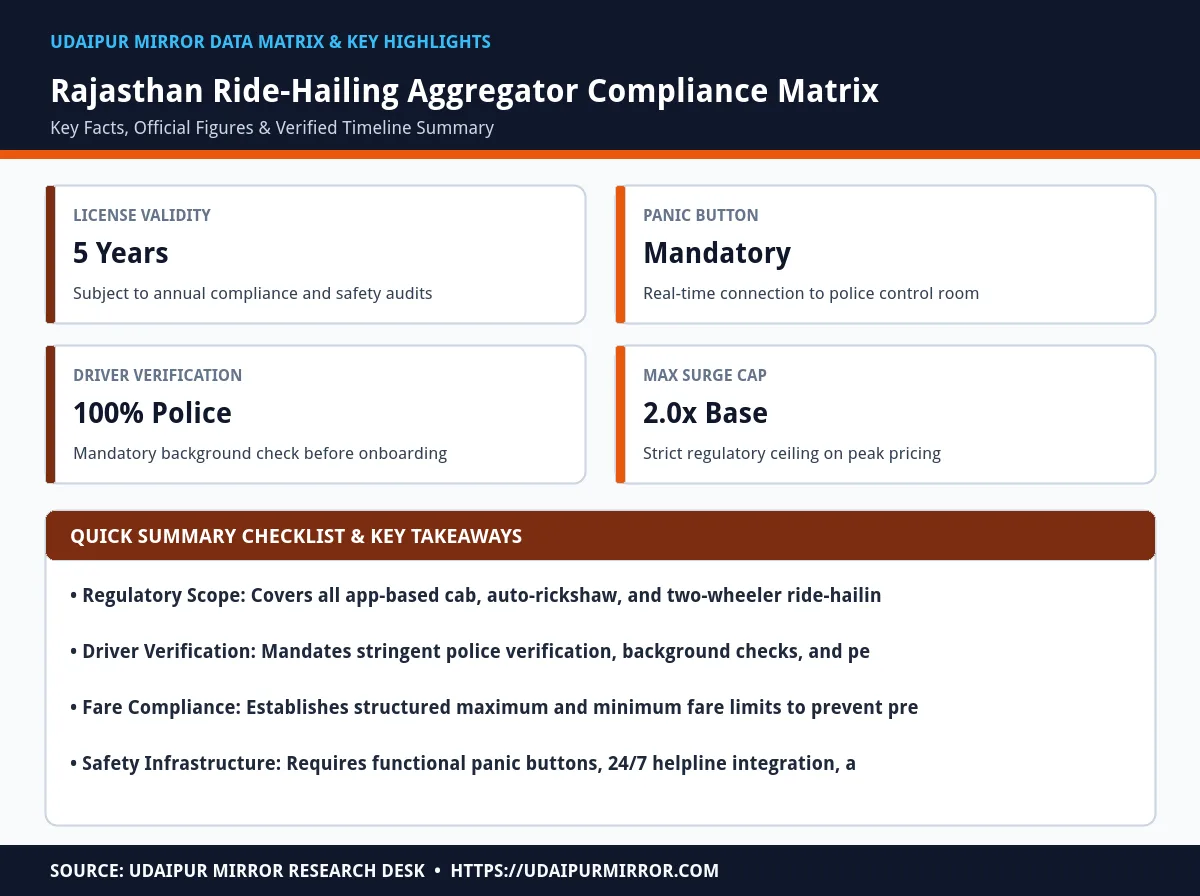
The following table outlines the key compliance requirements, documentation standards, and enforcement penalties mandated under the newly expanded Rajasthan transport aggregator framework.
| Compliance Category | Mandatory Requirement | Enforcement Authority | Penalty for Non-Compliance |
|---|---|---|---|
| Driver Onboarding | Complete police verification & valid commercial license | State Transport Department | Suspension of aggregator API access |
| Vehicle Safety | GPS tracker, panic button & first aid kit | Regional Transport Office (RTO) | Rs. 25,000 fine per vehicle |
| Surge Pricing | Capped at maximum 2x of base government rate | Consumer Affairs Directorate | Revocation of operating license |
| Data Localization | Ride logs and user data stored within India | IT & Cyber Cell Rajasthan | Heavy monetary penalties & legal action |
| Grievance Redressal | 24/7 helpline and 7-day complaint resolution | Transport Appellate Tribunal | Daily compounding fines |
Beyond commuter security, the updated rules introduce critical safeguards for drivers who rely on ride-hailing apps for their livelihood. High platform commission cuts have historically been a major point of friction between gig workers and aggregator management. Under the new provisions, the state has empowered authorities to review and cap maximum commission percentages, ensuring that drivers retain a fair share of every completed trip.
Moreover, drivers transitioning from rural districts or suburban corridors to urban hubs must undergo standardized orientation programs. For instance, discussions surrounding local employment shifts—reminiscent of outcomes noted in the Rajsamand Panchayat Samiti Election Result 2026 overview—highlight the growing economic interdependence between rural workforce migration and urban service sectors.
To operate legally in Rajasthan, every aggregator must maintain a physical grievance redressal office within the state capital and designated major districts, ensuring that driver payment disputes or wrongful deactivations can be contested through formal administrative channels rather than automated bot responses.
“Gig workers form the backbone of modern urban transit. Ensuring capped commissions and dispute resolution mechanisms protects their financial security.” — Transport Union Representative, Jaipur
All existing and prospective ride-hailing aggregators operating in Rajasthan have been granted a strict compliance window to overhaul their software interfaces, driver onboarding protocols, and backend data storage infrastructure. Transport authorities have clarified that non-compliant entities will face immediate suspension of operating licenses and API restrictions within state borders.
Special enforcement squads have been deployed across major transit hubs, railway stations, and airport terminals in Jaipur, Udaipur, and Jodhpur to conduct random inspections of commercial vehicles. Drivers are advised to carry digital or physical copies of their updated commercial permits, police verification certificates, and fitness documents at all times to avoid spot fines.
The state government remains committed to reviewing these guidelines quarterly, allowing for adaptive policy adjustments based on technological advancements and feedback from commuter advocacy groups. (Also read: Rajsamand Panchayat Samiti Election Result 2026: All 25 Wards Full Winners List, Party-Wise Tally & Victory Margins | राजसमंद 25 वार्ड परिणाम).
“We have established a zero-tolerance policy for unauthorized operations. Compliance audits will be conducted continuously without exception.” — Regional Transport Officer, Udaipur
The rules mandate strict driver police verification, functional panic buttons, real-time GPS tracking, capped surge pricing, and state-level licensing for all cab and auto aggregators.
Yes, all app-based transport formats including two-wheeler taxis, auto-rickshaws, and four-wheeler cab aggregators operating in Rajasthan fall under the expanded oversight.
The state transport department has established structured minimum and maximum fare limits, capping peak surge pricing at a maximum of 2x the base government-notified rate.
Aggregators failing to meet safety, data localization, or driver verification standards face heavy monetary fines, daily compounding penalties, and potential license revocation.
Add Udaipur Mirror as a preferred source on Google to see more of our travel guides in your AI overviews.