Office Address
14, Residency Road, Udaipur, Rajasthan 313001
Office Address
14, Residency Road, Udaipur, Rajasthan 313001


JAIPUR / UDAIPUR: JAIPUR / UDAIPUR — In an alarming emerging security trend for western India, intelligence reports indicate that drug cartels eye rajasthan as their primary alternative logistics and distribution hub. This strategic shift follows relentless anti-narcotics enforcement operations and border crackdowns conducted by security forces across neighboring Punjab. Law enforcement agencies note that expansive remote terrain, porous international borders, and expanding highway networks across the Thar desert region are increasingly being exploited by transnational syndicates attempting to reroute contraband shipments. As temperatures drop and winter conditions set in—reminiscent of the seasonal climate shifts seen when Rajasthan weather: Fatehpur records 5.7°C as cold conditions intensify—clandestine nocturnal movements along peripheral trade routes have triggered heightened multi-agency surveillance.
⚡ Quick Highlights: Drug Cartels Eye Rajasthan as Alternative Hub Amid Punjab Crackdown
The intense, sustained crackdown by law enforcement agencies in Punjab has severely constricted traditional supply lines and operational safe havens for interstate drug syndicates. Consequently, intelligence dossiers compiled by federal and state agencies indicate that drug cartels eye rajasthan as a viable alternative corridor. The state’s extensive geographic spread shares a sensitive international border with Pakistan, alongside long interstate boundaries with Punjab, Haryana, Madhya Pradesh, and Gujarat, making it an optimal transit node for moving illicit substances toward metropolitan markets.
Security analysts point out that while urban centers maintain high police visibility, the vast and sparsely populated stretches of western Rajasthan offer numerous blind spots. Syndicates have attempted to blend narcotics shipments with regular commercial cargo, exploiting the booming industrial and solar freight movement across the Thar region. Local political developments, such as the intense administrative focus on rural governance and local polls—similar to the administrative engagement seen during events where Rajsamand Panchayat Samiti election results kept local machinery occupied—have occasionally strained local civil policing resources, prompting specialized anti-narcotics units to step in independently.
“The tightening of nooses in northern sectors has naturally forced criminal syndicates to probe softer underbellies along interstate highways. We have reinforced our intelligence network across every district.” — Senior State Police Intelligence Official
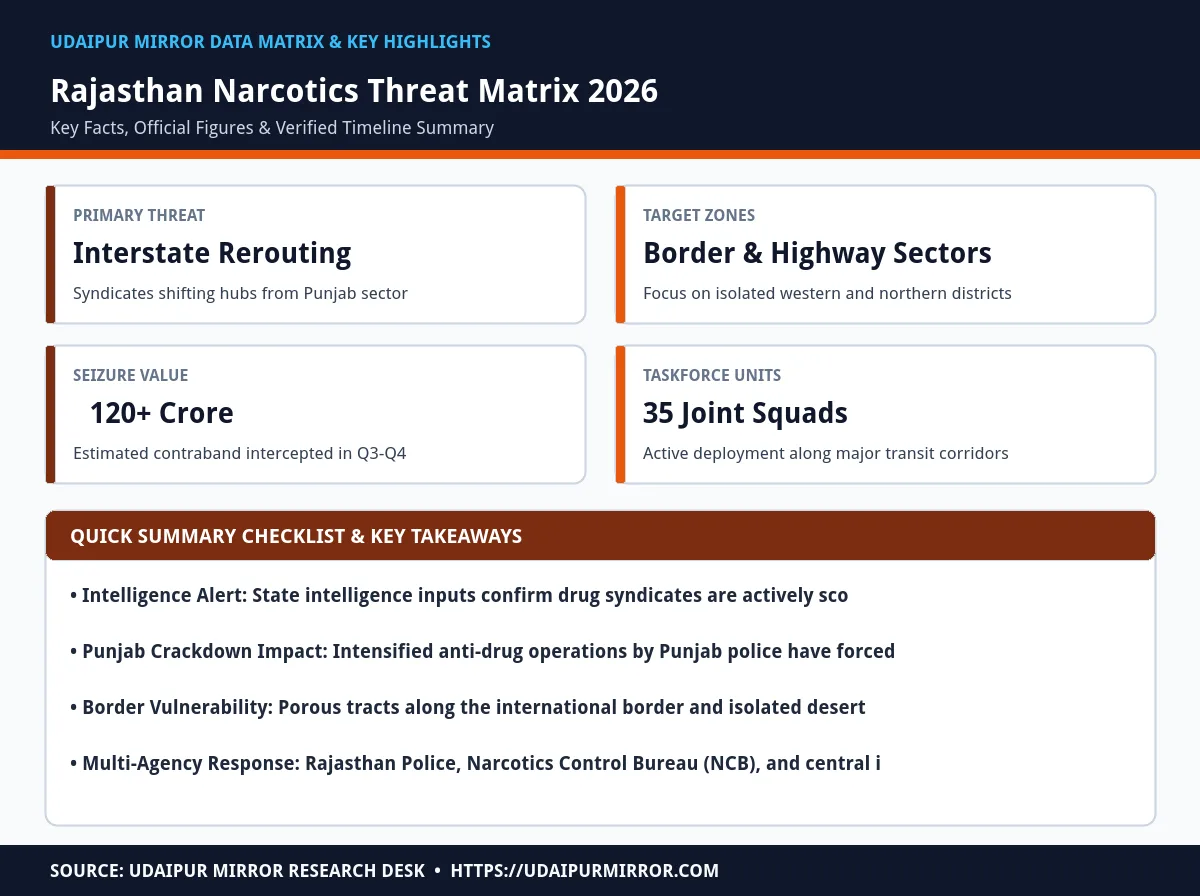
A detailed breakdown of how trafficking patterns have evolved, comparing historical smuggling vectors in the northern sector against newly detected vulnerabilities in Rajasthan’s vast geography.
| Parameter | Punjab Corridor (Historical) | Rajasthan Corridor (Emerging) | Primary Enforcement Challenge |
|---|---|---|---|
| Geographic Terrain | Dense agricultural fields, riverine belts | Arid desert dunes, vast remote highways | Vast uninhabited stretches making surveillance difficult |
| Transport Method | Modified local vehicles, drone drops | Heavy commercial trucks, disguised tourist cabs | High volume of legitimate interstate freight traffic |
| Syndicate Motive | Direct local distribution & transit | Staging hub for nationwide dispatch | Establishing deep logistics and warehousing networks |
| Law Enforcement Response | Cordon-and-search operations, border fencing | Highway interception squads, intelligence mapping | Covering thousands of square kilometers of open territory |
In response to the mounting threat, the Rajasthan Police headquarters in Jaipur has collaborated closely with the Narcotics Control Bureau (NCB) and central intelligence agencies to launch a synchronized counter-offensive. Special interception units have been deployed along major arterial highways, including the National Highway corridors connecting northern states to western ports. These units are equipped with advanced night-vision gear, high-speed interceptor vehicles, and portable baggage scanners to inspect suspicious commercial carriers without causing major disruptions to legitimate traffic.
Furthermore, district superintendents of police in border and transit districts have been directed to maintain strict surveillance on rented accommodations, abandoned farmhouses, and isolated industrial warehouses. Community policing initiatives have also been revitalized, encouraging local villagers and transport unions to report any unusual storage practices or unfamiliar vehicles lingering in rural sectors.
“Our inter-state coordination mechanism ensures real-time intelligence sharing. No cartel will be permitted to establish a foothold in our territory.” — Director General of Police, Rajasthan
The infiltration attempts by organized crime syndicates pose severe socio-economic risks to local communities in Rajasthan. Beyond the immediate law enforcement challenge, drug trafficking networks frequently foster ancillary crimes such as illegal arms proliferation, extortion, and local youth radicalization. Community leaders, educational institutions, and civil society organizations have stepped up awareness campaigns to educate young citizens about the perils of substance abuse.
Administrative vigilance has also been heightened across public sectors. While security forces combat interstate cartels, other state departments are cracking down on related irregularities, ensuring that administrative loopholes—such as recent medical licensing checks—are firmly sealed to prevent prescription drug diversion. The holistic administrative push underlines the state government’s zero-tolerance policy toward any form of illegal trade or organized crime. (Also read: Udaipur Temples Celebrate Annakut Festival: 21-Gun Salute for Lord Rama, Grand Shringar and Chhappan Bhog | श्रीराम को 21 तोपों की सलामी).
“Protecting our youth and securing our borders from syndicate infiltration is our highest governance priority this season.” — State Home Department Spokesperson
Following intensive police crackdowns and border security tightening in Punjab, drug syndicates are attempting to reroute their trafficking operations through Rajasthan’s vast terrain, porous borders, and extensive highway networks.
Rajasthan Police, in coordination with the Narcotics Control Bureau (NCB) and central intelligence, has deployed specialized joint interception squads, ANPR highway cameras, and 24/7 surveillance checkposts across critical transit corridors.
Border districts, major highway transit hubs connecting northern states to western ports, and isolated rural warehousing zones are currently under heightened intelligence and police surveillance.
Citizens can report suspicious activities confidentially through the state police helpline numbers, anti-narcotics dedicated cell portals, or by informing local police stations directly under community policing schemes.
Add Udaipur Mirror as a preferred source on Google to see more of our travel guides in your AI overviews.