Office Address
14, Residency Road, Udaipur, Rajasthan 313001
Office Address
14, Residency Road, Udaipur, Rajasthan 313001

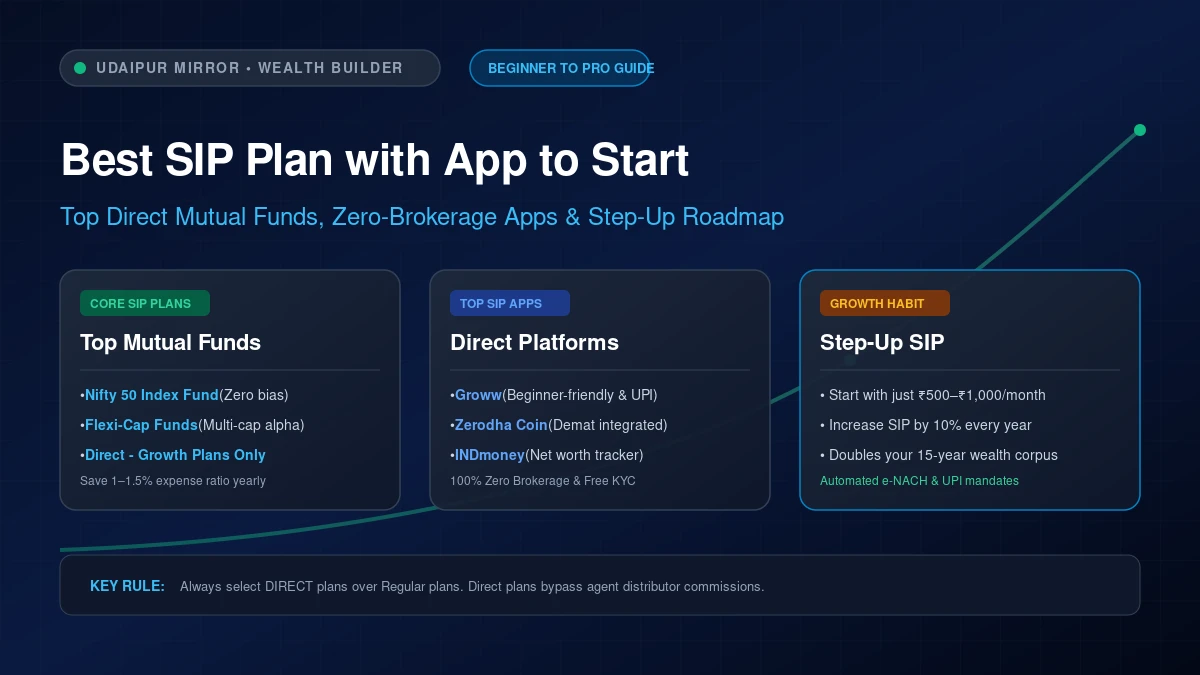
India is experiencing an unprecedented personal finance revolution. Every month, domestic retail investors channel upwards of ₹23,000 crore into equity markets through Systematic Investment Plans (SIPs). Yet for salaried professionals, first-time earners, and young adults taking their initial steps toward financial independence, finding the best sip plan with app to start can feel overwhelming amid hundreds of mutual fund schemes, confusing jargon, and competing fintech platforms.
The beauty of a Systematic Investment Plan lies in its simplicity: it removes emotional guesswork, automates rupee-cost averaging, and harnesses compounding growth over decades. Whether you have ₹500 or ₹50,000 to invest each month, aligning with the timeless principles on the best time to invest in Indian market and selecting zero-commission direct investment applications ensures every rupee compounds for your benefit rather than enriching middlemen.
Before selecting specific fund schemes, you must choose an investment platform. Crucially, investors must exclusively use platforms offering Direct Mutual Funds (where no distributor commission is deducted) rather than Regular Mutual Funds offered by traditional banks and offline brokers.
The leading SEBI-registered fintech platforms operating in India include:
Groww has become India’s largest mutual fund investment platform by active users due to its clean, clutter-free mobile interface. Account onboarding is 100% paperless through Aadhaar e-KYC, taking under 10 minutes. Groww allows zero-commission direct mutual fund investments with one-tap UPI Autopay mandates, making it the ideal choice for first-time retail investors starting small monthly SIPs.
For investors who already operate a Zerodha trading account or trade individual equities—such as those following our Monday stock market plan for retail investors—Zerodha Coin is the premier choice. Coin holds mutual fund units directly in your Central Depository Services Ltd (CDSL) Demat account, providing a single consolidated portfolio statement for stocks, government bonds, Sovereign Gold Bonds (SGBs), and mutual funds with zero brokerage fees.
INDmoney stands out by combining direct mutual fund SIPs with an all-in-one personal finance tracker. It automatically consolidates EPF (Employee Provident Fund), NPS, bank fixed deposits, credit card balances, and US stock investments into a unified dashboard, enabling automated rebalancing and goal-oriented milestones.
Kuvera pioneered zero-commission direct mutual funds in India. It offers powerful advanced features such as Family Account Management, Goal-Based SIP Planning, and TradeSmart (which provides automated tax-loss harvesting and capital gains tax optimization without switching fees).
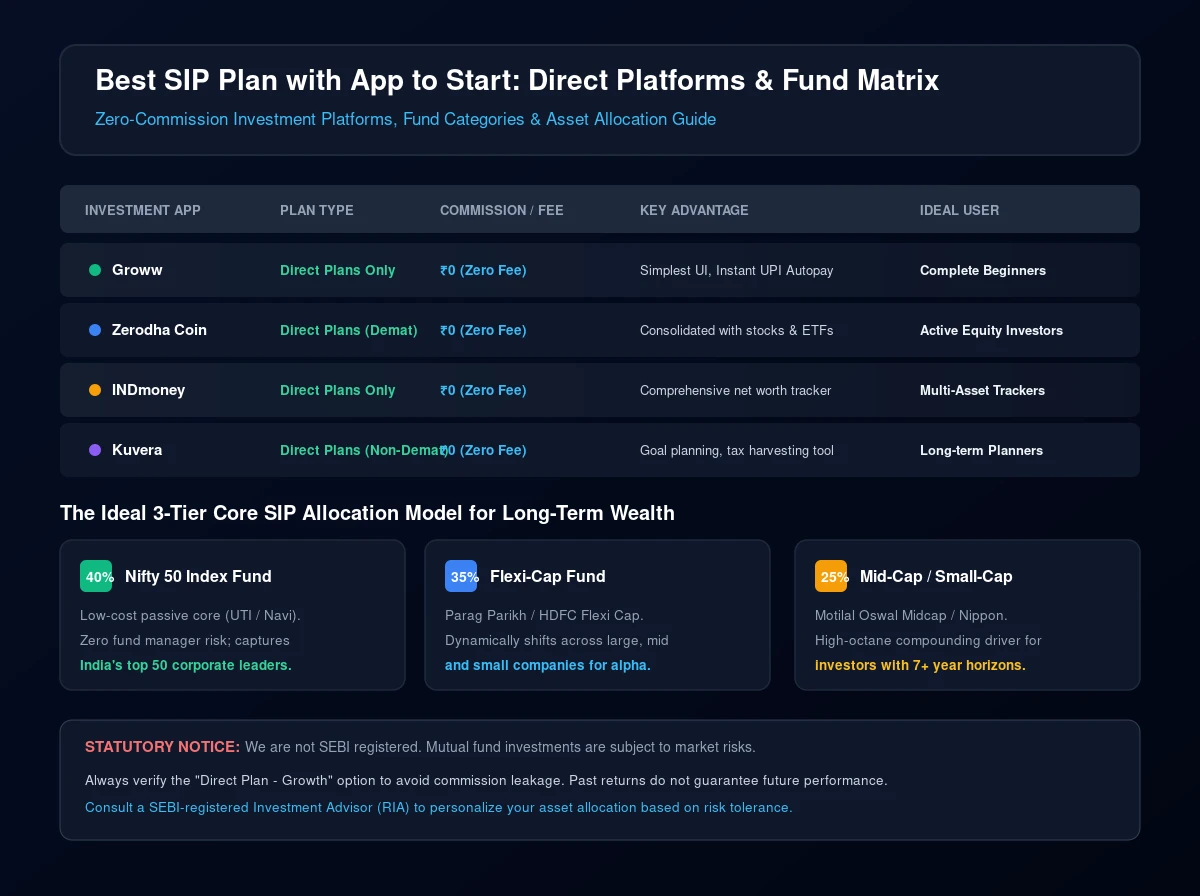
Rather than chasing last year’s highest-performing fund—which often leads to buying cyclical tops—a robust best sip plan with app to start combines a 3-tier diversified structure across market capitalizations:
Every SIP portfolio should anchor itself in India’s top 50 corporate blue-chips. Passive index funds (such as the UTI Nifty 50 Index Fund Direct-Growth or Navi Nifty 50 Index Fund Direct-Growth) carry microscopic expense ratios (below 0.20%) and zero fund manager bias. Over 10- to 15-year holding horizons, passive index funds consistently outperform the majority of actively managed large-cap funds.
Flexi-cap funds offer professional fund managers total statutory flexibility to allocate capital dynamically across Large, Mid, and Small-cap companies depending on economic cycles. Flagship schemes like the Parag Parikh Flexi Cap Fund Direct-Growth and HDFC Flexi Cap Fund Direct-Growth provide resilient downside protection during market downturns while maintaining opportunistic exposure to high-growth sectors, including the best EV stocks powering clean mobility.
For investors with an investment horizon exceeding seven years, mid-cap companies represent the next generation of large-cap industry leaders. Funds like the Motilal Oswal Midcap Fund Direct-Growth or Nippon India Growth Fund Direct-Growth provide superior earnings compounding, generating extra alpha on top of the benchmark index.
When selecting mutual funds on your chosen app, always verify that the scheme name contains the words “Direct – Growth”. Never select “Regular” plans.
While a 1% annual difference may seem minor in year one, the compounding math is staggering: on a ₹10,000 monthly SIP running over 20 years at a 13% CAGR, opting for a Direct Plan delivers an astonishing ₹25 lakh to ₹32 lakh in additional wealth directly into your bank account rather than into a distributor’s pocket.
Financial freedom is not built through overnight speculative lottery tickets; it is forged through automated consistency. Download a zero-commission direct mutual fund application, complete your paperless e-KYC, set up an automated UPI Autopay mandate for a well-diversified index or flexi-cap plan, and let the compounding power of India’s economic growth work for your future.
We are not SEBI registered. Udaipur Mirror, its authors, editors, administrators, and contributors are not registered with the Securities and Exchange Board of India (SEBI) as research analysts, investment advisors, portfolio managers, or mutual fund distributors under SEBI regulations.
All scheme mentions, mobile applications, platform comparisons, and asset allocation models shared in this article are provided strictly for educational, informational, and journalistic purposes. Nothing contained herein constitutes a recommendation, solicitation, endorsement, or offer to buy, sell, or subscribe to any mutual fund scheme or financial product. Mutual fund investments are subject to market risks; please read all scheme information and offer documents carefully before investing. Readers are strongly advised to perform independent research and consult a certified, SEBI-registered Investment Advisor (RIA) before initiating any investment decisions.
Add Udaipur Mirror as a preferred source on Google to see more of our travel guides in your AI overviews.