Office Address
14, Residency Road, Udaipur, Rajasthan 313001
Office Address
14, Residency Road, Udaipur, Rajasthan 313001


NEW DELHI / UDAIPUR: Automakers across the country are gearing up to roll out high-voltage nameplates, bringing intense competition to the zero-emission passenger market as four major original equipment manufacturers announce production-ready models. The race for mainstream electric mobility is accelerating rapidly, with upcoming electric cars in india set to bridge the gap between affordable mid-range crossovers and high-performance highway tourers, offering battery capacities extending up to 60 kWh and verified real-world ranges crossing the 500 km threshold.
⚡ Quick Highlights: Upcoming Electric Cars in India: Maruti, Tata, Honda, Hyundai
Maruti Suzuki is poised to make its most significant strategic pivot yet with the commercial arrival of the production-ready eVX electric SUV. Built on an all-new dedicated skateboarding platform developed in collaboration with Toyota Motor Corporation, the eVX signals Maruti’s intent to capture the fast-expanding mid-market electric SUV segment. The vehicle will be manufactured out of Suzuki Motor Gujarat’s Hansalpur facility, ensuring heavy domestic component localization.
Buyers will be offered two distinct battery capacities: a standard 48 kWh lithium-iron-phosphate (LFP) pack delivering approximately 420 km on a single charge, and an extended-range 60 kWh variant rated for up to 550 km. Importantly, Maruti is introducing an electric All-Wheel Drive (AWD) layout using twin motors on top trims, aimed directly at off-road lifestyle enthusiasts traversing Rajasthan’s rugged Aravalli belts.
This mass-market offensive aligns closely with industry data highlighted in our analysis on how India EV Sales to Surge 4-Fold by FY30 to 12.7% Penetration as consumer appetite shifts from early adopters to mainstream household buyers seeking low operational running costs.
“The eVX is engineered from the ground up as a native global EV platform, delivering structural battery protection, spacious packaging, and authentic 4×4 off-road character.” — Engineering Desk, Maruti Suzuki Product Development Division
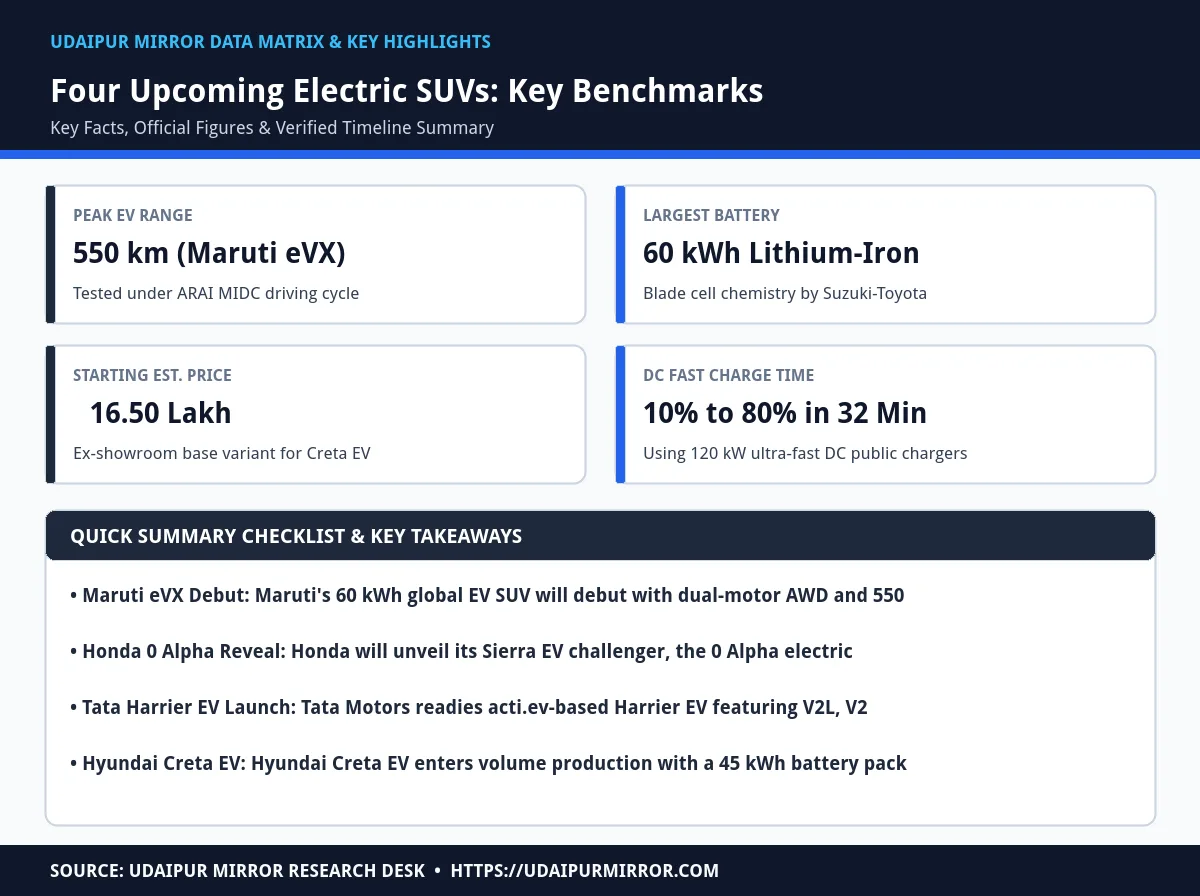
The upcoming four-car EV onslaught spans across localized C-segment utility vehicles to premium midsize lifestyle cruisers. The following table highlights technical specifications, anticipated battery pack configurations, expected ARAI-rated range, and estimated Rajasthan on-road pricing factoring in state road-tax exemptions.
| Model & Manufacturer | Battery & Drivetrain | ARAI Range (Claimed) | Est. Ex-Showroom | Est. Udaipur / Raj On-Road |
|---|---|---|---|---|
| Maruti Suzuki eVX | 48 kWh / 60 kWh LFP (FWD & AWD) | 420 km – 550 km | ₹18.00 – ₹24.50 Lakh | ₹18.90 – ₹25.75 Lakh |
| Tata Harrier EV | 60 kWh – 75 kWh acti.ev (AWD) | 500 km – 530 km | ₹22.00 – ₹28.00 Lakh | ₹23.10 – ₹29.40 Lakh |
| Honda 0 Alpha EV | 50 kWh – 65 kWh (Dedicated EV) | 480 km – 520 km | ₹20.00 – ₹26.00 Lakh | ₹21.00 – ₹27.30 Lakh |
| Hyundai Creta EV | 45 kWh Lithium-Ion (FWD) | 430 km – 460 km | ₹16.50 – ₹22.00 Lakh | ₹17.35 – ₹23.10 Lakh |
| Tata Sierra EV | 65 kWh acti.ev Architecture | 520 km – 550 km | ₹21.50 – ₹26.50 Lakh | ₹22.60 – ₹27.80 Lakh |
Honda Cars India has formally confirmed that its breakthrough zero-emission model, named the Honda 0 Alpha, will make its premiere on December 2, 2026. The new vehicle serves as Honda’s answer to the expanding mid-size electric segment and directly targets upcoming models such as the Tata Sierra EV and the Hyundai Creta EV.
Derived from the manufacturer’s global ‘0 Series’ design philosophy, the 0 Alpha features an ultra-low center of gravity, aerodynamic rake styling, and an open, airy cockpit. With battery packs expected to range between 50 kWh and 65 kWh, Honda engineers are tuning the vehicle’s driving dynamics for responsive highway cruising along major multi-lane expressways like the Delhi-Mumbai Corridor passing through Southern Rajasthan.
“Our upcoming zero-emission vehicle for India establishes our 'Thin, Light, and Wise' architecture, delivering driver engagement alongside zero tailpipe emissions.” — Official Briefing, Honda Cars India
Tata Motors continues to dominate India’s electric passenger car space, holding more than two-thirds of total retail volumes. The homegrown major is preparing to scale higher price bands by introducing the production-spec Tata Harrier EV alongside the lifestyle-oriented Tata Sierra EV. Both models leverage Tata’s generation-two pure electric architecture, branded as ‘acti.ev’.
The Harrier EV features a multi-link rear suspension accommodating a secondary electric motor to provide instantaneous All-Wheel Drive with specialized multi-terrain drive modes (Sand, Mud, Snow, Rock). Equipped with advanced bidirectional energy capabilities, the SUV supports Vehicle-to-Load (V2L) at 3.3 kW output to power camping appliances, as well as Vehicle-to-Vehicle (V2V) charging to rescue stranded electric vehicles on rural stretches.
As motorists navigate volatile fuel expenditures—detailed in our daily tracker for Petrol Price in Udaipur Today: Check Current Petrol, Diesel, CNG Rates & VAT Breakdown—the Harrier EV’s projected operational expenditure of ₹1.10 to ₹1.35 per kilometer represents a major financial incentive for high-mileage suburban drivers.
“The acti.ev architecture allows us to build heavy-duty four-wheel-drive electric SUVs without sacrificing highway range or battery integrity.” — Tata Passenger Electric Mobility Engineering Team
Hyundai Motor India is finalizing pre-launch validation tests on the Creta EV, which is slated to become one of the highest-volume electric utility vehicles on Indian roads. Adapting the proven structural rigidity of the ICE Creta platform with a custom-engineered battery enclosure, the Creta EV will feature a 45 kWh liquid-cooled battery pack powering a front-wheel-drive permanent magnet synchronous motor borrowed from the Kona Electric family.
The Korean automaker is aiming for aggressive localized pricing, targeting a base ex-showroom sticker of ₹16.50 Lakh. This pricing strategy will undercut several rival battery-electric crossovers while retaining consumer-favorite amenities including front ventilated seats, panoramic sunroof, shift-by-wire column gear selectors, and intelligent single-pedal regenerative braking.
“The Creta EV brings our global electric vehicle technology into India's most beloved SUV brand, ensuring no compromise on durability or everyday comfort.” — Product Management, Hyundai Motor India
The impending commercial launch of these four utility vehicles coincides with key policy interventions. The Ministry of Road Transport and Highways (MoRTH) is currently framing upcoming BS-VII emission standards proposed for 2029, a move that is expected to escalate diesel engine manufacturing costs significantly. Consequently, consumers are transitioning directly toward high-range electric vehicles to future-proof their vehicle investments.
In Rajasthan, adoption is being accelerated by the State EV Policy. Buyers in Udaipur, Jaipur, Jodhpur, and Kota benefit from full motor vehicle tax exemptions on zero-emission four-wheelers, alongside local municipal incentives. Meanwhile, charging infrastructure across southern Rajasthan is multiplying, with high-power fast charging stations active along NH-48 (Udaipur to Ahmedabad), NH-27 (Pintwara-Kota corridor), and NH-58, substantially minimizing range anxiety for long-distance drivers.
“State incentives, coupled with rapid charging hub deployment on state expressways, make 2026-2027 the turning point for SUV electrification across Rajasthan.” — Regional Transport Authority Analyst, Udaipur Division
The four key upcoming electric SUVs are the Maruti Suzuki eVX, Tata Harrier EV, Honda 0 Alpha electric SUV, and the Hyundai Creta EV, each slated for reveal or launch between late 2026 and early 2027.
Honda Cars India has officially scheduled the debut of the Honda 0 Alpha electric SUV for December 2, 2026, marking the brand’s first dedicated mass-market EV launch in the domestic market.
The Maruti Suzuki eVX will feature 48 kWh and 60 kWh battery packs, with the larger 60 kWh version providing an ARAI MIDC certified range of up to 550 km, translating to roughly 430-470 km of real-world driving range.
Yes, under the Rajasthan Electric Vehicle Policy, pure battery electric vehicles (BEVs) are eligible for 100% road tax exemptions and registration fee waivers at Regional Transport Offices across Udaipur, Jaipur, and other state districts.
Add Udaipur Mirror as a preferred source on Google to see more of our travel guides in your AI overviews.