Office Address
14, Residency Road, Udaipur, Rajasthan 313001
Office Address
14, Residency Road, Udaipur, Rajasthan 313001

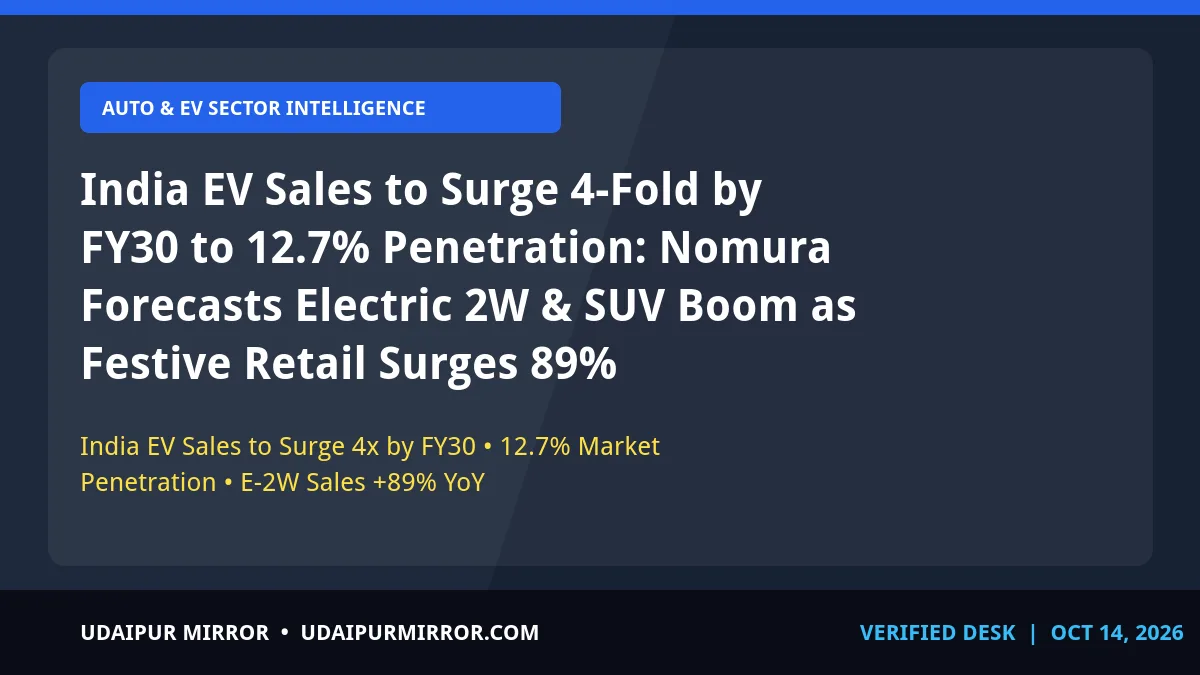
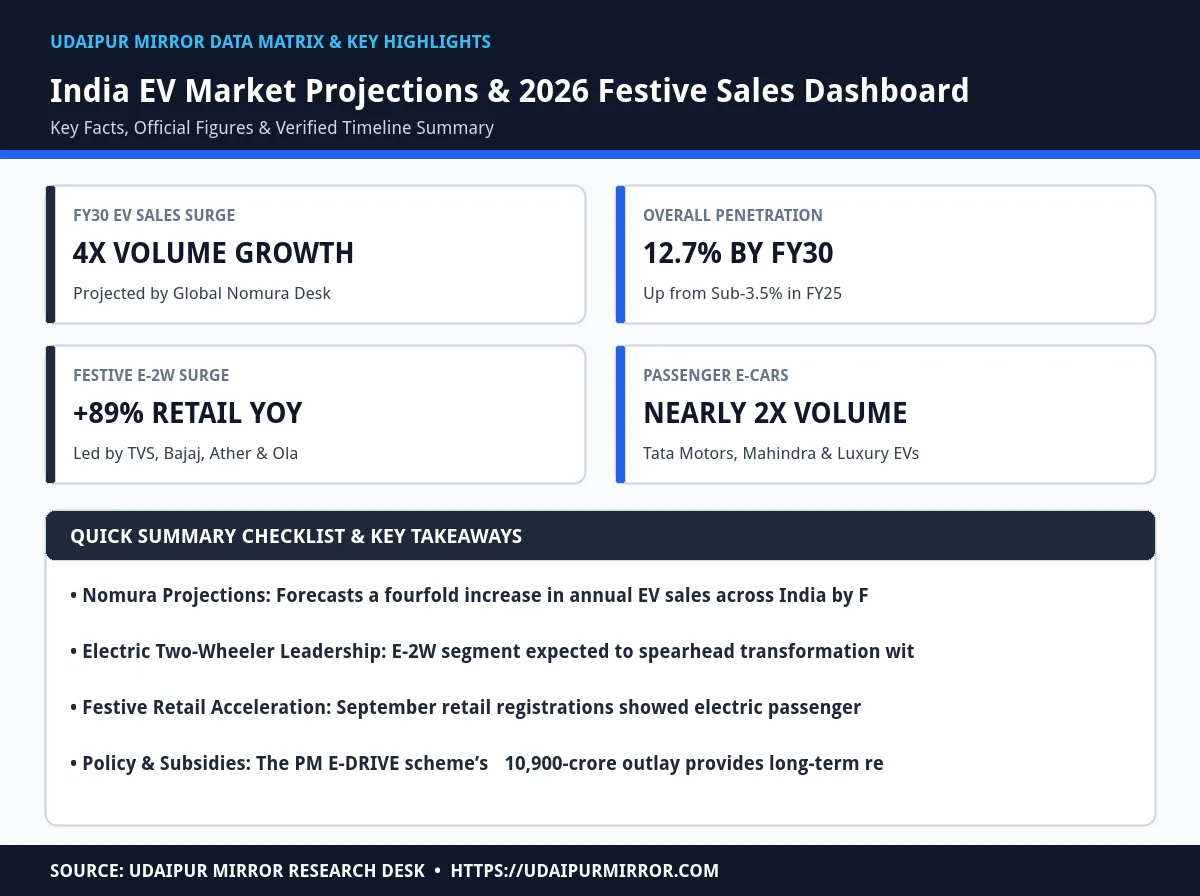
New Delhi / Udaipur: In a transformative research assessment of the domestic automotive sector, global investment bank Nomura has projected that India EV sales FY30 will expand more than fourfold, with clean-energy mobility capturing a 12.7% share of total automotive sales by the end of the decade. The findings arrive as high-frequency festive retail data shows unprecedented momentum, highlighted by September electric passenger car sales nearly doubling year-on-year and electric two-wheeler registrations climbing 89% across tier-1 and tier-2 markets, including Rajasthan.
⚡ Quick Highlights: India EV Sales to Surge 4x by FY30: Nomura Report & Growth Trends
According to the comprehensive industry note issued by Nomura Equity Research, India’s transition toward zero-emission mobility is entering an exponential adoption phase. While battery electric vehicles (BEVs) accounted for approximately 3.2% of total domestic automotive volumes in FY25, aggressive cost reductions in lithium-iron-phosphate (LFP) battery packs, coupled with local manufacturing localization under the Auto PLI scheme, will accelerate adoption rapidly through FY30.
The report highlights that the total cost of ownership (TCO) advantage for electric two-wheelers and three-wheelers has now reached a tipping point, making them economically compelling even without direct government purchase subsidies. Nomura projects electric two-wheelers will achieve over 22% penetration by FY30, while electric passenger cars are set to breach the 7.5% threshold. (Also read: Petrol Price in Udaipur Today: Check Current Petrol, Diesel, CNG Rates & VAT Breakdown).
| Vehicle Segment | Current Penetration (FY25) | Nomura Forecast (FY30) | Key Growth Drivers |
|---|---|---|---|
| Electric Two-Wheelers (E-2W) | 5.4% of total sales | 22.5% of total sales | Low TCO, battery cost parity & widespread home charging |
| Electric Three-Wheelers (E-3W) | 54.2% of total sales | 78.0% of total sales | Commercial last-mile logistics & shared mobility savings |
| Electric Passenger Vehicles (E-PV) | 2.3% of total sales | 7.8% of total sales | Long-range affordable SUVs & highway charging networks |
| Commercial Buses & Trucks | 3.8% of city buses | 18.5% of urban transit | PM E-DRIVE municipal bus tenders & green logistics |
| Overall Auto Industry EV Share | 3.2% total automotive | 12.7% total automotive | Battery pack localization, Auto PLI & national charging map |
Validating the structural shift outlined in the research note, official retail registration data from the Ministry of Road Transport and Highways (Vahan portal) indicates a massive festive demand surge in September and early October 2026. Electric two-wheeler registrations surged 89% year-on-year to cross 1.15 lakh units in a single month, led by heavy volume deliveries from legacy majors TVS Motor Company, Bajaj Auto, and pure-play leaders Ather Energy and Ola Electric.
Simultaneously, the electric passenger vehicle (e-PV) category grew nearly 98% YoY. Tata Motors retained market dominance with its Nexon.ev, Punch.ev, and newly launched Curvv.ev, while Mahindra & Mahindra and MG Motor India captured notable market share across metro centers like Delhi, Bengaluru, Mumbai, and tier-2 hubs like Jaipur and Udaipur.
A cornerstone driver behind the fourfold growth projection is the Central Government’s newly deployed PM Electric Drive Revolution in Innovative Vehicle Enhancement (PM E-DRIVE) scheme, which carries a financial commitment of ₹10,900 crore over two years. Unlike previous iterations, the PM E-DRIVE framework dedicates substantial capital—over ₹2,000 crore—directly toward installing public fast-charging stations along national highways and inter-city corridors.
Public sector oil marketing companies (IOCL, BPCL, HPCL) alongside private charge-point operators (Tata Power, Jio-bp, ChargeZone) are on track to install more than 72,000 public chargers by 2028. This rapid densification of charging hardware is effectively dissolving consumer “range anxiety” for highway travel, including key tourist routes such as the Delhi-Jaipur-Udaipur expressway. (Also read: Fusion CX IPO Opens for Subscription: ₹702 Cr Issue, 12% GMP, Ashish Kacholia & Kotak Life Lead ₹315 Cr Anchor Book).
At the top end of the spectrum, luxury automotive manufacturers are accelerating their all-electric portfolios. Swedish luxury carmaker Volvo has begun initial road trials and customer showcases for its flagship EX90 electric SUV in India, benchmarking luxury EV demand against rivals Mercedes-Benz, BMW, and Audi. Offering a dual-motor all-wheel-drive powertrain, advanced LiDAR safety sensors, and a real-world driving range exceeding 580 kilometers, the EX90 illustrates the technological sophistication entering India’s premium automotive space.
Industry executives note that while luxury EV adoption previously faced friction due to high import duties, localization of assembly and dedicated high-output DC charging networks are enabling premium OEMs to achieve 15% to 20% electric contribution in their total domestic luxury sales.
Beyond metropolitan capital cities, tier-2 and tier-3 urban clusters in Rajasthan—such as Udaipur, Kota, Jodhpur, and Bikaner—are registering among the fastest adoption curves in commercial electric three-wheelers and personal two-wheelers. Lower running costs of under ₹0.35 per kilometer (compared to over ₹2.40 per kilometer for petrol vehicles) make EVs exceptionally attractive for urban commuting and delivery fleets.
With Rajasthan’s state EV policy offering road tax exemptions and subsidized commercial charging power tariffs, local fleet operators in Udaipur’s tourism and hotel transfer ecosystem are steadily retiring diesel utility fleets in favor of modern electric minivans and crossovers, supporting the region’s green tourism goals.
Nomura forecasts that India’s total electric vehicle sales will surge more than fourfold by FY30, pushing overall EV market penetration to 12.7% of total vehicle sales from roughly 3.2% in FY25.
Electric two-wheelers (E-2W) and commercial three-wheelers (E-3W) are leading adoption. Nomura projects electric two-wheelers will surpass 22% penetration by FY30 due to running costs that are up to 80% lower than petrol.
September 2026 retail registration data revealed that electric passenger vehicle sales nearly doubled year-on-year, while electric two-wheeler sales surged 89%, crossing 1.15 lakh units in a single month.
The PM E-DRIVE scheme is a Central Government initiative with an outlay of ₹10,900 crore over two years, providing demand subsidies for electric two-wheelers, three-wheelers, and municipal buses, while allocating over ₹2,000 crore for public fast-charging stations.
Tier-2 cities in Rajasthan are witnessing rapid electrification in last-mile passenger three-wheelers, app-based delivery bikes, and hotel tourist fleets, motivated by fuel cost savings and state road tax waivers.
Add Udaipur Mirror as a preferred source on Google to see more of our travel guides in your AI overviews.